
Charles Darwin and the Theory of Evolution: The Voyage of the Beagle and Natural Selection
Charles Darwin's Early Life and Education. Charles Darwin (1809-1882) was born into a wealthy English family of the rural gentry. His father was a successful physician, and his mother was a Wedgwood, connecting him to industrial prosperity, though she died when he was young. Initially showing little scholarly ambition, Darwin's passion for the outdoors, dogs, and collecting beetles hinted at his future. After abandoning medical studies at the University of Edinburgh due to an aversion to surgery, he enrolled at Christ's College, Cambridge, intending to become an Anglican clergyman. It was at Cambridge that his growing interest in natural history led him to influential mentors, the botanist John Stevens Henslow and the geologist Adam Sedgwick, who shaped his scientific thinking.
The Transformative Voyage of HMS Beagle. Shortly after graduation, Darwin accepted the position of naturalist aboard HMS Beagle for a projected two-year surveying voyage, which ultimately lasted five years (1831-1836). This journey fundamentally transformed his understanding of the natural world. Darwin served as an acute observer and avid collector of geological and biological specimens, regularly corresponding with Henslow. Critically, he studied Charles Lyell's Principles of Geology, which advocated uniformitarianism—the idea that the Earth's features are shaped by slow, continuous processes. This prepared his mind to see biological change as a similarly gradual process over vast time.
Observations of Biological Change and Diversity. Throughout the voyage, Darwin documented compelling evidence of change. In South America, he found fossils of extinct giant armadillos alongside their smaller living relatives, indicating change over time. He also noted that related species of birds replaced one another across geographical regions. The most profound insights came from oceanic islands, such as the Galapagos Islands. There, he observed that species like the tortoises and the birds now known as Darwin's finches varied distinctly from island to island, yet resembled species on the South American mainland. This pattern challenged the doctrine of special creation and suggested adaptation to local environments.
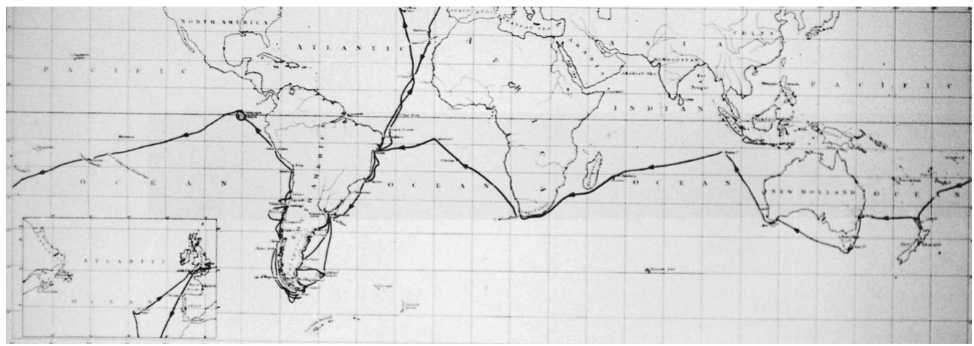
Map 16.1. The voyage of the Beagle. Charles Darwin sailed as naturalist aboard the HMS Beagle on its five-year voyage to map the coasts of South America (1831-36). A keen observer, Darwin became exquisitely sensitive to the distribution of plants and animals, particularly on the Galapagos Islands off the coast of Ecuador which he visited toward the end of his voyage. He returned to England convinced of the fact of evolution but struggled to articulate a theory or mechanism to account for evolutionary change.
Formulating the Mechanism: Natural Selection. Returning to England in 1836, Darwin was convinced of evolution (descent with modification) but sought a driving mechanism. In 1838, reading Thomas Robert Malthus's Essay on the Principle of Population provided the key insight. Malthus argued that populations tend to grow faster than food supplies, leading to a "struggle for existence." Darwin applied this concept to nature, realizing that in this struggle, individuals with advantageous variations would be more likely to survive and reproduce. He called this process natural selection, the core mechanism of his evolutionary theory, which could explain the adaptation and diversification of life over immense geological time.
Delay in Publication and Refining the Theory. Despite outlining his theory by 1844, Darwin delayed public announcement for two decades, meticulously amassing evidence and fearing the scientific and religious backlash. His caution was reinforced by the harsh reception of Robert Chambers's evolutionary work, Vestiges of the Natural History of Creation. During this period, Darwin established himself as a premier naturalist through detailed studies, such as his monographs on barnacles. He also suffered from chronic, debilitating illness, possibly psychosomatic, related to the immense burden of his revolutionary idea. He lived as a country gentleman in Down House, Kent, gradually moving from Christian faith to scientific materialism.
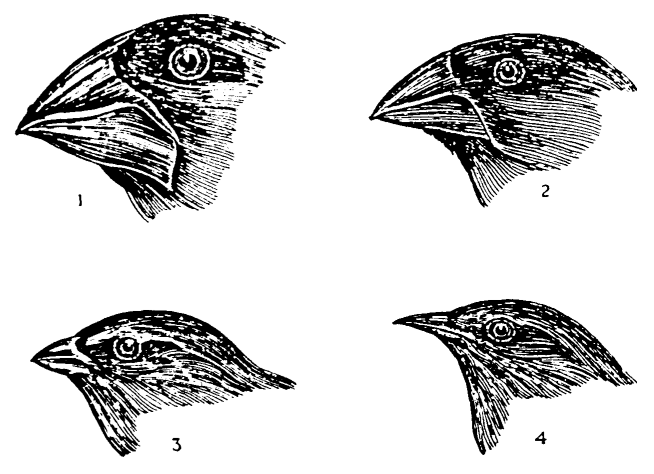
Fig. 16.2. Darwin’s finches. The variations in beak formation of the birds that Darwin collected on the Galapagos Islands were later interpreted in terms of evolution from an ancestral stock that arrived on the islands from the west coast of South America. Darwin saw that different finches with different styles of beak survived better in different ecological niches.
The Wallace Incident and Joint Announcement. In 1858, Darwin received an essay from naturalist Alfred Russel Wallace, who had independently deduced the principle of natural selection while in the Malay Archipelago. Fearing being scooped, Darwin, with advice from friends Charles Lyell and Joseph Hooker, arranged for a joint presentation of both men's work at the Linnaean Society of London. This secured Darwin's priority while acknowledging Wallace. The event finally spurred Darwin to condense his massive planned work into On the Origin of Species by Means of Natural Selection, published in 1859.
Legacy and the Darwin-Wallace Relationship. On the Origin of Species provided an overwhelming argument for evolution and its mechanism, natural selection, revolutionizing biological science. Despite their joint discovery, historical credit centered on Darwin due to his extensive documentation and social standing. Darwin and Wallace remained on cordial terms, though Wallace later diverged by invoking a "Higher Intelligence" in human evolution. Darwin's work established the foundational framework for modern biology, explaining the interconnected diversity of life through natural processes without need for divine intervention.
Date added: 2026-02-14; views: 390;