
Parasitism and Hemiparasitism. Allelopathy
Parasitism occurs in all biomes under very different climatic conditions (Fig. 19.7).
Many plant species developed the ability to live off other plants. In pure parasitism, as exhibited in Cuscuta (dodder: Fig. 19.8), Orobanche (broom-rape) or the spectacular Rafflesia, the parasite forms host-penetrating organs, so-called haustoria, which tap the phloem to extract sugars, nutrients, amino acids, water and all other substances required for growth.
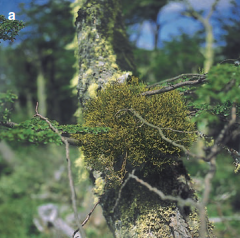
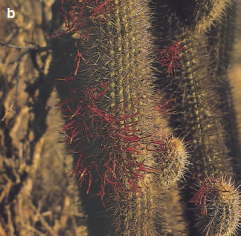
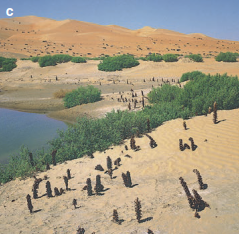
Fig. 19.7. Parasitic plants have developed in all biomes. a In cool, temperate southern Chile Misodendron punctatum on southern beech (Nothofagus antarctica), b in semiarid northern Chile a completely leafless Loranthacea (Tristerix aphyllus) lives on many cacti (e.g. Trichocereus spp.) c In the extremely arid Arabian Desert Cistanche violacea lives on various host plants, for example, even on halophytes like Suaeda fruticosa. (Photos: K. Müller-Hohenstein)
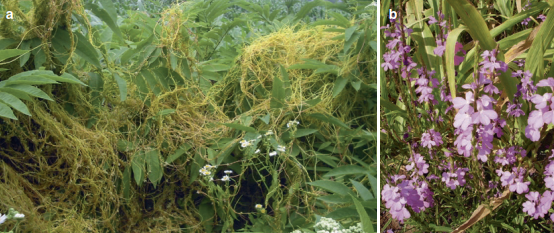
Fig. 19.8. Parasitic plants. Dodder, Cuscuta europaea a, and witchweed, Striga hermonthica b. Dodder penetrates leaves and branches to access the sap flow of the host. It can spectacularly overgrow its host in a hairlike web (here on dwarf elder, Sambucus ebulus), although its economic impact is often limited. Pretty-looking witchweed is one of the worst tropical plant pests, threatening in particular small self-sustaining farmers, draining the resources from the crops on which roots it parasitises (here maize Zea mays). (Photos under creative commons license from Wikipedia (dodder), and Jan Grenz (witchweed))
Semiparasites, such as Striga (witchweed, a common generalist parasite of tropical crops) or Rhinanthus (rattleweed now also in the Oro- banchaceae, formerly Scrophulariaceae), also draw water or nutrients from the host but are typically green and photosynthesise fully. While Rhinanthus can survive without a host, Viscum album (mistletoe) is an obligate hemiparasite and cannot.
The evolution of parasitism in plants from epiphytes over hemiparasites to obligate parasites (or over lianas towards strangler figs) is associated with a moderate increase in specialisation. Hemiparasites still have a wide host spectrum (Rhinanthus minor, yellow rattle, for example, parasitises over 50 species in 18 families), but even obligate parasites, such as Orobanche and Cuscuta, can have tens of host species. In the extreme, orchids, the most species-rich plant family, are largely parasitic, even photosynthetic active species. Generalist parasitism is akin to generalist herbivory and can hence have s uppressive effects on competitively dominant species and hence positive effects on plant community diversity (Sect 19.2).
Allelopathy.Chemical suppression of the growth of neighbours is called allelopathy (Greek: harm to others), because the allelopathic species was incorrectly assumed to be unaffected by its own chemical warfare (Molisch 1937). It may lead to reduced growth of competitors and occurs in a wide range of plant species and life forms, but it is not yet clear how significant allelopathy is under natural conditions and for the structure of plant communities. The list of allelopathic species is constantly growing because all plants produce substances of moderate to high toxicity to others, albeit to varying extents. Allelopathy received renewed attention in the context of invasion of introduced species, as some European species (e.g. Centaurea maculosa: spotted knapweed; Alliaria petiolata: garlic mustard) decimated their surrounding vegetation following introduction into the USA.
The chemical substances are released either directly, for example, as root exudates (e.g. in the macrophyte Stratiotes aloides: water soldier), or indirectly, for example, during decomposition of litter (Juglans regia, walnut, or Eucalyptus spec.). They affect the germination or growth of the plants in the surroundings, but they also often affect the soil community in general. Attempts to turn allelochemicals into herbicides have proven ineffective, suggesting low root uptake under natural conditions, but a chemical analogue (mesot- rione) to the original leptospermone (formed by species of the Myrtaceae) is available commercially (Syngenta’s Callisto and Tenacity herbicides).
Individuals of the same species, and offspring of the allelopathic individual in particular, are not immune to their own species’ toxin. Indeed, walnut understorey will be devoid of all plant life, excluding also walnut seedlings. Allelopathy is being particularly investigated in crop species such as rice (Oryza sativa) and barley (Hordeum vulgare). The benefit to the allelopathic species is obvious: it reduces competition for water, nutrients and, eventually, light. The costs are relatively high, however, as these substances are broken down by soil biota and need to be replenished continuously. Since allelopathy goes hand in hand with competition for nutrients or even herbivory (Halsey 2004), it is often difficult to tease the causal effects apart experimentally (usually by using activated coal to absorb aromatic substances). The “obvious” pattern in the field may thus be multicausal and not merely the effect of chemical interactions.
Date added: 2026-04-26; views: 227;