
Interactions Among Plants (Contribution by C. F. Dormann)
The growth of an individual plant is strongly affected, both negatively and positively, by its neighbours. Overall, negative effects—competition—are the more prevalent form of plant- plant interactions, but in specific situations positive effects (facilitation) are also detectable. Table 19.1 shows the potential types of interactions between organisms. We shall address positive and neutral plant-plant interactions first before looking more closely at competition.
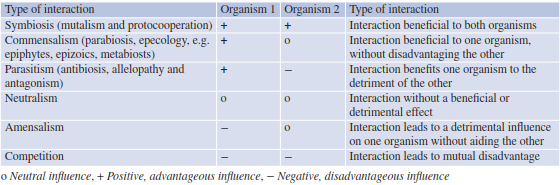
Table 19.1. Potential interactions between two organisms
Symbiosis and Other Nonnegative Relations of Plants and Fungi. Symbiosis refers to close positive interactions between two partners from different taxa (Fig. 19.6, top row). Traditionally, and in most of Europe, symbiosis refers to a mutualistic interaction. In other parts of the world and particularly in zoology, symbiosis refers to any kind of interaction, or at least any kind of cohabitation, including parasitism. Here we use the term in the traditional, strict sense. The most famous symbiosis with plants outside the marine world involves fungi. We include this interaction here to construct a gradient from obligatory symbiosis to facultative (and temporary) facilitation.
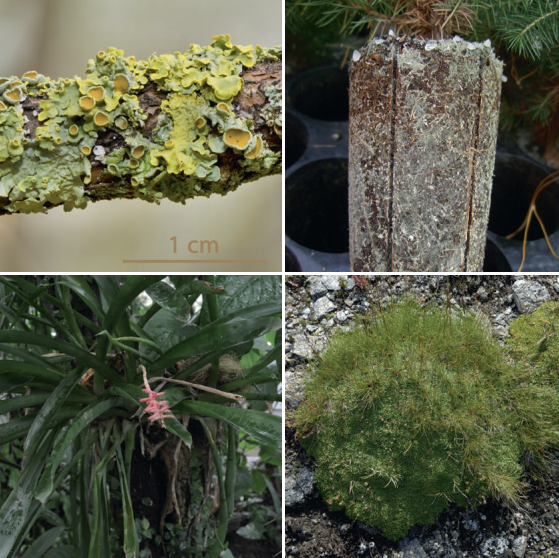
Fig. 19.6. Examples of plant–plant and plant–fungi interactions. Close symbiosis (lichens: top left), mycorrhization of Picea glauca roots (top right), bromeliad epiphyte on tree (bottom left) and facilitation of Poa alpina by alpine cushion plant Silene acaulis (bottom right). (Photos: top left: N. Nagel, top right: Silk666, bottom left: M. Scherer-Lorenzen, bottom right: C.F. Dormann)
Above-ground, fungi of the phylum Ascomy- cetes form a symbiosis with green algae of the division Chlorophyta in the form of lichens. In this symbiosis, the algal partner provides the capacity to fix CO2, the end product of which they share with the fungi, while the fungal partner provides access to nutrients and serves as the holdfast in the substrate. It can be argued that fungi have domesticated algae for their own benefit. The advantage of this symbiosis is that, while both species have free-living forms in other habitats, only in combination can they colonise the barren rocks and tree barks on which they grow. Lichens form, in some sense, a new organism. Sexual reproduction of each partner is sometimes still possible, but propagation of lichens occurs largely through the dispersal of lichen fragments comprising both partners.
Below-ground, various fungi interact with plant roots as mycorrhizae. Depending on the specialisation of this interaction, it varies from obligatory partnership (e.g. in epiphytic tropical orchids, where fungal spores may even travel on dust-fine seeds) over high host specificity (in ericoid mycorrhizae) to more opportunistic matches (in vascular-arbuscular mycorrhizae (VAM) and ecto-mycorrhizae). In the latter cases the evolutionary parasitic history of this association is still evident, as plant roots “forage” for mycorrhizae, and the subsequent colonisation of roots through fungi shares a close resemblance with fungal infections, and in the case of VAM the plant seeks to enclose the invading mycelium to prevent its spread in the roots (Sect. 19.3).
A commensal relationship, where one plant benefits from the other without affecting it, is exhibited by epiphytes (in particular many orchids, bromeliads, ferns and mosses) growing on the branches of trees. In most cases, the host tree has no benefit but also no disadvantage from the presence of the other plants. Since the host trees serve merely as substrate-near-the-light, species associations between epiphytes and their hosts are highly generalistic and indistinguishable from random associations.
Lianas rely on their hosts for structural support. Typically starting growth on a branch where their seeds were deposited by fruit-eating birds or mammals, they send aerial roots to the ground to then climb the host to reach the light without investing in support structures (“hemi- epiphytes”). In some cases (strangler figs of the genus Ficus, Moraceae, e.g. F. benghalensis, F. virens), lianas encircle the host so tightly that they “strangle” it, preventing effective phloem transport, progressing from commensalism to parasitism (and parasitoidy, Chap. 12).
Similar to commensalism, facilitation of individuals of one species by those of another is a relatively common phenomenon (Brooker et al. 2008). In the case of nurse plants, seedlings of one species profit from the physical environment created by another plant (e.g. hydrolic redistribution in arid systems, thorny thickets reducing grazing, reduction of wind chill in artic/alpine systems) (Chap. 10). In only a few cases have these systems been investigated well enough to explore whether the facilitated plant eventually returns this benefit. It rather seems that facilitation may well be a transient state, moving from commensalism to competition as the plant matures and becomes independent of the sheltered environment. This phenomenon can be observed particularly well along stress gradients, where competitive interactions become less and mutualistic interactions more important as environmental harshness increases (“stress gradient hypothesis”: Bertness and Callaway 1994).
Date added: 2026-04-26; views: 226;