
Influences of Vegetation on Climatic Conditions
Climatic factors (especially temperature and precipitation) are directly related to vegetation cover and structure, with the effects varying on different spatial scales. In the case of a closed forest, these influences lead also to microclimatic changes (between the soil surface and the canopy) in terms of climatic differentiations in the stem region, the crown and the entire forested area. Within the space occupied by vegetation, horizontal and vertical patterns and gradients of climatic parameters must be measured in order to be able to recognise the interactions between vegetation and climate.
Figure 19.2 shows the variability of temperatures within a forest-edge ecosystem, which largely depends on exposure to sun. Surface temperatures measured at places only a few metres apart at the edge of a forest in the Netherlands at noon on a clear day in March correspond, in their extremes, to those in boreal forests (north side) and temperate deserts (south side). However, these differences apply only under direct solar radiation and disappear completely under cloudy skies. It is obvious that characterisation of the climate in a stand requires the temporal course of a climatic variable and its spatial differentiation.
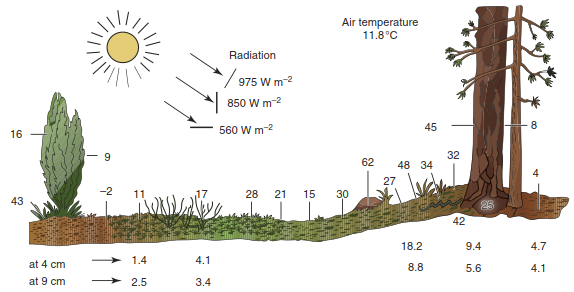
Fig. 19.2. Vegetation affecting temperature regimes. Surface temperatures along a transect from a forest edge to a juniper heath in the Netherlands. Soil temperatures were measured at 4 and 9 cm depth, air temperature at 1 m above the ground, the input radiation to surfaces at different inclinations was 560, 850 and 975 W m−2. (After Stoudtjesdijk and Barkman 1992)
For the climate of a stand, the albedo is just as important as the layers of vegetation, the type of branching of trees and shrubs, and the density and position of leaves. These structural characteristics of plant communities determine the amount of light that reaches the assimilating organs of individual plants. A dense tree canopy may severely decrease the light available for light-demanding species while also providing shade for shade-demanding plants. Oasis cultures occur in arid regions all over the world; their multiple layers of annual and permanent crops— cereals and vegetables, fruit-bearing shrubs and small trees, closed palm canopies—would not be possible without the shade provided by the date palms in the strong radiation conditions and with the dry air in arid regions.
In low, one-layered stands, for example, in lichen communities and on moss carpets during the day, higher temperatures are reached than in neighbouring open areas. However, because of the high surface radiation during the night, temperatures may fall much more than in multilayered stands. In the latter, temperature layers can be observed. The first maximum, higher than the temperature in open spaces, is reached in the canopy at higher daytime temperature fluctuations; a second occurs at the ground surface, especially in more open areas. In the space between the canopy and soil surface, temperatures are more balanced. Temperatures on the ground may even be further affected by the consistency of litter. According to Stoutjesdijk and Barkman (1992) on a clear winter night -4 °C was measured under Douglas fir, under pine -9 °C, but under larch and oaks -14 °C. Thus, in species-rich forests, considerable differences occur over small distances. For the development of spring geophytes, the favourable light and temperature conditions in deciduous forests are decisive. Conditions under oak are usually more favourable than under beech and hornbeam.
Vegetation also influences precipitation over small distances. This was measured at different wind speeds (Stoudtjesdijk and Barkman 1992) for isolated juniper bushes with dense needles on the southern side in a shrub and grass community (Fig. 19.3). Interception is very important in multilayered stands (Sect. 16.1). The path of a raindrop is determined primarily by the structural characteristics of the plant cover. Some plant species are able, because of the form of their leaves or needles, to comb out precipitation (Pirns patula, P. canar- iense). Run-off paths on branches and stems and the distribution of water at the base of the stem are also important. In total, the measured interception by conifers is about twice that of deciduous trees, but it also depends on the abundance and intensity of precipitation. Gaps in a stand, development of the leaves in different seasons and layering of the stand are important determinants of the amount of water that actually reaches the ground. Also the relative humidity inside a stand is higher and more balanced than in open spaces.
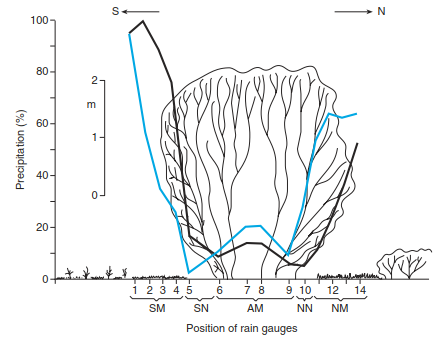
Fig. 19.3. Vegetation effects on small-scale distribution of rainfall. Distribution of rainfall along transect through juniper bush, measured with 14 rain gauges with a northerly wind (black line) and southerly wind (blue line). Maximum rainfall is equal to 100%. SM South, mossy; SN south, needle litter; AM without moss; NN north, needle litter; NM north mossy. (After Stoudtjesdijk and Barkman 1992)
Various forms of wind shear show the influence of wind on vegetation. It may be concluded that plant stands also weaken wind, since hedges provide protective wind barriers (Fig. 19.4). This depends on the height, width and permeability of the vegetation, and the reduction in wind speed and the development of turbulence, in turn, cause large differences in microclimatic conditions within small scales. Also the energy transport and transport of materials—such as atmospheric inputs, soil particles and litter—and how they are affected by vegetation must be considered.
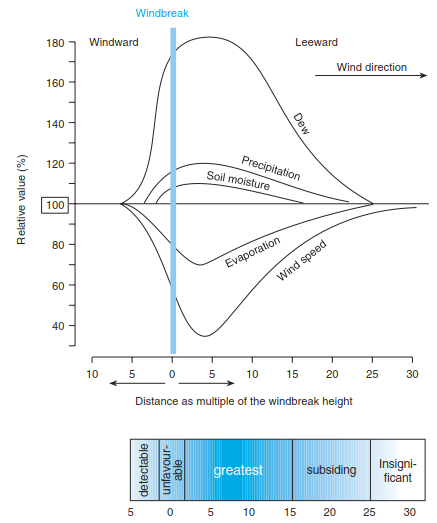
Fig. 19.4. Influence of a shelter belt on the microclimate. (After Reichelt and Wilmanns 1973)
Dune systems along coastlines worldwide characterise littoral zones. The sequence of different
| Windbreak |
sites along the coast into the hinterland is shown in Fig. 19.5. Some plant species are able to stabilise mobile sand, which is transported by wind, and influence transitions from the coast to the hinterland.
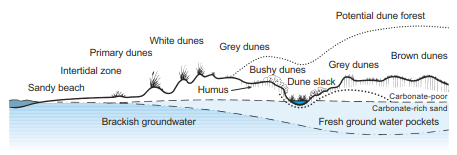
Fig. 19.5. Sequence of habitats in coastal regions with dune formation. (After Ellenberg and Leuschner 2010)
These plants are able to withstand the mechanical effects of wind and the salt carried by it. Following from the sea towards the land, communities include sea rocket (Cakile maritima), lyme grass (Elymus arenarius) and marram grass (Ammophila arenaria). The latter is the most important primary dune species and is not only able to stabilise dunes but also to tolerate being covered by sand because it forms layers of rhizomes and survives the cover of primary dunes (white dunes), which are often metres high. If marram grass is not covered by sand, secondary and tertiary dunes (grey and brown dunes) develop from the gradual accumulation of humus from the decaying plant material. Tertiary dunes are recognised by an increasingly closed cover of dune grasses and shrub communities. Without plant species adapted in such a way, this formation of relief and zonation would not be possible. At the moment, dune complexes disturbed by tourists are successfully protected by planting with the salt-tolerant sand dune couch grass (Agropyron junceum) and marram grass (Ammophila arenaria), which are tolerant to sand cover.
Plants also play a role in triggering the formation of inland dunes. Long (1954) traced the origin of the Nebket (Arabic term for a special dune system) in North Africa to single, particularly resistant, dwarf shrubs. Sand blown in by the wind is deposited on the leeward and windward sides of these shrubs. With time, the accumulation of sand serves as a water reservoir and improves the nutrient supply of the “initial shrub”, which is able to grow better and thus offers possibilities for other plants to establish and finally for animals to settle. Thus, particularly at the edges of deserts, island-like dune systems develop with communities surprisingly rich in species in an otherwise hostile environment.
This shows that vegetation, with its floristic composition and, above all, with its structural characteristics, greatly influences the variability of environmental conditions. Many vegetation patterns can be understood only if the influences of vegetation that cause the differences in the local climate are known.
Date added: 2026-04-26; views: 226;