
Influences of Vegetation on Site Conditions
Introduction.In the previous chapters we discussed aspects of the development of plants and plant communities over the course of time (Chap. 17) and their distribution in space (Chap. 18). In this chapter, the interrelations and interactions between plants and their environment are described. Plants and plant communities not only depend on environmental conditions but also affect their environment, changing climatic conditions and soils, and thus contribute to temporal dynamics and spatial changes.
The formation of plant communities involves interactions between different plant species (interspecific) as well as between the individuals of the same species (intraspecific).The niches for plant species in a community are determined by competition and coexistence. And finally, plants are only one part of the entire community of organisms. In particular, animals play an important role as pollinators, seed dispersers and herbivores.
It must be underlined that many interactions are extremely complex and far from being completely understood, especially if one considers not just the interactions between single individuals or plant species but also within the community of all organisms (biocoenosis). Furthermore, it should not be forgotten that over the course of these interactions plants may change the abiotic site conditions.
Influences of Vegetation on Site Conditions.The extent to which vegetation influences the growing conditions on a site becomes clear when the vegetation is disturbed or completely removed. According to Lovelock (1992), drastic changes would occur on Earth if there was no life, particularly the composition of the atmosphere, which would become oxygen free, and the current surface temperatures of about 300 K would be affected.
Plant cover influences the entire biological community and the abiotic environment. Already microclimatic conditions change over small distances. Increased soil erosion at an intermediate scale is witness to the change in run-off of water and to the protective effect of vegetation cover (Fig. 19.1).
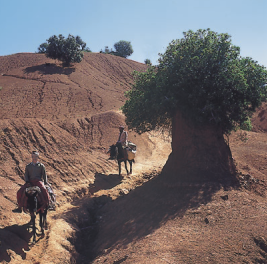
Fig. 19.1. Vegetation affecting the environment. Lower hill slope, with advanced degradation of vegetation, in central Atlas Mountains (Morocco). The roots of the few remaining bushes (Quercus rotundifolia, Pistacia lentiscus) protect the soil from erosion. The plants seem to be growing on a pedestal. (Photo: K. Müller-Hohenstein)
Plants and plant communities not only fulfill their requirements for light, water and nutrients at the site where they grow, they also affect it. This may improve the conditions at the site to the plant’s advantage, for example, by increasing the humus content of the soil, which provides a better water supply owing to the increased water storage capacity, or they make conditions worse because they create conditions for species that outcompete them (see the facilitation model according to Connel and Slatyer 1977) (Chap. 17). Undemanding pioneers (e.g. lichens on bare rock) must make way for more demanding species, for example, mosses and flowering plants on substrates prepared by biogenic weathering.
Wilson and Agnew (1992) distinguished various feedback switches, almost like electrical control systems, that are triggered by vegetation in relation to changes on a site. Thus, a plant community not only changes its environment but in addition also affects neighbouring plant communities (e.g. by shading, wind protection). In each of these cases such effects must be regarded as dynamic processes. They concern mostly climatic and edaphic relations, but also aspects of relief formation at several spatial and temporal scales. In what follows, these connections will be explained using examples at the level of the plant community.
Date added: 2026-04-26; views: 230;