
Cosmic Distances: Galaxies, Dark Matter, and Hubble's Law
The observable universe contains at least 100 billion galaxies, each typically harboring billions of stars. Most of these galaxies reside far beyond the Milky Way, making detailed observation challenging. To measure distances to remote galaxies, astronomers employ standard candles—objects with known intrinsic brightness, such as planetary nebulae or specific types of supernovae. By comparing the apparent brightness of these objects to their known luminosity, the distance from Earth can be accurately calculated. An alternative method exploits the relationship between a galaxy's rotational speed, its mass, and its luminosity; rotational velocity can be measured even at great distances, enabling determination of absolute brightness and, subsequently, distance.
Using these techniques, scientists have determined that the majority of galaxies lie at vast distances from Earth, often exceeding 20 megaparsecs (Mpc). Moreover, galaxies are not randomly distributed but exhibit large-scale order, forming galaxy clusters, superclusters, and even larger structures. These arrangements reveal a hierarchical organization of matter throughout the cosmos.
Determining the mass of distant galaxies presents significant challenges. For spiral galaxies within roughly 50 kiloparsecs (kpc) of Earth, astronomers measure the Doppler shifts of spiral arms to derive rotational speeds. Combining these data with the distance from the galactic center allows application of Newton's laws of motion to compute the galaxy's mass. For more distant systems, less direct methods must be used, such as identifying binary galaxy systems and applying Kepler's third law to their orbital size and period. These approaches show that most spiral and large elliptical galaxies contain approximately 10¹¹–10¹² solar masses, while irregular galaxies are less massive, ranging from 10⁸ to 10¹⁰ solar masses. The least massive are dwarf elliptical galaxies, typically holding only 10⁶–10⁷ solar masses.
Rotational properties of spiral and many elliptical galaxies indicate the presence of excess, non‑luminous mass—termed dark matter. This invisible component is estimated to be 3 to 10 times the mass of visible matter in individual galaxies. Galaxy clusters also exhibit strong evidence for dark matter, with calculations requiring 10 to 100 times the mass of their luminous members. These findings lead to the striking conclusion that approximately 90 percent of the universe consists of dark matter, detectable solely through its gravitational effects and not at any electromagnetic wavelength.
X-ray observations of galaxy clusters reveal intense X‑ray emissions originating from hot intergalactic gas within the clusters. In some cases, the mass of this hot gas equals or even exceeds the mass of visible matter. Nevertheless, the gas mass remains substantially lower—by factors of 10 to 100—than the mass required to explain gravitational observations, further underscoring the dominance of dark matter.
The motions of galaxies display intriguing patterns across different scales. Within clusters, individual galaxies move randomly, yet the clusters themselves exhibit highly ordered motions on the largest observable scales. In 1912, American astronomer Vesto Slipher, working with Percival Lowell (founder of Lowell Observatory), discovered that every spiral galaxy he observed showed a redshifted spectrum, indicating movement away from Earth. This observation has since been extended to all known galaxies, which recede from Earth in all directions. Moreover, the recession velocity increases with distance: the farther a galaxy lies, the greater its redshift and the faster it moves away.
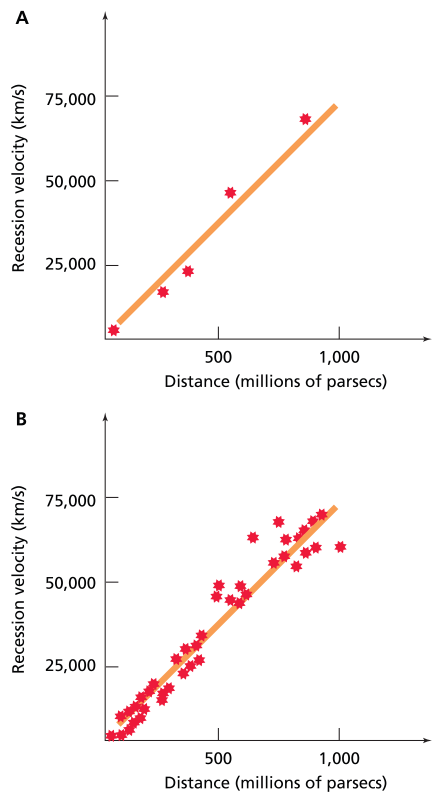
Plot of recessional velocity versus distance for many galaxies within about 1 billion parsecs of Earth, illustrating Hubble’s law, that recessional velocity is proportional to distance (modified from Chaisson and MacMillan)
In the 1920s, Edwin Hubble plotted galaxy redshifts and their calculated recessional velocities against distance. He discovered a straight‑line relationship: velocity increases steadily with distance. This proportionality is known as Hubble's law, and the overall picture of galaxies moving apart is termed Hubble flow. Hubble's law provides unequivocal evidence that the universe is expanding.
Hubble's law is expressed as:
V = H₀ × D where V is the recessional velocity, D is the distance, and H₀ (Hubble's constant) is the proportionality constant. On a distance–recessional velocity diagram, the slope equals Hubble's constant, approximately 75 km/s per megaparsec (46.5 miles/s per 3.3 million light‑years). However, uncertainty remains; most estimates fall within 60–90 km/s per Mpc (37–56 miles/s per Mpc). Hubble's constant represents the best estimate of the universe's expansion rate.
Hubble's law is also an invaluable tool for measuring distances to faraway objects. Because recessional velocity is proportional to distance, measuring the redshift (hence velocity) allows direct distance estimation. This method works even for extremely distant objects, such as Q051‑279—an object with a recessional velocity of 93 percent of the speed of light and a distance of 4,000 Mpc. The electromagnetic radiation now detected from Q051‑279 was emitted approximately 13 billion years ago, near the time of the big bang (currently estimated at 13.73 billion ± 120 million years ago). In 2004, the Hubble Space Telescope and gravitational lensing (a general relativity effect where foreground massive objects bend and magnify background light) revealed another extremely distant object. A team of scientists discovered a small, compact star system about 2,000 light‑years across and 13 billion light‑years away, magnified by the galactic cluster Abell 2218. Based on the universe's age, the light from this object was emitted when the cosmos was only 750 million years old.
Using powerful telescopes and Hubble's law, astronomers can now map the large‑scale structure of the universe. The cosmos is not a random collection of stars and galaxies but rather a patterned distribution of galaxies and clusters arranged in string‑ or filament‑like groups separated by vast, nearly empty regions called voids. These filaments lie on the surfaces of bubble‑like voids, as if the universe consists of a network of empty bubbles with galaxy clusters forming chains along the bubble surfaces. Regions where multiple bubbles intersect host the densest galaxy clusters and superclusters. The origin of this bubble‑like structure remains debated but is thought to arise from density fluctuations or ripples in the early universe, which grew over time as the universe expanded.
Date added: 2026-04-26; views: 239;