
Galaxy Clusters and Superclusters: Large-Scale Structures in the Universe
Most galaxies reside at vast distances from Earth and the Milky Way Galaxy, forming groups or clusters bound by mutual gravitational attraction. These aggregations are separated by immense voids—regions of relatively empty space largely devoid of luminous matter. The Milky Way belongs to the Local Group, which also includes the large Andromeda Spiral Galaxy, the Large and Small Magellanic Clouds, and approximately 20 smaller galaxies. The majority of galaxies within the Local Group are elliptical and dwarf irregular systems, and the entire group spans roughly 1 megaparsec (Mpc) in diameter, equivalent to about 3.26 million light-years.
Astronomers classify galaxy clusters into two primary types: regular and irregular clusters. Regular clusters exhibit a spherical shape with a dense central core, and their classification depends on the number of galaxies located within 1.5 Mpc of the cluster’s center. Most regular clusters have radii between 1 and 10 Mpc and possess total masses on the order of 10^15 solar masses (where one solar mass equals the mass of the Sun). The Coma Cluster exemplifies a regular cluster, containing thousands of galaxies within 1.5 Mpc of its core, making it one of the densest large-scale regions in the observable universe.
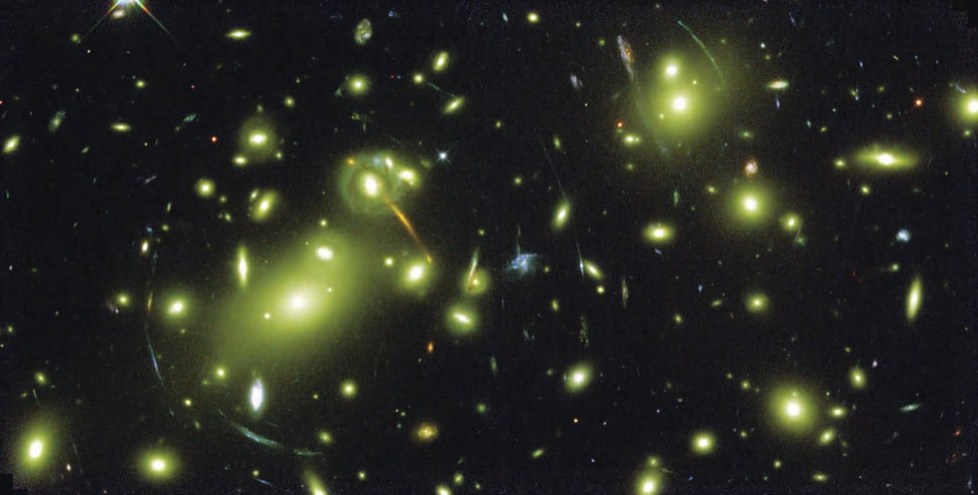
Cluster of galaxies called Abell 2218, taken by Hubble Space Telescope (NASA, A. Fruchter and the ERO Team, STScI, ST-ECF)
Irregular clusters generally have lower masses, ranging from approximately 10^12 to 10^14 solar masses, and lack a well-defined central concentration. Unlike regular clusters, they display asymmetric, amorphous shapes without a prominent core. The Virgo Cluster serves as a nearby example of an irregular cluster, located about 16.5 Mpc from the Milky Way and containing over 1,300 member galaxies. These irregular systems often represent younger, less dynamically evolved structures compared to their regular counterparts.
Galaxies and galaxy clusters are further organized into even larger assemblages known as superclusters. A supercluster typically consists of groups or chains of clusters, with total masses around 10^16 solar masses. The Milky Way is part of a supercluster centered on the Virgo Cluster, spanning roughly 15 Mpc in size. In contrast, the largest known superclusters—such as the one associated with the Coma Cluster—extend across about 100 Mpc. Recent advances in astronomical mapping techniques, including redshift surveys and cosmic microwave background analysis, reveal that approximately 90% of all galaxies reside within an interconnected network of superclusters permeating the known universe.
The largest-scale structures known in the cosmos exhibit a bubbly distribution of galaxies and clusters. Voids—roughly 25 Mpc across—separate interconnected sheets and filaments of galaxy clusters, creating a sponge-like cosmic web. The Great Wall is a prominent example of such a sheet-like structure: a vast accumulation of galaxies about 100 Mpc long, located approximately 100 Mpc from Earth. This filamentary architecture arises from the gravitational collapse of dark matter and baryonic matter following the Big Bang, with simulations confirming that such patterns emerge naturally from initial density fluctuations.
Redshift studies of galaxies from Earth demonstrate that many galaxy groups on scales of 60 Mpc move in a relatively coherent manner, suggesting linkage by some overarching large-scale structure. Consistent with this observation, astronomers have determined that the Milky Way Galaxy—along with the entire Local Group—is moving at approximately 600 km/s toward a region in space about 45 Mpc away, located within the Centaurus Supercluster. This mysterious region is known as the Great Attractor. The mass contained in this area is calculated to exceed 5 × 10^16 solar masses, and it likely represents a diffuse concentration of matter spanning roughly 400 million light-years across, possibly constituting a supercluster itself. Ongoing surveys using X-ray observations and radio telescopes continue to refine our understanding of this gravitational anomaly.
Cosmological simulations and deep-sky surveys such as the Sloan Digital Sky Survey have mapped the three-dimensional distribution of galaxies out to billions of light-years. These maps confirm that dark matter plays a crucial role in structuring the universe, as visible matter alone cannot account for the gravitational binding of clusters and superclusters. The Lambda-CDM model (Lambda Cold Dark Matter) successfully reproduces the observed hierarchy of structures, from individual galaxies to superclusters and the cosmic web. Understanding these large-scale formations remains a central goal of modern astrophysics and cosmology.
FURTHER READING: Chaisson, Eric, and Steve McMillan. Astronomy Today. 6th ed. Upper Saddle River, N.J.: Addison-Wesley, 2007.
Comins, Neil F. Discovering the Universe. 8th ed. New York: W. H. Freeman, 2008.
National Aeronautics and Space Administration. “Universe 101, Our Universe, Big Bang Theory. Cosmology: The Study of the Universe” Web page. Available online. URL: http://map.gsfc.nasa.gov/universe/. Updated May 8, 2008.
Snow, Theodore P. Essentials of the Dynamic Universe: An Introduction to Astronomy. 4th ed. St. Paul, Minn.: West, 1991.
Date added: 2026-04-26; views: 266;