
Types of Galaxies: Spiral, Barred Spiral, Elliptical, and Irregular – Hubble Classification Explained
Galaxies are gravitationally bound assemblages of stars, dust, gas, radiation, and dark matter. Most contain vast numbers of star systems and are located at enormous distances from our Milky Way Galaxy, such that the light reaching Earth from these galaxies was generated billions of years ago. Understanding galaxy types helps astronomers trace the evolution of the universe and the distribution of matter on cosmic scales.
Types of Galaxies. Telescopic observations of galaxies show that they have a wide range of different shapes first classified by the American astronomer Edwin Hubble in 1924 into four basic types: spiral galaxies, barred spiral galaxies, elliptical galaxies, and irregular galaxies. Hubble’s classification has since been modified and elaborated upon, but astronomers continue to use the same basic scheme, often referred to as the Hubble tuning fork diagram. This classification remains fundamental for organizing our understanding of galactic morphology and evolution.
Spiral galaxies are characterized by a flattened disk shape that exhibits a central bulge and spiral-shaped arms that emerge from this central bulge, extending in variously curved forms to distant reaches of the galaxy. These are surrounded by a galactic halo made of a ball of old faint stars forming a sphere around the other parts of the galaxy. The Milky Way, which contains billions of star and planetary systems including Earth, is a spiral galaxy. One of the major differences between different types of spiral galaxies is how tightly wrapped the spiral arms are as they circle the bulge in the core.
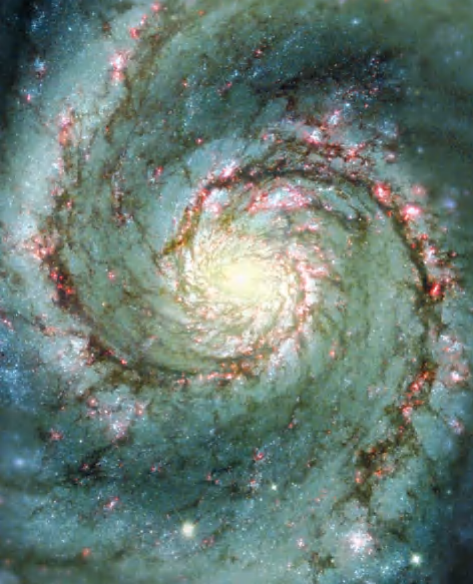
Hubble image of M51 Whirlpool Galaxy dated November 7, 2002 (NASA Goddard Space Flight Center)
Generally, the larger the central bulge of the galaxy, the more tightly wrapped the arms become. Galaxies with small central bulges in their cores tend to have loosely wrapped spiral arms and more lumpy or knotty distributions of matter within their arms. In the Hubble classification, forms of spiral galaxies are abbreviated by the letter S, with small letters a–d denoting progressively more open spiral forms, such that Sc galaxies are more open than Sa galaxies. Most spiral galaxies have galactic disks rich in gas and dust, and halos comprised largely of old dim stars. The spiral arms contain many younger stars and newly forming star systems, representing the densest parts of these galaxies and providing material for the birth of new star systems.
Barred spirals are a special class of spiral galaxies in which a concentrated “bar” of stellar and interstellar matter passes through the central bulge of the galaxy, and the spiral arms extend from the ends of this bar. Most of these have unusual shapes, resembling giant Z or S shapes, with spiral trails of luminous matter extending around the letter. Barred spiral galaxies are designated by the Hubble classification as SB galaxies, with the small letters a–c denoting how open the spiral arms are around the bar. Recent studies suggest that more than half of all spiral galaxies, including the Milky Way, may actually possess a barred structure, making barred spirals a dominant morphological type.
Elliptical galaxies are circular to highly elliptical concentrations of stellar and interstellar matter whose density increases toward the center of the galaxies. The size of elliptical galaxies and the number of stars contained within them vary widely. Some are small and known as dwarf ellipticals, being only a kiloparsec across and containing on the order of a million stars. Others are huge, many times the size of the Milky Way Galaxy, and contain trillions of stars in giant elliptical galaxies that can be several megaparsecs across. Elliptical galaxies typically exhibit little internal structure, with no spiral arms and no central bulge. They are designated in the Hubble classification by the letter E with numbers 1–7 indicating a progression from least-elongated (E1) to most-elongated (E7) varieties.
Elliptical galaxies also differ from spiral galaxies in that they contain little gas and dust, and they seem not to have any young stars or places where star formation is currently occurring. Most of the stars in elliptical galaxies appear to be old, relatively cold, reddish low-mass stars, similar to the stars in the halo of the Milky Way and other spiral galaxies. Ellipticals are therefore old systems in which the gas and dust was all swept up by star formation long ago, and the stars move about in irregular paths within the elliptical mass. As with most generalized statements, there are exceptions; recent observations have shown that some giant elliptical galaxies have smaller areas containing disks of gas and dust, but some astronomers speculate that these may be other spiral galaxies that collided with the giant ellipticals. Such merger events are thought to play a key role in the formation of elliptical galaxies.
Irregular galaxies include the whole range of other galaxies that do not fit into Hubble’s spiral, barred spiral, or elliptical galaxy classes. These galaxies tend to lack systematic structure such as spiral arms or bulges, but they do contain large amounts of interstellar material such as dust and gas. Irr I type irregular galaxies slightly resemble distorted spiral galaxies, with famous examples including the Magellanic Clouds that orbit the Milky Way. The less common Irr II galaxies exhibit explosive or filamentous characteristics, often indicating violent internal processes. Different models have been advanced to explain these characteristics of Irr II galaxies, including massive explosions inside the galaxies (such as supernova bursts or active galactic nuclei) or the effects of close encounters with other galaxies that disrupt their morphology.
Most irregular galaxies contain between one billion and one hundred billion stars, with the smaller “dwarf irregular” being more common than larger elliptical galaxies. These dwarf irregulars are especially abundant in the local universe and are considered important laboratories for studying star formation in low-metallicity environments. Observations from telescopes such as the Hubble Space Telescope and the James Webb Space Telescope continue to refine our understanding of galaxy formation, revealing that many irregular galaxies may represent early-stage or interacting systems that eventually evolve into more structured forms over cosmic time.
Date added: 2026-04-26; views: 245;