
Area Types-Floristic Elements-Plant Kingdoms
Areas of similar basic structures, size and geographical positions are categorised into area types. Various species do not occupy absolutely identical areas, but all species of the same area type are considered to be geo-elements if spatial aspects are considered more and floristic elements if floristic aspects are considered. Nevertheless, these terms may be regarded as synonyms.
The spatial distribution of area types is linked to climatic characteristics: (1) zonal temperature dependence with latitude, (2) dependence on the duration of the growing season with altitude above sea level, (3) dependence on the influence of oceanic or continental climates that affect temperature ranges. Groups of geo-elements for Europe are shown on the map in Fig. 18.7. The following abbreviations are generally used for the zonal sequence from north to south, which can be further subdivided based on clearly defined floristic contrasts between the observed areas (e.g. sub-Mediterranean).
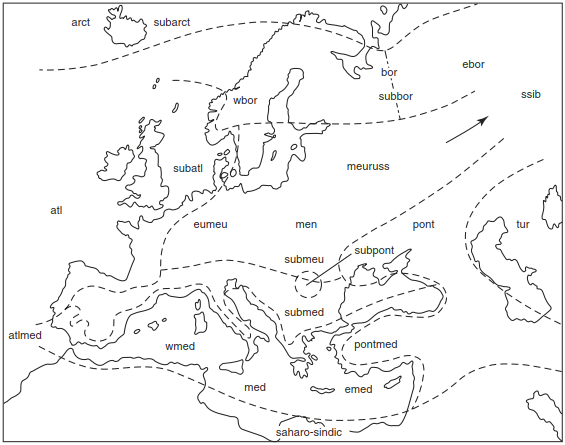
Fig. 18.7. Classification of geoelements (similar area types) of Central Europe. atl atlantic, arct arctic, bor boreal, eu European, m central, med mediterranean, pont pontic, russ russian, saharo saharian, sindic indian, tur turanic, e east, s south, w west (after Kreeb 1983)
For altitudinal belts the following terms are used:
- plan (planar belt of lowlands).
- coll (colline belt).
- mont (montane belt).
- subalp (subalpine belt to the timberline).
- alp (alpine belt).
- niv (nival belt).
For the west-east changes in Europe the following terms are used:
- atl (atlantic).
- cen (central European).
- ssib (southern Siberian).
Examples of geo-elements influencing Central Europe are listed in Table 18.5.
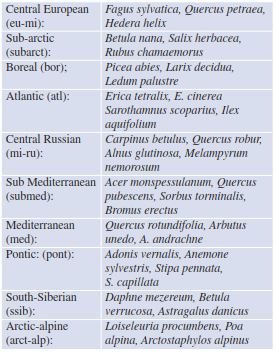
Table 18.5. Examples of types of central European geoelements and neighbouring geoelements
Vegetation may thus be regarded as the combination of species of a certain area or geoelement. The causes of boundaries between areas and types remain poorly understood; however, their evaluation and interpretation can be based on ecological characteristics of the species. For example, Muller-Hohenstein (1988) characterised vegetation units on the Arabian peninsula using an area typological approach (Fig. 18.8). The figures show the different interpretations of the boundaries, which could then be used by climatologists and plant geographers. It is easy to see from this figure that there is a lot of variability between boundaries, suggesting that the north-eastern Arabian coastal regions should not be classified as tropical, according to neither the climate nor the vegetation.
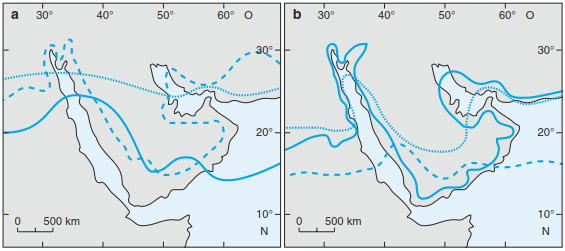
Fig. 18.8. The position of plant kingdoms or climatic zones on the Arabian Peninsula. a Position of the bound-aries between the Holarctic and the Palaeotropic plant kingdoms according to plant geographers Diels (1908, dotted line), Al Hubaishi and Müller-Hohenstein (1984, continuous line) and Kürschner (1986, broken line). b Boundaries between the subtropics and tropics on the Arabian Peninsula according to climatologists Troll and Paffen (1964, dotted line), von Wissmann (1964, continuous line), Blüthgen (1964, broken line) (after Müller-Hohenstein 1988)
Area types and the corresponding geoelements are the basis of a hierarchical division of the Earth according to floral relationships. At the highest level of this hierarchy are the six plant kingdoms. This division is made on the best possible homogeneity within and the greatest contrast between neighbouring units. The differentiation is mainly based on the geographical positions in which these species have developed for different periods in isolation. To define the plant kingdoms, mainly higher taxonomic units (families) are used, which are based on not only their exclusive distribution but also the spatial centres of their distributions. Plant kingdoms can be further subdivided into floral regions and floral provinces (Fig. 18.9). The early separation of the southern continents with the corresponding formation of three plant kingdoms, Antarctic, Capensis and Australis, is particularly important. The sole plant kingdom in the northern hemisphere, which covers the middle and higher latitudes, is the Holarctic. In the lower latitudes of the tropics, the Palaeotropics and Neotropics are differentiated.
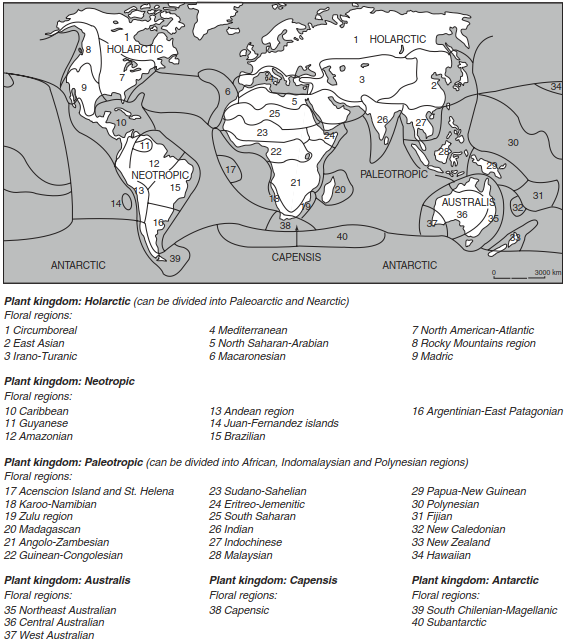
Fig. 18.9. Plant kingdoms and floral regions (after Richter 1997)
The Holarctic is the largest plant kingdom with distribution centres of many plant families (Apiaceae, Betulaceae, Brassicaceae, Caryo- phyllaceae, Fagaceae, Primulaceae, Ranun- culaceae, Rosaceae, Salicaceae). Current differences, for example, between holarctic regions in North America and Eurasia, are caused by recent geological events (ice ages). However, in more recent geological time periods, no insurmountable barriers have arisen.
This does not apply to the southern, tropical regions. The separation of the African continent from South America led to the subdivision of two tropical plant kingdoms; this subdivision is justified, despite existing parallels (pantropical species and families, e.g. Annonaceae). Particularly characteristic families in the Palaeotropics, including the African continent and the SouthEast Asian archipelagos, are Combretaceae, Dipterocarpaceae, Euphorbiaceae, Moraceae (with over 1000 species of the genus Ficus), Nepenthaceae, Pandanaceae and Zingiberaceae. For the Neotropics, including most parts of Central and South America, species of Araceae, Bromeliaceae, Cactaceae and Solanaceae are particularly characteristic. Tropaeolaceae are entirely limited to this plant kingdom.
The Capensis in the south of the African continent is the smallest plant kingdom, but it is a particularly autonomous realm, where some families have developed into many species. This applies particularly to Ericaceae and Mesembryanthemaceae. In these two families relations to the Holarctic and Antarctic become obvious. The Bruniaceae is an endemic family of the cape, and representatives of the Proteaceae and Restionaceae are dominant.
The Southern Hemisphere plant kingdom of Australis comprises only the Australian continent and Tasmania; at the level of genera and species it is rich in endemic species. Eucalyptus species (Myrtaceae) are particularly important and are now distributed worldwide. The neighbouring New Zealand belongs in part to the Palaeotropics, but in the south partly to the Southern Hemisphere, the Antarctic, which has its largest area almost completely inhabited by plants. However, in the southern tip of South America, southern beeches (genus Nothofagus) developed.
Date added: 2026-04-26; views: 250;