
Flysch and Turbidite Deposits: Sedimentary Processes and Geological Significance
Flysch is a syn-orogenic clastic sedimentary deposit characterized by interbedded shales and sandstones. The term was first applied to sedimentary rocks deposited in the Alps during the Cretaceous-Tertiary periods, prior to the main erosional event that produced coarser-grained conglomerates known as molasse. Typical sedimentary structures within flysch include graded and cross-laminated sandstone layers that form Bouma sequences, indicating deposition by turbidity currents. Flysch accumulates primarily in foreland basins, creating regionally extensive clastic wedges underlain by distal black shales and overlain by fluvial deposits and conglomerates.
The predominant sedimentary deposit type in flysch sequences is the turbidite, which represents a submarine turbidity current deposit composed of graded sandstone and shale. Turbidites typically accumulate in thick, repetitive sequences and are thought to form in various subenvironments of submarine fans, ranging from shallow- to deep-water settings. These deposits originate when water-saturated sediments on a shelf or in shallow water are disturbed by storms, earthquakes, or other triggering mechanisms that initiate downslope sediment sliding. The resulting sediment-laden density current moves rapidly downslope, traveling tens or even hundreds of miles at speeds of tens of miles per hour, until the slope decreases and current velocity diminishes.
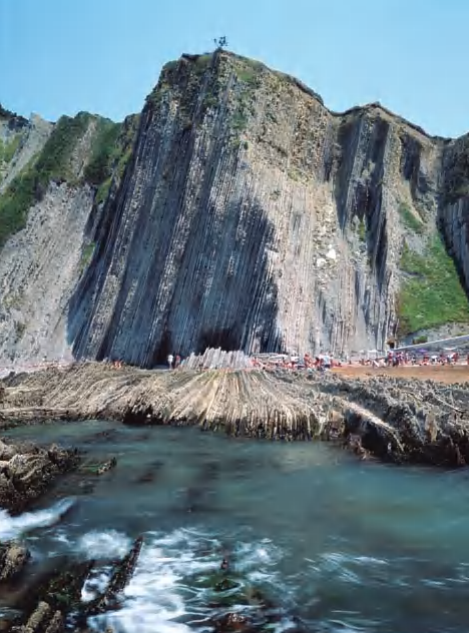
Alternating sandstone and shale deposits arranged in an anticline fold in flysch sediments in Zumaia, Spain (Dirk Wiersma/Photo Researchers, Inc.)
As the turbidity current slows, its capacity to suspend coarse material progressively decreases, leading to sequential deposition of the coarsest load first, followed by progressively finer material. Consequently, the coarsest sediment accumulates closest to the channel or slope down which the current flowed, while finer material settles farther away. The same vertical sequence of coarse-to-fine material develops upward within an individual turbidite bed as current velocity declines over time at any given location. This process produces graded beds, characterized by coarse-grained material at the base and finer-grained sediment at the top.
A complete, classical turbidite bed exhibits a regular sequence of sedimentary structures designated as the A-E Bouma sequence, named after the sedimentologist Arnold Bouma who first described it. The A horizon consists of coarse- to fine-grained graded sandstone beds representing material deposited rapidly from suspension. The B horizon comprises parallel-laminated sandstones deposited by material moving as bedload traction, whereas the C division contains cross-laminated sands formed under lower-flow regime conditions. The D and E horizons represent the transition from deposition during the waning stages of the turbidity current to background pelagic sedimentation.
Variations in the thickness and presence or absence of individual Bouma sequence horizons correlate with depositional position on the submarine fan or slope. Turbidites containing more of the A-B-C horizons are interpreted as having been deposited closer to the slope or channel, representing proximal environments. Conversely, turbidite sequences dominated by C-D-E horizons are considered more distal deposits, formed farther from the sediment source. These spatial variations provide valuable information for reconstructing ancient submarine fan systems and understanding sediment dispersal patterns in deep-water basins.
Many turbidite sequences are deposited in foreland basins and deep-sea trench settings, environments characterized by steep source-area slopes, virtually unlimited sedimentary material supply, and numerous tectonic triggers that initiate turbidity currents. The combination of high sediment input and tectonic activity in these settings results in thick, laterally extensive flysch deposits that record the early stages of mountain building. Additional examples of modern turbidite systems include the Amazon Fan, Bengal Fan, and Monterey Fan, which serve as analogues for ancient flysch sequences preserved in the rock record.
Molasse sequences overlie many turbidite-bearing flysch deposits, particularly those formed in foreland basins. Molasse consists of thick accumulations of coarse-grained postorogenic sandstones, conglomerates, shales, and marls that develop in response to erosion of orogenic mountain ranges. The name derives from the classic Miocene-Oligocene-Pliocene molasse of the European foreland, which was deposited across much of France, Switzerland, and Germany, directly overlying the Alpine flysch sequence. These sediments reach thicknesses of up to four miles (approximately seven kilometers) on the Swiss Plateau, reflecting rapid erosion of the rising Alps.
Lower portions of molasse sequences typically include shallow marine and tidally influenced sediments, reflecting initial foreland basin subsidence and marine transgression. These marine deposits are progressively overlain by alluvial fan deltas, alluvial fan complexes, and overbank deposits as the orogenic belt continues to rise and shed sediment into the basin. The transition from flysch to molasse in foreland basins records the shift from deep-marine turbidite deposition during active convergence to shallow-marine and continental sedimentation during later stages of mountain building. Understanding this vertical succession is critical for interpreting the tectonic evolution of convergent plate margins and associated sedimentary basin development.
FURTHER READING: Bouma, Arnold H. Sedimentology of Some Flysch Deposits. Amsterdam: Elsevier, 1962.
Kuenen, Phillip H., and Carlo I. Migliorini. “Turbidity Currents as a Cause of Graded Bedding.” Journal of Geology 58 (1950): 91-127.
Walker, Roger G. Facies Models. Toronto: Geoscience Canada Reprint Series 1, Geological Association of Canada, 1983.
Date added: 2026-04-26; views: 217;