
Devonian Period: Geological Time Scale, Paleogeography, and Appalachian Orogeny
The Devonian Period represents the fourth geological interval of the Paleozoic Era, spanning from approximately 408 to 360 million years ago. This period derives its name from well-exposed rock sequences in Devonshire, southwestern England, where British geologists Adam Sedgwick (1785–1873) and Roderick I. Murchison (1792–1871) first provided detailed descriptions in 1839. The Devonian is formally subdivided into three series and seven stages, with these divisions primarily established based on marine faunal assemblages.
Devonian sedimentary rocks are preserved on all modern continents, reflecting a distinct paleogeographic configuration. During this interval, the continents were assembled into a large remnant Gondwana landmass situated in the Southern Hemisphere, alongside portions of Laurasia (comprising North America and Europe), Angaraland (Siberia), China, and Kazakhstania in the Northern Hemisphere. The eastern margin of North America and adjacent Europe experienced the Acadian orogeny, a mountain-building event resulting from subduction and subsequent collision between Avalonian terranes and ultimately Africa with Laurasia. Additional orogenic episodes affected North China, Kazakhstania, and other continental fragments, generating substantial clastic wedges such as the Catskill delta in North America and the Old Red Sandstone deposits in the British Isles.
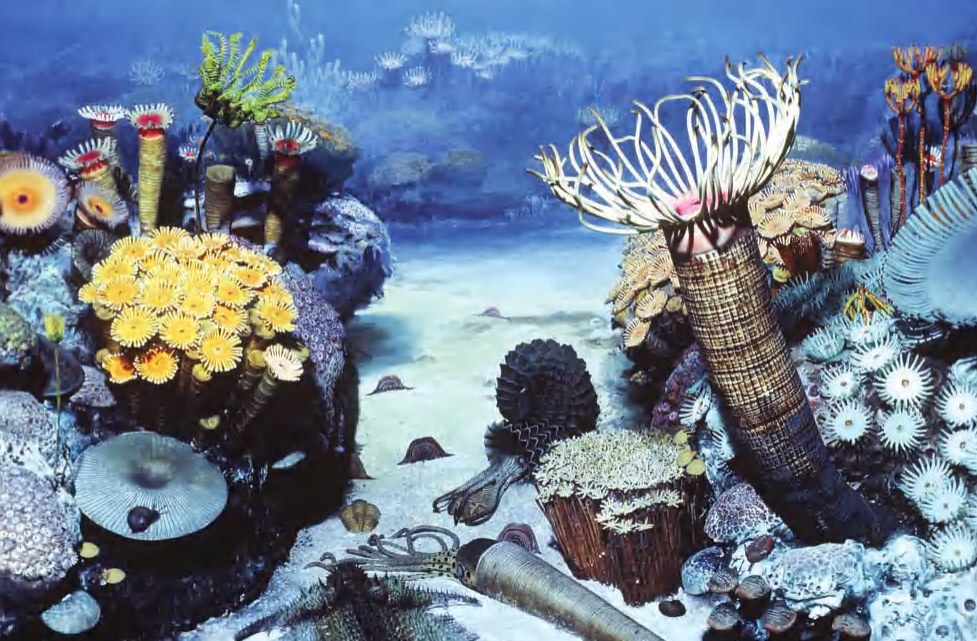
Middle Devonian coral reef construction, including different metazoans such as the coelenterates (Tom McHugh/Photo Researchers, Inc.)
The Devonian Period was characterized by multiple eustatic sea-level fluctuations and evidence of glacial episodes. Climatic conditions exhibited a pronounced latitudinal gradation, with tropical and monsoonal regimes prevailing in equatorial regions while cold-water environments dominated higher paleolatitudes.
Marine ecosystems during the Devonian achieved remarkable diversity. Brachiopods reached their acme in abundance and taxonomic variety. Rugose corals, tabulate corals, stromatoporoids, and calcareous algae constructed extensive carbonate reef complexes across North America, China, Europe, North Africa, and Australia. Crinoids, trilobites, ostracods, and various bivalve taxa inhabited reef environments and shallow-water settings, whereas calcareous foraminifera and large ammonites proliferated in pelagic realms. Conodonts, small marine vertebrates, attained their peak diversity during the Devonian; their exceptional variety, widespread geographic distribution, and rapid evolutionary turnover render them invaluable biostratigraphic markers that form the foundation for much of the period’s chronostratigraphic subdivision. Bony fish (Osteichthyes) evolved during this interval and gave rise to tetrapod amphibians by the end of the period, marking a crucial transition in vertebrate evolution.
Terrestrial environments witnessed significant colonization by vegetation during the Devonian. Early Devonian landscapes supported primitive plant communities, but by the Middle Devonian, extensive swamp forests dominated by giant fern trees (Archaeopteris) and spore-bearing plants had become established. Insects, including early flying forms, inhabited these swamp ecosystems.
The terminal Devonian event precipitated a widespread mass extinction that severely impacted marine animal communities, including brachiopods, trilobites, conodonts, and reef-building corals. The causal mechanisms remain incompletely understood, with proposed models including climatic cooling associated with southern hemisphere glaciation or bolide impact.
The Devonian Period marked the climactic development of the Appalachian Mountain belt in eastern North America. This orogenic system extends approximately 1,600 miles (1,000 km) along the eastern continental margin, from the St. Lawrence River valley in Quebec, Canada, southward to Alabama. Many geological classifications consider the Appalachians to continue through Newfoundland in maritime Canada; prior to the opening of the Atlantic Ocean, this system was continuous with the Caledonides of Europe. The Appalachians host numerous prominent academic institutions and represent one of the most comprehensively studied mountain ranges globally. Investigations into their evolutionary history significantly contributed to the development and refinement of plate tectonic theory during the early 1970s.
Rocks comprising the Appalachian orogen include sequences deposited on or adjacent to North America that were subsequently thrust onto the continent during multiple orogenic events. Throughout the Appalachian system, older continental crust consists of Grenville Province gneisses, which were deformed and metamorphosed approximately 1 billion years ago during the Grenville orogeny. Appalachian development occurred through several discrete stages. Following Late Precambrian rifting, the Iapetus Ocean evolved, hosting island arc development while a passive margin sequence accumulated along the rifted North American margin during the Cambrian-Ordovician. The Middle Ordovician collision of an island arc terrane with North America constituted the Taconic orogeny. This was followed by the Middle Devonian Acadian orogeny, which likely represents the collision of North America with Avalonia, a microcontinent originally situated off the coast of Gondwana. This orogenic event generated extensive molassic fan delta complexes forming the Catskill Mountains, succeeded by strike-slip faulting. The Late Paleozoic Alleghenian orogeny produced prominent folds and faults in the southern Appalachians, whereas strike-slip faulting dominated in the northern segment. This event appears related to the rotational closure of the remaining ocean basin in the southern Appalachians as Africa converged with North America. Late Triassic–Jurassic rifting subsequently initiated the reopening of the Appalachian region, leading to the formation of the present Atlantic Ocean.
FURTHER READING: Condie, Kent C., and Robert Sloan. Origin and Evolution of Earth, Principles of Historical Geology. Upper Saddle River, N.J.: Prentice Hall, 1997.
Prothero, Donald R., and Robert H. Dott. Evolution of the Earth. 6th ed. Boston: McGraw Hill, 2002.
Stanley, Steven M. Earth and Life through Time. New York: W. H. Freeman, 1986.
Windley, Brian F. The Evolving Continents. 3rd ed. Chichester, U.K.: John Wiley & Sons, 1995.
Date added: 2026-04-26; views: 258;