
Geological Hazards: Causes, Types, and Mitigation Strategies
Geological hazards encompass a wide range of natural phenomena, from sudden earthquakes and volcanic eruptions to the slow downhill creep of soil and the seasonal expansion of clay minerals. Natural geologic processes operate continuously on Earth but become hazardous when they reach extremes that interfere with human activities. For example, plate tectonics constantly moves the Earth’s surface, yet this motion goes unnoticed until sudden shifts generate destructive earthquakes.
The Earth functions as a naturally dynamic and hazardous world. Volcanic eruptions spew lava and ash, earthquakes push up mountains and shake the surface, and tsunamis sweep across ocean basins at hundreds of miles per hour (500 km/h), rising into enormous waves on distant shores. Mountains may suddenly collapse, burying entire villages under massive landslides, while other slopes gradually creep downhill, tilting and moving structures built on them. Coastal storms remove millions of tons of sand from one location and deposit it elsewhere in a single day, large regions are turning into desert, glaciers are retreating rapidly, and sea level is rising faster than previously imagined. Scientists better understand these expected consequences of planetary processes, enabling improved predictions of when and where natural geologic hazards may become disasters and allowing preventative measures to be taken.
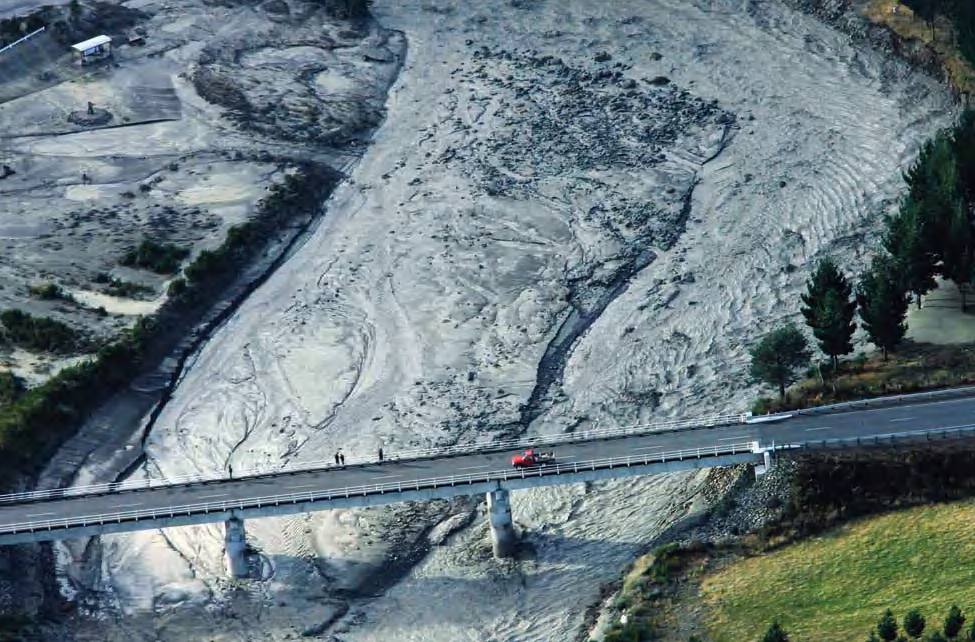
Mudflow on Whangaehu River after lahar from crater lake of Mount Ruapehu in the central North Island of New Zealand, March 18, 2007: The bridge over river is Tangiwai road bridge
Plate Tectonics as a Primary Driver of Hazards. The slow but steady movement of tectonic plates directly or indirectly causes many geologic hazards. Plate tectonics controls the distribution of earthquakes and volcanoes and drives mountain uplift. Other hazards relate to Earth’s surface processes, including river floods, coastal erosion, and shifting climate zones. Many surface processes form parts of natural cycles but become hazardous because people build on exposed coastlines or in areas prone to climate shifts without adequate understanding. A third group of hazards involves materials such as expansive clays that swell when wetted and sinkholes that develop in limestone terrains. Additional hazards originate beyond Earth, including occasional meteorite and asteroid impacts. The exponentially growing human population worsens the effects of most hazards, and the planet is now experiencing a mass extinction event whose severity rivals the extinction 66 million years ago that eliminated the dinosaurs.
Many geologic hazards arise directly from plate tectonics, associated with the motion of individual blocks of Earth’s rigid outer shell. Because so much energy is accommodated by plate motion, plate tectonics represents a major energy source for natural disasters. Most earthquakes occur directly along plate boundaries, and these devastating events account for much of the interplate motion. Single earthquakes have killed tens to hundreds of thousands of people, such as the 1976 Tangshan earthquake in China (250,000 deaths) and the 2008 Sichuan earthquake (approximately 100,000 deaths). Earthquakes also cause enormous financial losses; for instance, the 1994 Northridge earthquake in California caused over $14 billion in damage. Most of the world’s volcanoes are also associated with plate boundaries. Thousands of volcanic vents line the mid-ocean ridge system, where most magma erupts, though such volcanism is rarely explosive or hazardous. In contrast, volcanoes above subduction zones at convergent boundaries produce tremendous explosive eruptions that devastate local regions. Volcanic eruptions and associated phenomena killed tens of thousands in the 20th century, including the massive mudflows (lahars) at Nevado del Ruiz, Colombia, which killed 23,000 people in 1985. Larger eruptions cover vast areas with ash and can alter global climate. Plate tectonics also uplifts the world’s mountain belts, bringing associated hazards such as landslides and other forms of mass wasting.
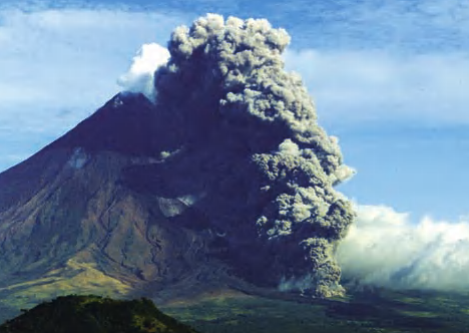
Pyroclastic flow on Mayon volcano in Legazpi City, Philippines, March 7, 2000
Landslides, Creep, and Gravity-Driven Processes. Some geologic hazards are associated with steep slopes where gravity moves material down into inhabited areas. Landslides and the slow downhill movement of earth materials occasionally kill thousands in large disasters, such as when part of a mountain collapsed in 1970 in the Peruvian Andes, burying a village tens of miles away and killing 60,000 people. Downhill movements are typically more localized, destroying individual homes, neighborhoods, roads, or bridges. Some downslope processes are slow, involving the inch‑by‑inch (centimeter by centimeter) creep of soil and other material that carries everything along its path. Creep ranks among the costliest natural hazards, costing American taxpayers billions of dollars annually.
Solar‑Driven Hazards: Floods, Storms, and Coastal Erosion. Many other geological hazards are driven by energy from the Sun and reflect interactions among the hydrosphere, lithosphere, atmosphere, and biosphere. Heavy or prolonged rains cause river systems to overflow, flooding low‑lying areas, destroying towns and farmlands, and changing the courses of major rivers. Flood types range from flash floods in mountainous areas to regional floods in large river valleys, such as the great floods of the Mississippi and Missouri Rivers in 1993. Coastal regions experience floods from typhoons, hurricanes, or coastal storms that bring high tides, storm surges, heavy rains, and deadly winds. Such storms cause extensive coastal erosion, including cliff retreat, beach and dune migration, and the opening or closing of tidal inlets. These normal beach processes have become hazardous as more people migrate into beachfront homes. Hurricane Andrew caused more than $19 billion in damage to the southern United States in 1992.
Desert Hazards, Droughts, and Desertification. Deserts and dry regions present their own natural geologic hazards. Blowing winds and shifting sands hinder agriculture, and deserts have limited capacity to support large populations. Some of history’s greatest disasters have been caused by droughts, some associated with desert expansion into areas that previously received significant rainfall and supported agriculture. In this century, the sub‑Saharan Sahel region of Africa has experienced multiple drought disasters affecting millions of people and animals. These droughts appear part of a natural climate cycle of alternating wet and dry periods in the Sahara. The contraction and expansion of desert fringes have severe consequences for those trying to live in such changing conditions.
Glaciers and Global Climate Change. Desertification represents one possible manifestation of global climate change. Earth has fluctuated between climate extremes—hot and dry, cold and dry, or cold and wet—and has experienced several periods when much of the land surface was covered by glaciers. Glaciers pose local hazards: ice crevasses can be deadly if fallen into, glacial meltwater streams can change discharge rapidly and wash away encampments, and icebergs threaten shipping lanes. More importantly, glaciers reflect subtle changes in global climate—retreating glaciers may indicate warming and drying, while advancing glaciers suggest cooling and wetter conditions. Glaciers have advanced and retreated over northern North America several times in the past 100,000 years. Earth currently experiences an interglacial episode and may see the return of continental glaciers within the next few hundred or thousand years.
Hazardous Geologic Materials. Geologic materials themselves can be hazardous. Asbestos, a common mineral, is being removed from thousands of U.S. buildings because certain types of airborne asbestos fibers threaten human health. In some cases this threat is real and removal is necessary; in others, leaving asbestos undisturbed is safer than releasing particles. Natural radioactive decay releases harmful gases, including radon, which seeps into homes, schools, and offices and causes numerous cancer cases annually. Simple monitoring and ventilation can mitigate radon hazards effectively. Other seemingly inert materials can also be hazardous. For example, some clay minerals expand by hundreds of times when wetted. These expansive clays lie under many foundations, bridges, and highways, causing billions of dollars in damage every year in the United States.
Sinkholes, Subsidence, and Sea‑Level Rise. Sinkholes, including the one in Winter Park, Florida, have swallowed homes and businesses in Florida and elsewhere in recent years. Sinkhole collapse and other subsidence hazards are more important than many realize. Large parts of southern California near Los Angeles have sunk tens of feet (about 10 meters) due to pumping of groundwater and oil from underground reservoirs. Other developments above former mining areas have begun sinking into collapsed mine tunnels. Coastline areas experiencing subsidence face the added risk of ocean waters encroaching into former living space. Coastal subsidence coupled with gradual sea‑level rise is rapidly becoming a major global hazard, since most of the world’s population lives near the coast within reach of rising waters. Cities may become submerged, and farmlands covered by shallow salty seas. New Orleans and much of the Gulf coast have been sinking at rates up to one inch per year (2.5 cm/year) due to natural and human‑induced processes, placing some urban areas at high risk for storm surge and hurricane damage. These risks were dramatically shown by Hurricanes Katrina and Rita in 2005. Enormous planning is needed as soon as possible to address this growing threat.
Extraterrestrial Hazards: Asteroid and Meteorite Impacts. Occasionally in Earth’s history, the planet has been struck by asteroids and meteorites from outer space, causing complete devastation of the biosphere and climate system. Many mass extinctions in the geologic record are now thought to have been triggered, at least in part, by large impacts. For instance, the extinction of the dinosaurs and a huge percentage of other species 66 million years ago is attributed to a combination of massive volcanism from a flood basalt province preserved in India and an impact with a six‑mile‑wide (10‑km) meteorite that struck the Yucatán Peninsula of Mexico. The impact generated a 1,000‑mile‑wide (1,610‑km) fireball that erupted into the upper atmosphere, a tsunami hundreds or thousands of feet (hundreds of meters) high that washed across the Caribbean and southern North America, and huge earthquakes. Dust blown into the atmosphere initiated a dark global winter; as the dust settled months or years later, excess carbon dioxide created a greenhouse condition that warmed Earth for many years. Many life forms could not tolerate these rapid changes and perished. Similar impacts at several times in Earth’s history have profoundly influenced the extinction and development of life.
Human Population Growth and Its Consequences. The human population is growing at an alarming rate, currently doubling every 50 years. At this rate, there will be only a three‑foot by one‑foot space (about 0.3 square meters) for every person on Earth in 800 years. This unprecedented population growth stresses other species to the point of driving a new mass extinction. Because the relationships between species are incompletely understood, many fear that destroying so many life‑forms may contribute to our own demise. In response to the population explosion, people are moving into hazardous locations including shorelines, riverbanks, steep mountain slopes, and volcano flanks. Populations that grow too large to be supported by their environment typically suffer catastrophe, disease, famine, or other growth‑limiting mechanisms. Society must find ways to limit human population growth to sustainable rates; the survival of the planet depends on maintaining these limits.
Advances in Science, Engineering, and Public Perception. Advances in science and engineering in recent decades have dramatically changed perceptions of natural hazards. In the past, people viewed destructive natural phenomena (earthquakes, volcanic eruptions, floods, landslides, and tsunamis) as unavoidable and unpredictable. Society’s investment in basic scientific research has changed that view, enabling general predictions regarding the timing, location, and severity of such events, thereby reducing their consequences. Communities use this information to plan evacuations, strengthen buildings, and prepare detailed disaster response plans, greatly reducing costs. Increased government responsibility accompanies this greater understanding. Formerly, society hardly looked to government for aid in natural disasters. For example, nearly 10,000 people perished in a hurricane that hit Galveston, Texas, on September 8, 1900; because no warning systems existed, no one was blamed. In 2001, two feet (0.6 m) of rain with consequent severe flooding hit the same area, resulting in no fatalities but billions of dollars in insurance claims. When Hurricane Ike hit Galveston in 2008, most people evacuated and loss of life was minimal.
Public perception of natural hazards has changed with the development of warning and protection systems, and few disasters occur without blame being assigned to public officials, engineers, or planners. Extensive warning systems, building codes, and increased understanding have prevented thousands of deaths, yet they also give society a false sense of security. When an earthquake or other disaster strikes, people expect their homes to be safe, but those homes were built to withstand only a certain level of shaking. When a natural geological hazard exceeds the expected level, a natural disaster with great destruction may result, and people often blame the government for not anticipating the event or preventing destruction. However, planning and construction efforts are designed to meet only certain force levels for earthquakes and other hazards; planning for rarer, stronger events would be exorbitantly expensive.
Economic Costs of Geologic Hazards. Geologic hazards are extremely costly in terms of both price and human casualties. With growing population and wealth, the cost of natural disasters has grown as well. The amount of property damage measured in dollars has doubled or tripled every decade, with individual disasters sometimes costing tens of billions of dollars. A 2000 report to the Congressional Natural Hazards Caucus estimated costs of recent disasters: Hurricane Andrew (1992) – $23 billion; 1993 Midwest floods – $21 billion; 1994 Northridge earthquake – $45 billion. Recovery from Hurricane Katrina cost a staggering $80–200 billion, with some estimates exceeding $1 trillion. In contrast, the entire first Persian Gulf War cost the United States and its allies $65 billion. That the costs of natural geologic hazards now rival the costs of warfare demonstrates the importance of understanding their causes and potential effects.
FURTHER READING: Abbott, P. L. Natural Disasters. 3rd ed. Boston: McGraw Hill, 2002.
Bryant, E. A. Natural Hazards. Cambridge: Cambridge University Press, 1993.
Erickson, Jon. Quakes, Eruptions, and Other Geologic Cataclysms: Revealing the Earth’s Hazards. New York: Facts On File, 2001.
Griggs, Gary B., and J. A. Gilchrist. Geologic Hazards, Resources, and Environmental Planning. Belmont, Calif.: Wadsworth, 1983.
Kusky, Timothy M. Geologic Hazards: A Sourcebook. Greenwood Press, 2003.
Date added: 2026-04-26; views: 259;