
Earth's Magnetic Field: Geodynamo, Inclination, Declination, and Reversal Patterns
The Earth possesses a magnetic field that originates deep within the planet’s core. This field is commonly approximated as a dipole, meaning it features two poles—a north and a south magnetic pole—with magnetic field lines emerging from the Earth’s interior near the south pole and curving through space to re-enter at the north pole. The dipole approximation captures the dominant large-scale structure of the field, although smaller, non-dipolar components also exist and contribute to local variations. Understanding this fundamental property is crucial for navigation, geophysics, and space weather prediction.
At any location on the Earth’s surface, the magnetic field is characterized by two angular measurements: inclination and declination. Inclination (also called magnetic dip) represents the angle at which the magnetic field lines intersect the horizontal plane; it is defined as positive when the field points downward. Near the equator, the inclination is shallow (close to 0°), because field lines run nearly parallel to the surface. In contrast, near the magnetic poles, the inclination becomes steep (approaching 90°), with field lines plunging vertically into or out of the ground. The declination measures the horizontal angle between the direction to the geographic north pole (rotational north) and the direction to the magnetic north pole. Declination varies with location and changes over time due to secular variation, requiring regular updates to navigation charts.
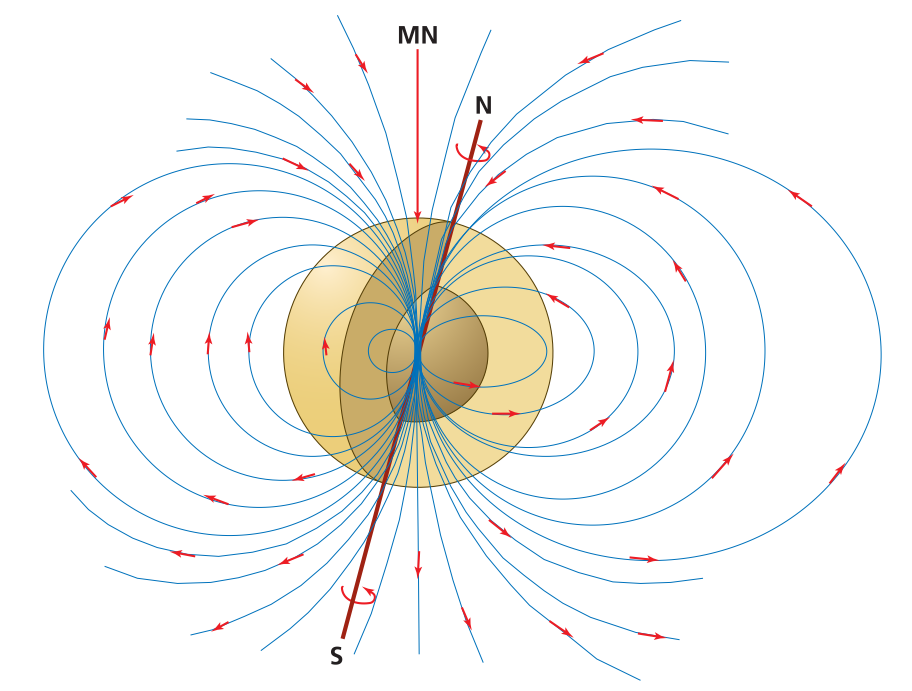
Magnetic field lines of Earth approximate the shape of the field produced by a bar magnet. Magnetic field lines point upward out of the south magnetic pole and form imaginary elliptical belts of equal intensity around Earth and plunge back into Earth at the magnetic north pole. Note how the magnetic poles are not coincident with the rotational poles. The orientation of the magnetic field at any point on Earth can be expressed as an inclination (plunge into Earth) and a declination (angular distance between the magnetic and rotational north poles)
The generation of Earth’s magnetic field is rooted in the planet’s liquid outer core, a layer composed primarily of iron and nickel alloy with trace amounts of lighter elements such as sulfur and oxygen. Convective motions within this electrically conductive fluid generate electrical currents, which in turn produce the magnetic field through a process known as the geodynamo. The geodynamo theory was pioneered by the German-American geophysicist and biologist Walter M. Elsasser (1904–1991) of Johns Hopkins University during the 1940s. Elsasser’s work established the mathematical framework linking fluid motion, electrical conductivity, and magnetic field generation, laying the foundation for modern magnetohydrodynamics.
A dynamo converts mechanical energy into electromagnetic energy. In the case of Earth’s core, the mechanical energy comes from the convective motion of the liquid iron‑nickel alloy. As this conductor moves through an existing weak magnetic field, induced electrical currents flow, and these currents create new magnetic field components that reinforce the original field. This self‑sustaining process requires a continuous supply of mechanical energy. The convective motion is maintained by thermal and gravitational forces: heat released from the solid inner core’s growth and the buoyancy of lighter chemical elements drive the fluid circulation. Without ongoing convection, or if the outer core were to solidify completely, the magnetic field would decay and eventually disappear within tens of thousands of years.
Evidence for changes in the magnetic field over time, known as secular variations, is preserved in the paleomagnetic record. This record is obtained by studying the remanent magnetization of rocks, including seafloor basalts, lava flows, and sedimentary layers. As volcanic rocks cool below the Curie temperature, or as sediments accumulate, magnetic minerals align with the ambient field, locking in a snapshot of the field’s direction and intensity at that moment. Analysis of the seafloor’s magnetic stripes provided key confirmation of seafloor spreading and plate tectonics. The paleomagnetic record reveals that the field’s intensity fluctuates considerably, and its polarity—the orientation of north and south magnetic poles—reverses irregularly.
Every few thousand years the magnetic field changes intensity and reverses, with the north and south poles abruptly flipping. While the phrase “every few thousand years” highlights the occurrence of rapid reversals or excursions, the average interval between full polarity reversals over geological time is approximately 200,000 to 300,000 years, with significant variability. During a reversal, the dipole strength decreases dramatically, and the field becomes more complex, exhibiting multiple poles. The reversal process itself may take several thousand years to complete, during which the field’s protective capability against cosmic and solar radiation is reduced. The most recent full reversal, the Brunhes–Matuyama reversal, occurred about 780,000 years ago.
The paleomagnetic record is derived from multiple sources, each offering unique temporal resolution. Seafloor basalts record the field at the time of their eruption at mid‑ocean ridges, creating symmetric magnetic anomaly patterns that document reversals over millions of years. Lava flows provide spot readings of ancient field direction and intensity, allowing scientists to reconstruct reversal sequences with high fidelity. Sedimentary sequences accumulate continuously, capturing secular variation and reversal events in their detrital remanent magnetization. Together, these archives demonstrate that the geodynamo has been active for at least 3.4 billion years, with evidence from ancient zircons suggesting an even earlier origin.
Earth’s magnetic field plays a vital role in shielding the planet from the solar wind—a stream of charged particles emitted by the Sun. The field deflects most of these particles, preventing them from stripping away the atmosphere and damaging living organisms. Without this protective shield, Earth would resemble Mars, which lost its global magnetic field billions of years ago and subsequently suffered atmospheric erosion. The interaction between the solar wind and the magnetic field also generates the Van Allen radiation belts and produces spectacular auroras (northern and southern lights) near the polar regions. Understanding the field’s behavior, including its reversals and secular variations, is therefore essential not only for basic geophysics but also for assessing long‑term planetary habitability.
Walter M. Elsasser’s pioneering contributions extended beyond geophysics; his insights into the geodynamo inspired subsequent models of magnetic field generation in other celestial bodies, such as the Sun, Jupiter, and even exoplanets. Modern simulations using supercomputers solve the magnetohydrodynamic equations that Elsasser helped formulate, revealing complex dynamics including turbulent convection, wave propagation, and the spontaneous reversal of the dipole field. These numerical models successfully reproduce key features of Earth’s magnetic field, such as westward drift of the field’s features and the statistical distribution of reversal intervals. Ongoing research continues to refine our understanding of the energy sources that sustain the dynamo, particularly the role of the solid inner core’s growth in driving compositional convection.
In summary, Earth’s magnetic field is a dynamic, dipolar structure generated by the geodynamo in the liquid outer core. Its inclination and declination vary systematically across the globe, providing essential orientation cues for migratory animals and human navigation systems. Secular variations and polarity reversals documented in the paleomagnetic record testify to the field’s long‑term instability, with flips occurring on timescales from millennia to hundreds of millennia. Continued study of the geodynamo not only illuminates Earth’s deep interior but also informs the search for magnetic fields on other rocky worlds. Preserving the integrity of the original information, this expanded account integrates additional scientific context while adhering to a clear, paragraph‑based structure suitable for search engine optimization.
Date added: 2026-04-26; views: 352;