
Geysers, Hot Springs, and Hydrothermal Systems: A Comprehensive Guide to Geothermal Phenomena
Geysers represent a unique class of thermal springs characterized by the sporadic or episodic eruption of hot water and steam as jets from surface openings. These eruptions can propel water hundreds of feet into the air, creating impressive natural towers. The surface expression of a geyser often includes a cone of siliceous sinter and other minerals precipitated from the hot water, commonly referred to as geyser cones. Many geyser systems also host thermophilic (heat-loving) bacteria that form layers and mounds in stromatolitic buildups, contributing to the complex microbial ecology of these environments.
The formation of geysers requires a specific hydrogeological setting where water within pore spaces and bedrock fractures becomes heated by underlying igneous intrusions or naturally hot rock. As this water reaches boiling temperatures, it erupts, and the discharged water is subsequently replaced by lateral inflow from surrounding portions of the system. This process establishes a circulation system that, in some cases, operates with remarkable regularity and predictable eruption intervals. The most renowned example is Old Faithful in Yellowstone National Park, Wyoming, which reliably erupts every 20 to 30 minutes, demonstrating the precise dynamics of natural geothermal plumbing systems.
Hot springs are defined as thermal springs with temperatures exceeding that of the human body, typically considered above body temperature. These features develop in locations where porous geological structures—such as faults, fractures, or karst terrains—channel meteoric water (derived from precipitation) deep into the subsurface. The water warms at depth and subsequently rises rapidly enough to prevent significant heat loss through conduction to surrounding rocks. The majority of hot springs, particularly those exceeding 140°F (60°C), are associated with regions of active volcanism or deep magmatic activity, though some occur in areas of tectonic extension without known magmatic sources.
Active faulting plays a crucial role in sustaining hot spring systems, as fluid pathways tend to become mineralized and sealed by precipitates from the hot waters. Repeated tectonic movements along faults continuously reopen these closed passageways, maintaining the hydraulic connectivity necessary for long-term spring activity. This interplay between mineralization and tectonic activity ensures the persistence of thermal features in geologically dynamic regions.
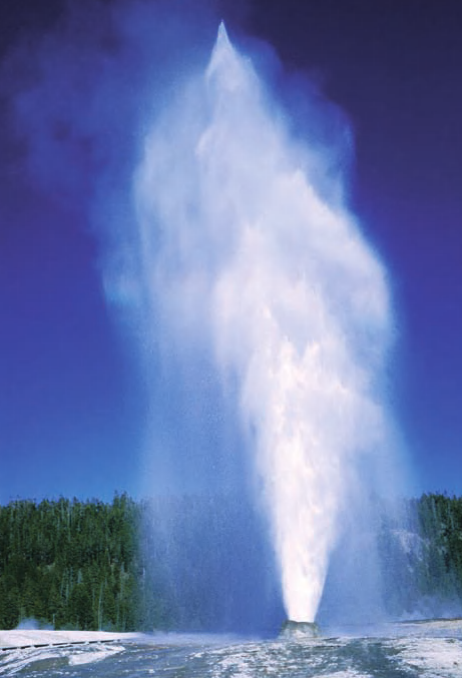
Beehive Geyser at Yellowstone National Park, Wyoming
Thermal Dynamics and Circulation Patterns. The physical behavior of hot spring systems is governed by fundamental thermodynamic principles. When cold, descending water heats up within a thermal system, it expands, decreasing in density and gaining buoyancy that drives upward circulation. Under typical conditions, geothermal gradients increase by approximately 120–140°F per mile (25–30°C per km) within the Earth. For surface hot springs to achieve temperatures greater than 140°F (60°C), water must generally circulate to depths of at least two miles (two to three kilometers), though this depth is significantly reduced in volcanically active regions where hot magmas exist at shallow crustal levels.
Boiling occurs in hot springs when water temperatures reach or exceed 212°F (100°C) and upward flow rates are sufficiently rapid to allow decompression. Under these conditions, boiling water and steam may be released at the surface, and in some configurations, this process manifests as geyser activity. The transition from a simple hot spring to a geyser depends on the specific geometry of subsurface conduits and the balance between heat input, water supply, and pressure conditions within the system.
Mineral Deposits and Chemical Composition. Hot springs are typically associated with diverse mineral precipitates and deposits whose composition reflects the chemistry of the circulating waters. This composition is primarily determined by the types of rocks through which the water circulates and from which it leaches minerals. Common deposits include mounds of travertine (a calcium carbonate precipitate), siliceous sinters, and various hydrogen sulfide compounds. These mineral accumulations often form distinctive topographic features and provide valuable records of past hydrothermal activity.
Submarine Hydrothermal Systems. Submarine hot springs represent a particularly fascinating category of hydrothermal phenomena, occurring extensively along the oceanic ridge system where magma lies at shallow depths beneath the seafloor. The immense pressure exerted by the overlying water column significantly elevates the boiling temperature of water at these depths, allowing vent temperatures to exceed 572°F (300°C). These deep-sea thermal features often form towering structures of sulfide minerals reaching ten feet (several meters) or more in height, with black clouds of fine metallic mineral precipitates emanating from the vents.
These systems, known as black smoker chimneys, host some of the most primitive life-forms known on Earth. These organisms derive their energy not from sunlight but from sulfur and other minerals discharged from the hot springs, representing chemosynthetic ecosystems that have fundamentally altered scientific understanding of life's requirements and origins. The biological communities associated with submarine hot springs include endemic species found nowhere else on the planet.
Hydrothermal Fluids and Ore Formation. Geysers and hot springs represent the surface expressions of deeper hydrothermal systems that circulate hot waters from within the Earth. While many thermal features discharge meteoric water that has undergone heating and circulation, others emit fluids originating from deeper crustal levels, collectively termed hydrothermal fluids. These heated subsurface waters typically contain dissolved minerals and substances, functioning as hydrothermal solutions that play a critical role in geological processes.
Hydrothermal solutions are significant because they dissolve, transport, and redistribute numerous elements within the Earth's crust. These fluids are responsible for concentrating and depositing many economically important ores, including gold, copper, silver, zinc, tin, and various sulfide deposits. Collectively known as hydrothermal deposits, these mineral accumulations represent the primary source for many metals essential to modern society.
The derivation of hydrothermal solutions involves multiple potential sources, including fresh or saline groundwater, connate water trapped in sedimentary rocks during deposition, water released during metamorphic reactions, and magmatic water released from cooling igneous systems. The minerals and metals dissolved in these fluids are typically derived from the dissolution of rocks encountered during fluid migration or are released directly from magmatic systems.
Magmatic Contributions and Metal Enrichment. Hydrothermal solutions commonly form during the late stages of magmatic crystallization, when residual fluids become enriched in chemical elements that do not readily incorporate into the crystal structures of forming minerals. These fluids exhibit elevated concentrations of lead, copper, zinc, gold, silver, tin, tungsten, and molybdenum. Many hydrothermal fluids are also saline, with salts derived from the leaching of surrounding country rocks. Saline solutions possess significantly greater capacity for carrying dissolved metals compared to nonsaline fluids, further enhancing the metal transport capabilities of these systems.
As hydrothermal solutions ascend through the crust, they cool from temperatures as high as 1,112°F (600°C). At lower temperatures, the solutions can no longer hold equivalent quantities of dissolved materials, leading to the precipitation of hydrothermal veins and ore deposits. Different minerals precipitate at characteristic temperatures, creating zoned deposits. Additional precipitation occurs when fluids encounter rocks of particular compositions, triggering fluid-wall rock reactions that can further concentrate mineral deposits.
Geothermal Energy in Regions with Geysers. Geysers, hot springs, and fumaroles are indicative of elevated subsurface temperatures, making such regions targets for geothermal energy development. Subsurface temperatures generally increase with depth according to the regional geothermal gradient, typically ranging from 90°–250°F (30°–140°C) per mile. Areas near active volcanic vents and deep-seated plutons exhibit enhanced geothermal gradients and are characterized by abundant thermal features. These systems develop when rising magma heats groundwater within rock fractures and pore spaces, establishing natural hydrothermal circulation.
Optimal natural hydrothermal systems occur where porous rocks coincide with heat sources such as young magma bodies. Geothermal energy extraction involves drilling wells, frequently extending several kilometers deep, into these natural systems. Wells penetrating productive zones typically encounter water, and less commonly steam, at temperatures exceeding 572°F (300°C). The elevated pressures at depth allow water to remain liquid at temperatures well above the surface boiling point, and reducing pressure by bringing water toward the surface induces boiling that drives turbines.
For efficient geothermal power generation, subsurface temperatures should exceed 392°F (200°C). Turbines coupled to generators are installed at wellheads, requiring approximately two kilograms of steam per second to generate each megawatt of electricity. Several nations, including China, Hungary, Iceland, Italy, Japan, Mexico, and New Zealand, have developed substantial geothermal energy capacity. While geothermal energy currently constitutes a modest fraction of total electrical generation in industrialized nations, its utilization continues to grow as sustainable energy infrastructure expands globally.
Date added: 2026-04-26; views: 352;