
Understanding Divergent Plate Boundaries: Mechanisms, Models, and Continental Rifts
Divergent plate margins represent zones where tectonic plates move apart. The most extensive expression of this process is the mid-ocean ridge system, a continuous mountain chain spanning approximately 25,000 miles (40,000 km) across the globe. These ridges form where oceanic plates diverge, allowing magma from the mantle to upwell and generate new oceanic crust and lithosphere. Such systems are considered mature extensional boundaries, many of which originate from immature extensional zones within continents, known as continental rifts. While some continental rifts, such as the Red Sea-East African rift system, are connected to the global oceanic rift system and actively fragment continents, others accommodate only minor crustal extension and may never evolve into oceanic rifts, with prominent examples including the Basin and Range Province in the western United States and Lake Baikal in Siberia, Russia.
Distinct Mechanisms of Extension at Divergent Boundaries. Although divergent boundaries share the common characteristic of lithospheric rupture and separation, the underlying processes driving this extension vary considerably. These mechanisms can operate independently in different regions or interact to facilitate crustal thinning and surface subsidence. The primary end-member models for extension and subsidence in continental rifts are the pure shear model, the simple shear model, and the dike injection model.
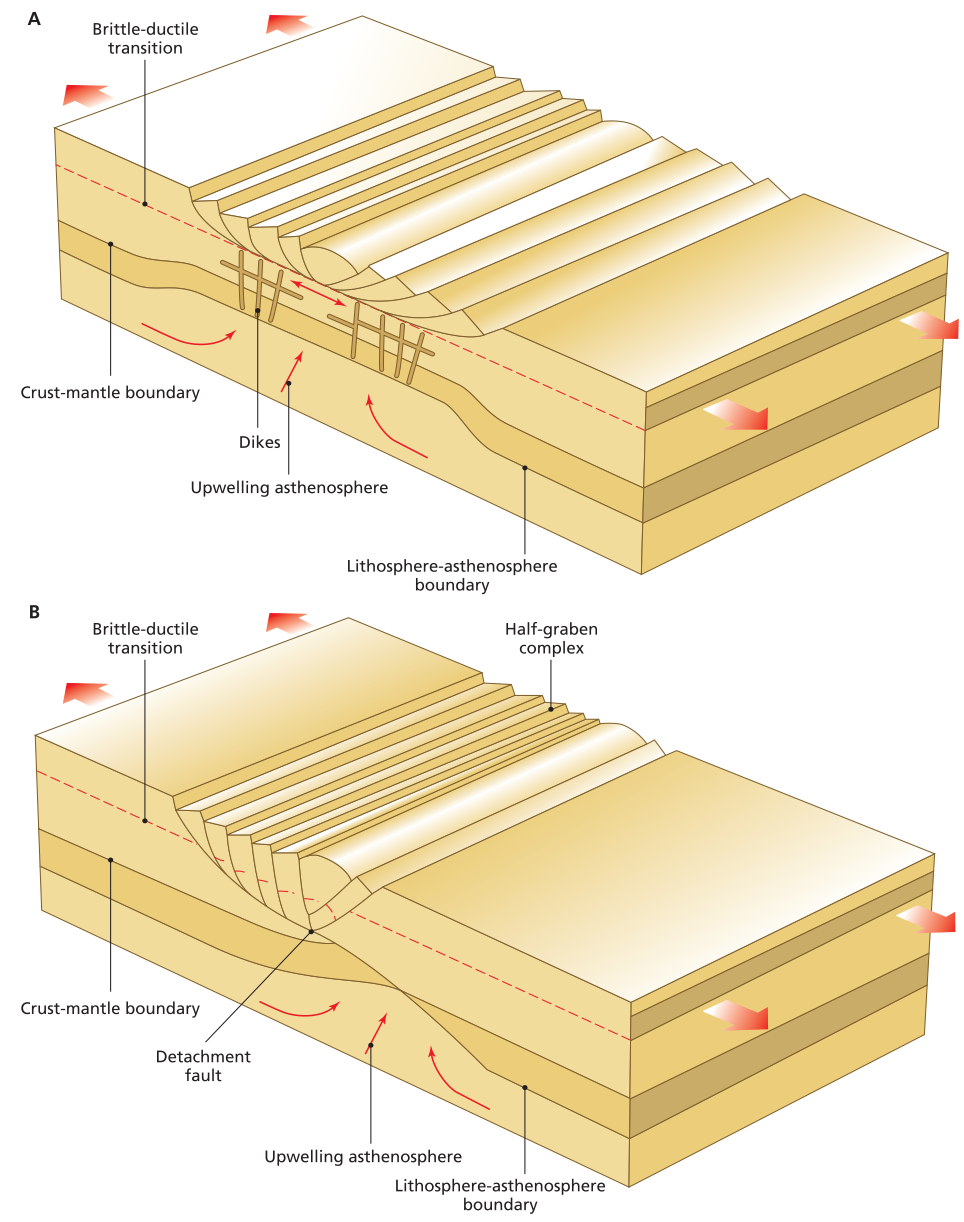
Modes of extension in rifts. (A) Shows pure shear model, in which the lithosphere extends symmetrically and asthenosphere rises to fill the space vacated by the extending lithosphere. (B) Shows simple shear or asymmetric rifting, where a shallow-dipping detachment fault penetrates the thickness of the lithosphere, and asthenosphere rises asymmetrically on the side of the rift where the fault enters the asthenosphere. Faulting patterns are also asymmetric, with different styles on either side of the rift.
In the pure shear model, the lithosphere undergoes symmetric thinning about the rift axis. This process resembles the stretching of a viscous material, where deformation near the surface is accommodated by brittle faulting, while ductile flow occurs at depth. The lithosphere-asthenosphere boundary, defined by the 2,425°F (1,330°C) isotherm, rises significantly to depths of 10-20 miles (15-30 km) beneath the rift center, contrasting with its typical depth of 75 miles (120 km) away from the rift. This upward migration results in elevated geothermal gradients and high heat flow within the rift, a condition supported by gravity measurements indicating an excess mass at depth from the upwelling asthenosphere. The transition between brittle and ductile behavior occurs at approximately four miles (7 km) depth, known as the brittle-ductile transition, below which extension is accommodated by ductile shear zones rather than fractures.
The simple shear model proposes an asymmetric extension regime dominated by a large-scale, low-angle detachment fault that cuts through the entire lithosphere. This configuration generates a system of asymmetric structures across the rift, including rotated fault blocks on the side where the detachment is shallow. Conversely, the opposing side, which experiences the most pronounced lithospheric thinning, is often characterized by extensive volcanic eruptions. Lithospheric thinning induces crustal heating and upward doming of the detachment fault, with the zone of maximum uplift typically offset from the rift's central axis. This model effectively accounts for the contrasting geological features observed on conjugate margins, such as the volcanic margins on one side and fault-dominated margins on the other. A notable example is the Red Sea, where the Arabian side exhibits abundant volcanic rocks, while the African side shows significantly fewer.
The dike injection model posits that the intrusion of numerous dense basaltic dikes into the continental lithosphere increases its density, leading to isostatic sinking and subsidence. While this mechanism is generally considered insufficient as a standalone explanation for the full range of rift features, it is recognized as a contributing factor to subsidence within the frameworks of the pure and simple shear models.
Across these models, the initial phase of rifting is characterized by elevated and compressed geothermal gradients beneath the rift axis. Following the primary stretching and subsidence phases, a rift will either become inactive or progress to form a mid-ocean ridge system. In the latter scenario, the rift's shoulders evolve into passive continental margins. Both failed rifts and passive margins undergo a subsequent, prolonged phase of thermal subsidence, driven by the gradual cooling and return of isotherms to their pre-rift depths. This process spans approximately 60 million years and results in the formation of broad basins characterized by the absence of active faulting and volcanism. The transition from the active rifting phase—marked by coarse clastic sediments and volcanics—to this thermal subsidence phase is commonly defined as the rift-to-drift transition.
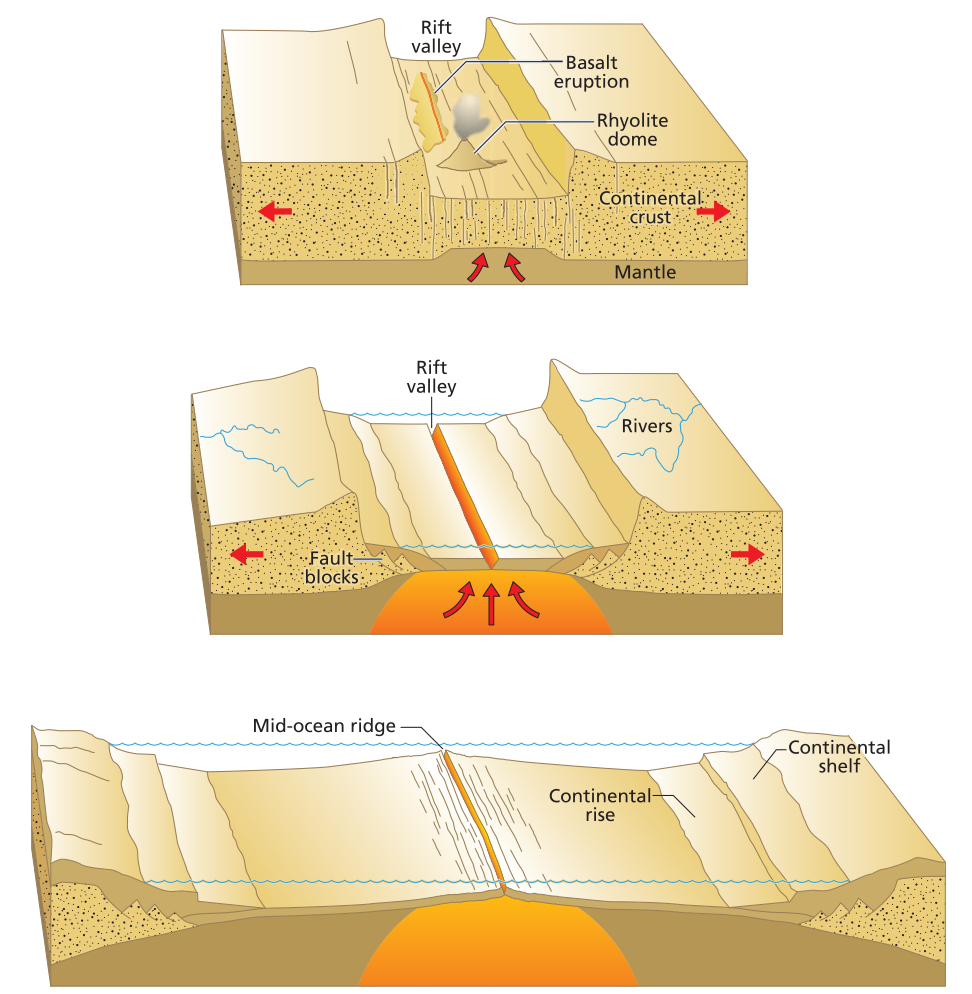
Figure showing simplified three-stage evolution of divergent margins. The young rift valley stage like that in the East African rift system has steep rift shoulders and basaltic and rhyolitic volcanoes. The young ocean stage, similar to the modern Red Sea, has seafloor spreading and steep rift shoulders. Mature ocean stage is like the modern Atlantic Ocean, with thick passive margin sequences developed on continental edges around a wide ocean basin.
Continental Rifts as Incipient Divergent Boundaries. Rifts are elongate depressions formed where the entire lithospheric thickness has been ruptured under extensional forces, representing the initial stage of continental breakup and potential new ocean basin formation. The primary geomorphic feature of this process is a rift valley, characterized by steep, fault-bounded margins and adjacent rift shoulders that often tilt away from the valley floor. Internal drainage systems are typical, with short streams originating on the steep valley sides, flowing along the axial trough, and terminating in deep, narrow lakes. In arid climates, such as in parts of East Africa, these drainage systems are often closed basins where water evaporates before reaching the sea, leading to the precipitation of characteristic evaporite deposits. The sedimentary record of continental rifts is further defined by lake sediments within the central basin and conglomerates derived from erosion of the uplifted rift shoulders. These sedimentary layers are frequently interbedded with volcanic rocks, which typically exhibit an alkaline composition and a bimodal silica distribution, consisting predominantly of basalts and rhyolites.
Date added: 2026-04-26; views: 251;