
Caesar's Helvetian Campaign: Strategy, Logistics, and Tactical Leadership
Strategic Imperatives and Pretext for the Helvetian War. The decision of Julius Caesar to launch a full-scale military campaign against the Helvetii in 58 BC marked a decisive turning point in Roman expansionism into Transalpine Gaul. In his primary account, Commentarii de Bello Gallico, Caesar justified his intervention by claiming that the Helvetii intended to migrate and settle on the borders of the Santones. This region was located uncomfortably close to the Tolosates, a tribe residing within the Roman province of Gallia Narbonensis. Caesar argued that such a demographic shift posed an immediate security risk to the province, placing a warlike, anti-Roman population adjacent to fertile, undefended agricultural regions crucial for grain production. Beyond official rhetoric, the influx of a migrating confederation threatened the delicate balance of power established through Roman diplomatic alliances and military deterrence. To secure the frontier, Caesar left his senior legate Titus Labienus in charge of the defenses along the Rhône river. The necessity of leaving Labienus behind indicated that the Helvetii were moving in dispersed groups, requiring significant time to organize their sprawling populace, livestock, and baggage trains. Leaving Labienus to guard the border, Caesar hastened to Aquileia to assemble his main force. He raised two new legions—the Eleventh (Legio XI) and Twelfth (Legio XII)—to reinforce the three legions stationed at Aquileia and the single legion left near the Rhône.
Legal Authority, Recruitment Dynamics, and Provincial Finances. Although Caesar’s narrative suggests that the enrollment of the new legions occurred rapidly upon his arrival in Aquileia, the practical requirements of recruitment, arming, and organizational logistics imply that orders were issued well in advance. It is plausible that these troops were originally intended for campaign operations in the Balkans, but the burgeoning Helvetian migration provided a politically advantageous pretext to deploy them in Gaul instead. From a constitutional perspective, Caesar possessed no formal authority from the Roman Senate to levy additional legions, as such powers were strictly reserved for senatorial decree. However, a lack of constitutional authorization had rarely hindered Caesar's political or military ambitions. In his youth as a private citizen, he had independently raised allied forces to combat Mediterranean pirates and oppose the forces of Mithridates VI during the Pontic invasion of Asia. Furthermore, during his propraetorship in Hispania, he levied ten additional cohorts—equivalent to a full legion—without prior senatorial sanction. Operating on the conviction that his actions served the higher interests of the Republic, Caesar routinely bypassed legislative constraints. Because the Senate had not authorized these new levies, no funds were allocated from the central treasury (aerarium) to pay, clothe, or provision the Eleventh and Twelfth legions. Consequently, Caesar was forced to finance these military formations using revenue raised within his own province alongside anticipated profits from military plunder. The vast majority of these recruits were drawn from Cisalpine Gaul. Although inhabitants of this region were not full Roman citizens and were technically ineligible for legional service, Caesar had long advocated for their political enfranchisement and treated them as full citizens, establishing a crucial precedent for personal troop loyalty.
Alpine Crossing, Force Concentration, and Logistical Pressures. With five legions organized, Caesar led his force across the Alps via the fastest available route to re-enter Transalpine Gaul. Despite being partially flanked by Roman provinces, this mountainous terrain remained unconquered, exposing the Roman column to repeated ambushes by independent mountain tribes seeking plunder. The week-long march served as a brutal introduction to warfare for the newly raised recruits, though Caesar completed the crossing without suffering major losses. Upon reaching the territory of the Allobroges, Caesar consolidated his forces with the legion previously left along the Rhône. His combined force totaled six legions, comprising approximately 25,000 to 30,000 legionaries, supported by 4,000 allied cavalry, auxiliary light infantry, and a vast support apparatus including enslaved individuals, baggage handlers, and camp followers. Maintaining supply lines for an army exceeding 30,000 men and thousands of draft animals presented a monumental logistical challenge. Because the Helvetian campaign developed unexpectedly, Caesar had been unable to establish pre-positioned supply depots in Transalpine Gaul. Furthermore, the rapid march from Aquileia meant the legions carried limited field rations. Compounding the problem, the campaign began in early spring before the local wheat harvest had matured in the colder northern climate. Unable to forage effectively from the countryside, Caesar relied on diplomatic provisions, demanding grain shipments from Roman allies, primarily the Aedui.
Inter-Tribal Conflicts and the Justification for Military Intervention. While Caesar organized his logistical chain, the Helvetii negotiated passage through the Pas de l'Ecluse into the lands of the Sequani and began entering the borderlands of the Aedui. Aeduan representatives, along with envoys from the Ambarri and Allobroges, sought protection from Caesar, reporting widespread plundering, destruction of property, and the enslavement of their populations by the migrating masses. Whether the Helvetian chieftains deliberately authorized these attacks or simply lost control over decentralized migrating bands remains uncertain. Given the extended delays of their journey, many Helvetian groups were likely experiencing acute food shortages, leading to violent foraging. For Caesar, defending an ally provided the ideal legal and moral justification (casus belli) required by Roman tradition for aggressive military intervention. Politically, failing to protect established allies would have destroyed Roman authority in Gaul, causing friendly tribes like the Aedui or recently pacified groups like the Allobroges to abandon their treaties. Furthermore, as consul in 59 BC, Caesar had passed the Lex Julia de Repetundis, which regulated the conduct of provincial governors and restricted their freedom to lead armies beyond their provincial borders without senatorial approval. In his Commentarii, Caesar took meticulous care to demonstrate that his unilateral military action outside Gallia Narbonensis was a necessary defensive response to protect Roman allies.
Tactical Engagement at the Saône and the Embassy of Divico. Caesar intercepted the migrating Helvetian force at the Saône river, where the tribesmen had spent twenty days attempting to cross using crude rafts and linked boats. Reconnaissance revealed that three-quarters of the Helvetian force had already reached the opposite bank, leaving the Tigurini clan isolated on the eastern side. The Tigurini held a prominent place in Roman collective memory, having inflicted a catastrophic defeat on a Roman army under Lucius Cassius Longinus in 107 BC. Caesar explicitly noted a personal motive for vengeance, as the grandfather of his father-in-law, Lucius Calpurnius Piso, had perished in that battle. Launching a surprise attack before dawn with three legions, Caesar caught the unprepared Tigurini off guard. The engagement resulted in a slaughter rather than a pitched battle; large numbers of the Tigurini were killed, and the survivors scattered into nearby forests, abandoning their baggage and wagons. Immediately following the engagement, Roman engineers constructed a pontoon bridge across the Saône, allowing Caesar’s entire army to cross the river in a single day—an operational feat that deeply impressed the remaining Helvetian leadership.
Diplomatic Standoff and Logistical Sabotage. Alarm by the swift Roman crossing, the Helvetii sent an embassy led by Divico, the aging chieftain who had led the Tigurini during the victory of 107 BC. Divico offered peaceful settlement wherever Caesar designated, but warned the proconsul against provoking a tribe that won battles through traditional valor rather than treacherous ambushes. Caesar countered by demanding hostages and financial restitution for the Aedui and Allobroges. Refusing these terms, Divico asserted that the Helvetii were accustomed to receiving hostages rather than giving them, whereupon the embassy departed. As the Helvetian column resumed its march, Caesar shadowed them at a distance of five to six miles, utilizing a forward detachment of 4,000 allied cavalry under the command of the Aeduan noble Dumnorix. However, an overconfident advance by the allied cavalry resulted in a humiliating defeat against a numerically inferior force of Helvetian horsemen. This tactical failure exposed internal political fractures: Dumnorix, who had previously forged alliances with the Helvetian leader Orgetorix, was actively sabotaging the Roman supply line. As the Helvetii veered away from the Saône, Caesar lost access to riverboat supply transports. Despite repeated promises from the Aedui, the promised grain shipments failed to arrive. Face-to-face inquiries with the Aeduan magistrate Liscus revealed that Dumnorix was leveraging his immense private wealth, gained from river tolls, to withhold grain shipments in a bid to secure royal power over the Aedui. Out of respect for Dumnorix’s pro-Roman brother, the druid Diviciacus, Caesar spared Dumnorix’s life but placed him under strict surveillance.
The Miscalculation at the Hill: Tactical Failure of Considius. Seeking a decisive end to the campaign, Caesar planned a coordinated night attack after scouts identified the Helvetian encampment near a prominent hill eight Roman miles away. Labienus was dispatched with two veteran legions to ascend the height from an unobserved path during the early hours of the morning. Caesar followed two hours later with the main body, led by a scouting party under Publius Considius, a decorated veteran who had served under Sulla and Crassus. The plan dictated that Labienus would hold the high ground and attack only when he saw Caesar’s vanguard approach the enemy camp. However, at dawn, Considius galloped back to Caesar in a state of panic, falsely reporting that the hill was occupied by Gaulish warriors rather than Labienus’s legions, claiming to have recognized their distinctive armor and helmet crests. Fearing a tactical trap, Caesar aborted the assault, pulled his force back to a defensive ridge, and deployed into battle formation. In reality, Labienus held the hill unimpeded, awaiting orders that never arrived because of Considius’s misidentification. By the time Roman scouts rectified the error late in the afternoon, the Helvetii had broken camp and moved on. Caesar was forced to abandon the pursuit and redirect his army toward the Aeduan stronghold of Bibracte, 18 miles away, to secure rations for his troops.
The Battle of Bibracte: Tactical Deployment and Victory. Interpreting the Roman march toward Bibracte as a retreat, the Helvetii reversed direction and began harassing the Roman rearguard. Recognizing that a pitched battle was unavoidable, Caesar deployed his army on the slope of a nearby hill. He placed his four veteran legions—the Seventh (Legio VII), Eighth (Legio VIII), Ninth (Legio IX), and Tenth (Legio X)—in the primary battle line using the traditional triple-line formation (triplex acies). The raw recruits of the Eleventh and Twelfth legions, along with auxiliary light infantry, were stationed at the top of the hill to guard the baggage train and construct basic field fortifications. To project numerical strength, these reserves were arranged to cover the entire ridge. In a dramatic gesture aimed at reassuring his inexperienced troops and eliminating any option of retreat, Caesar dismounted and sent his horse, along with those of his officers, to the rear.
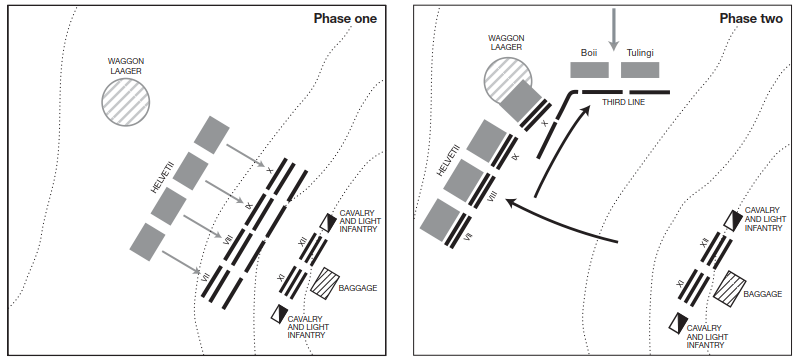
Fig. 1 illustrates the two distinct tactical phases of the engagement at Bibracte.
The battle commenced in the afternoon as the Helvetii advanced uphill in a tight phalanx formation. The Roman legionaries waited silently until the attackers reached a distance of 10 to 15 yards before releasing a synchronized volley of heavy javelins (pila). The pila pierced the overlapping shields of the Helvetian front ranks, bending upon impact and locking the shields together, forcing many warriors to discard their protection. Capitalizing on the disruption, the legionaries drew their short swords (gladii) and charged downhill, pushing the Helvetii back into the plain. However, as the Romans pursued, 15,000 warriors from the Boii and Tulingi arrived on the field, striking the exposed Roman right flank. The Helvetii rallied and renewed their assault. Executing a complex tactical maneuver, Caesar ordered the third line of his triplex acies to pivot and face the incoming flank attack while the first two lines maintained pressure against the Helvetii. The intense, multi-directional engagement lasted late into the night around the Helvetian wagon laager before the Roman forces successfully routed the enemy, securing a decisive strategic victory that established Roman dominance over Gaul.
Date added: 2026-09-24; views: 2;