
Caesar's Campaign Against Ariovistus: Strategy and Victory
Strategic Context and Tribal Delegations in Central Gaul. Following the successful defeat of the Helvetii, Julius Caesar found himself with several remaining months in the summer campaigning season. Although shifting forces back to the Balkan frontier was unfeasible within the remaining timeframe, Caesar was reluctant to stand idle. Delegations representing most of the Gallic/Celtic tribes of central Gaul arrived to congratulate him on his victory over the Helvetii. These envoys requested permission to assemble a general council of all tribes to present petitions directly to the Roman proconsul. During this council, tribal chieftains, led by the Aeduan druid Diviciacus, appealed to Caesar for protection against the German King Ariovistus. Diviciacus detailed how Ariovistus, originally invited to assist the Sequani, had settled 120,000 Germanic people on Gallic territory, seized hostages from various tribes, and exercised severe tyranny. The Aedui and Sequani expressed profound fear of Germanic expansion across the Rhine, invoking the historical memory of the massive migrations of the Cimbri and Teutones. Caesar felt compelled to intervene to protect Rome's long-standing alliance with the Aedui and to prevent uncontrolled demographic movements into Gaul.
Diplomatic Negotiations and Escalation of Demands. Caesar initiated diplomatic communications by requesting a conference with Ariovistus at a mutually accessible location. Ariovistus declined, asserting that if Caesar wished to speak, he should travel to Germanic-controlled territory, and questioned Roman authority in Central Gaul. Caesar issued a formal ultimatum based on Ariovistus's prior status as a "king and friend" recognized by the Roman Senate during Caesar's consulship. The proconsul demanded two main conditions: first, Ariovistus must cease bringing additional Germanic groups across the Rhine to settle in Gaul; second, he must restore all hostages to the Aedui and refrain from further aggression against Roman allies. Ariovistus rejected these demands, asserting his right of conquest and equating his governance of tribal territory with Rome’s administration of its provinces. Reports arrived rapidly that Germanic forces were actively raiding Aeduan territory and that one hundred clans of the Suebi were attempting to cross the Rhine, creating an urgent military imperative for Roman intervention.
Logistical Preparations and the Crisis at Vesontio. Before marching, Caesar secured his grain supply lines to prevent operational bottlenecks. Upon learning that Ariovistus was advancing toward Vesontio (modern Besançon), the fortified capital of the Sequani, Caesar executed a rapid force march day and night to seize the city and establish a Roman garrison. Vesontio provided exceptional defensive terrain and substantial food reserves essential for sustaining legionary operations. During the operational pause at Vesontio, widespread psychological panic erupted among the Roman troops. Discussions with local Gauls and traders regarding the formidable physical stature, courage, and combat reputation of the Germanic warriors unnerved the military tribunes, prefects, and inexperienced officers who had accompanied Caesar from Rome. This panic spread to experienced soldiers, centurions, and cavalry officers, leading many to draft wills, cower in tents, or request leave under various pretexts. Historian Cassius Dio notes that some officers openly criticized the war as an unauthorized venture driven primarily by Caesar's personal ambition.
Leadership Strategy and the March to the Rhine Plain. To quell the impending mutiny and restore military discipline, Caesar summoned a consilium (military council) comprising all senior officers and approximately 360 centurions across his six legions. Exercising his authority under Roman imperium, Caesar rebuked the officers for questioning his strategic decisions. He addressed their tactical concerns by referencing historical Roman victories over Germanic forces, including those achieved by Gaius Marius against the Cimbri and Teutones, as well as the defeat of Germanic elements within the gladiator armies of Spartacus. Caesar reasserted his confidence in his logistics and famously declared that even if all other legions refused to march, he would advance against Ariovistus accompanied solely by the Legio X (Tenth Legion), designating them as his personal bodyguard. This rhetorical maneuver appealed directly to the professional pride of the centurions, prompting the Tenth Legion to express complete loyalty and driving the remaining legions to reaffirm their obedience. To manage morale, Caesar modified his route on the advice of Diviciacus, executing a 50-mile detour through open terrain to reach the vicinity of the German positions, located approximately 24 miles away.
Tactical Maneuvers, Supply Security, and Superstition. Upon arrival, Ariovistus requested a formal meeting, which was arranged on a neutral plain with each leader escorted by cavalry. Caesar mounted legionaries from the Tenth Legion on horses belonging to Gallic allies to ensure a trustworthy escort (earning the Tenth the humorous nickname equites or "knights"). During the parley, Caesar reiterated his diplomatic terms regarding the Aedui, while Ariovistus maintained his right of conquest, warning that many prominent figures in Rome would welcome Caesar's death. The negotiations broke down when Germanic cavalry began discharging missiles at the Roman escort. Caesar withdrew without initiating immediate combat to preserve Roman diplomatic integrity. Over the following days, Ariovistus maneuvered his forces past Caesar's camp to establish a position 2 miles behind the Romans, cutting off their primary supply lines. Caesar countered by organizing his army into three columns forming a triplex acies formation and constructing a smaller secondary camp just under 1,000 yards from the German position to secure incoming supply convoys. Intelligence gathered from captured prisoners revealed that Ariovistus hesitated to engage in full-scale battle because Germanic diviners had declared victory impossible prior to the full moon. Caesar resolved to exploit this cultural belief by forcing a decisive engagement.
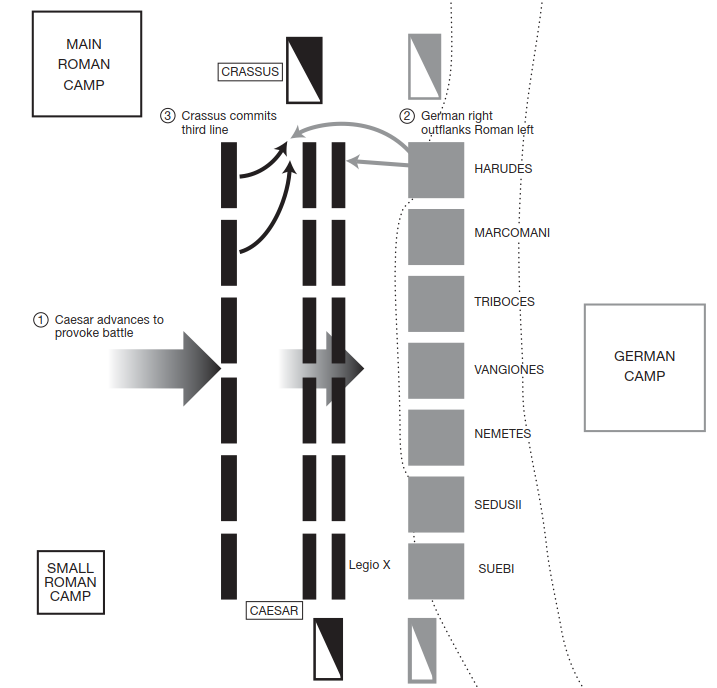
Fig. 1. Battle against Ariovistus showing the deployment of Roman legions in triplex acies and the tactical counter-attack by Publius Crassus on the left flank.
The Battle of Alsace and the Total Defeat of Ariovistus. Caesar deployed his entire force of six legions in triplex acies, stationing the newer Eleventh and Twelfth Legions between veteran units to ensure structural cohesion. Caesar positioned himself on the Roman right flank, intending to strike at the weakest section of the German line. Ariovistus deployed his army into seven tribal contingents (including the Harudes, Marcomani, Triboci, Vangiones, Nemetes, Sedusii, and Suebi), placing their wagons and families behind the battle line to prevent retreat.
| Contingent / Force Element | Operational Role and Tactical Function |
| Harudes | Tribal infantry block positioned on the main German front line. |
| Marcomani | Tribal infantry block occupying the central-right tactical sector. |
| Triboci | Tribal infantry contingent providing central line support. |
| Vangiones | Middle tribal unit reinforcing the frontline cohesion. |
| Nemetes | Tribal infantry contingent deployed in the left-center sector. |
| Sedusii | Tribal infantry unit defending the main line against Roman assault. |
| Suebi | Core tribal contingent occupying the left flank of the German array. |
| Mixed Cavalry / Centeni | Light infantry support trained to operate alongside cavalry. |
| Legio X (Tenth Legion) | Anchor of the Roman right flank under Caesar's direct command. |
| Reserve Cavalry | Mobilized under Publius Crassus to reinforce vulnerable sectors. |
Table 1. Structure and Tactical Alignment of Forces at the Battle against Ariovistus.
The battle commenced rapidly, with both sides closing the distance before missile exchanges could occur. The Roman right flank successfully shattered the German left wing; however, the German right flank overwhelmed the Roman left. Recognizing the danger, Publius Crassus, commanding the cavalry, acted independently to commit the cohorts of the third line (triplex acies) to reinforce the struggling Roman left flank. This tactical decision stabilized the line and triggered a full collapse of the German formation. The Germanic forces fled toward the Rhine, pursued ruthlessly by Roman cavalry. Ariovistus escaped across the river, but a large portion of his force was destroyed, and key political figures were captured or killed, including the rescue of Roman envoy Valerius Procillus.
Conclusion. The victory over Ariovistus effectively neutralized the immediate threat of Germanic dominance in Central Gaul and secured Roman hegemony over the region. By concluding two major campaigns—against the Helvetii and Ariovistus—within a single summer, Caesar established firm control over the territory of the Sequani and Aedui. Leaving his legions in winter quarters under the command of Labienus, Caesar returned to Cisalpine Gaul to execute judicial duties and monitor political developments in Rome, setting the stage for subsequent operations deeper into Gaul.
Date added: 2026-09-24; views: 1;