
Tactical Dynamics and Operational Leadership in the Battle of the Sambre (57 BC)
Strategic Context and Force Dispositions prior to the Engagement. Julius Caesar now drove north-west against the Nervii, the largest tribe still willing to fight. After three days, the Roman column was about 10 miles away from the River Sambre, and captives revealed under interrogation that the tribal army was waiting on the far side. They had been joined by the Atrebates and Viromandui, and another tribe, the Atuatuci, were on their way. According to estimates provided by the Remi, the Nervii, Atrebates, and Viromandui had contributed 75,000 men to the coalition army raised earlier in the summer, and Caesar gives the first tribe 10,000 more men in this battle. As historical analyses show, the reliability of these figures is questionable, and their contingents had probably been weakened by earlier operations and further reduced by warriors who had not yet been able to join the army. Caesar's eight legions probably mustered somewhere in the region of 30,000–40,000 men, backed by several thousand cavalry and as many light troops. It seems likely that the Nervii and their allies had at the very least parity of numbers with Caesar's men, and probably a significant numerical advantage, although likely not double the Roman numbers.
The Belgae were determined to fight and had evacuated their women, children, and other non-combatants to places of sanctuary deep in inaccessible marshland. They also possessed intelligence sent secretly by some of the Gauls and Belgae marching with Caesar as allies or hostages. These informants reported that Caesar's normal order of march involved each legion forming up separately, guarding its own baggage train. This structural arrangement meant that the combat troops were split into eight main sections, interspersed with cumbersome lines of servants, carts, and pack animals, making it difficult to form an immediate battle line.
Topographical Analysis and Tactical Vulnerabilities. Such a marching formation made the Romans vulnerable, and the Nervii had picked their ground carefully. While precise spatial certainty regarding the battlefield location remains uncertain, a site within a few miles of Maubeuge appears highly probable. It is possible that the tribe had repelled invaders at this spot before. They evidently knew where Caesar would cross the river, indicating that he was following a well-trodden route used by local tribes for trade and military movements. Low hills rose on either side of the river, which at this time of year was only about 3 feet deep and easily forded. On the far bank, the valley side was open for about 200 paces but was then heavily wooded, allowing the warriors to wait in concealment. On the side from which the Romans were approaching, the ground was broken by lines of thick, high hedges, constructed deliberately by the Nervii to hinder raids by enemy horsemen.
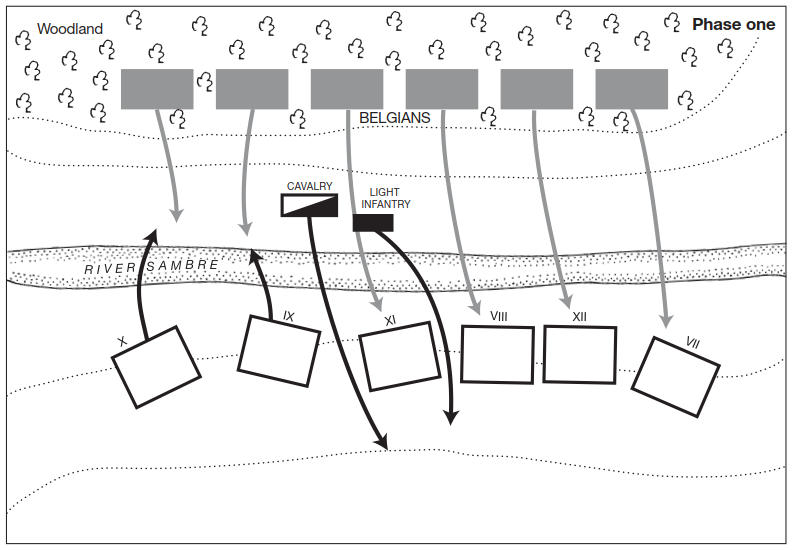
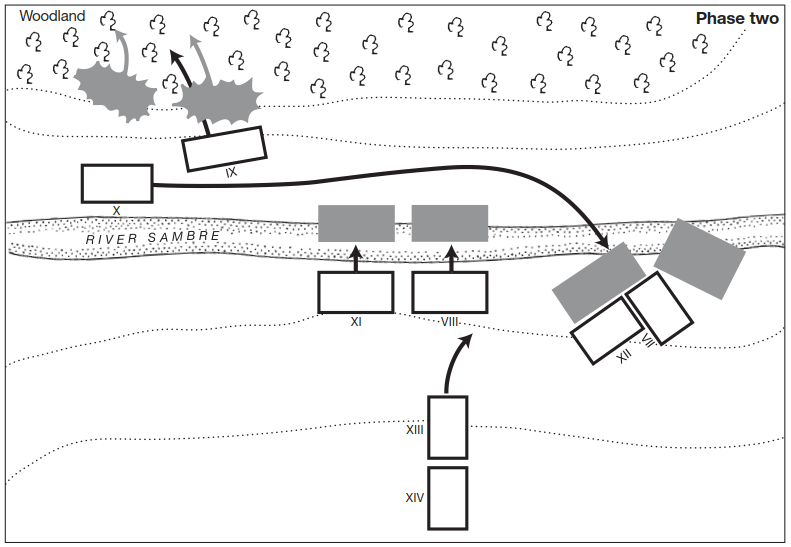
Fig. 1. Battle of the Sambre: Operational tactical maneuvers in Phase One and Phase Two.
Topography and Initial Engagements. These dense hedges constituted a formidable obstacle both to movement and visibility, sending a clear signal that any crossing would be met with resolute resistance by a tribe proud of its martial reputation. Now they intended to demonstrate this by launching an all-out attack as soon as the baggage behind the leading legion came into view. The captive interrogations—conducted by cavalry patrols and reconnaissance scouts—had warned Caesar that the river crossing would be contested. As a result, he altered his march formation, adopting what he claims was his standard deployment when facing an imminent risk of encountering the enemy. Behind the screening force of cavalry and light troops, six experienced legions marched unencumbered by baggage, while all transport assets were massed together and guarded by the two newly raised legions following at the rear. On this day, Legio X was in the lead, followed by Legio IX, Legio XI, Legio VIII, Legio XII, and Legio VII.
Engineering of the Roman Marching Camp. A party of centurions accompanied the forward scouting patrols with the assignment of selecting and marking out the camp site for the night. The construction of a fortified marching camp protected by a perimeter ditch and an earth wall formed from the excavated spoil was standard doctrine for any Roman army in the field, serving as the ancient equivalent of infantry digging in. A camp required several hours to construct but offered vital security against sudden assault, laid out according to a standardized grid so that every unit knew its precise position. The centurions marked out the site on the hill on the near side of the river. When the main force began to arrive, the cavalry and light troops crossed the water to establish a protective screen on the enemy-held bank. Although the bulk of the tribal force remained hidden within the dense forest, small skirmishing parties darted forward to engage the Romans. The Nervii possessed very few cavalry, allowing the Roman auxiliaries to hold their ground in these preliminary skirmishes, though they refrained from pursuing the enemy deep into the woods. As the main legions arrived, the legionaries laid down their packs, piled their helmets, shields, and pila (javelins), and began constructing the camp, though standard orders dictated that they retain their armor while digging. Each legate supervised his respective legion, following Caesar's standing order to remain with the troops until fortification was complete. Small armed detachments were deployed as piquets, but no full-scale defensive battle line was established to cover the laboring troops.
Tactical Risks and Ambush Execution. In the previous year, Caesar had secured the construction of a camp near Ariovistus' army by keeping the first and second lines of his legions in battle array facing the enemy while the third line executed the digging operations. Military historians, including Napoleon Bonaparte, have criticized Caesar for failing to adopt a similar protective posture at the Sambre. Caesar was aware that the enemy was massed beyond the river and had observed active skirmishing on the far bank. However, he may have judged an immediate large-scale attack unlikely due to the advanced hour and the fact that previous encounters had involved passive tribal tactics behind natural barriers. Furthermore, maintaining a large portion of the force under arms would have significantly delayed camp construction. Whether due to a calculated risk or tactical complacency following recent rapid victories, Caesar left his working legions unprotected—a decision that almost proved fatal.
The Belgae displayed impressive tactical discipline, waiting under cover of the woods under the command of the Nervian chieftain Boduognatus. The allied plan called for an assault the moment the Roman baggage train appeared. Despite the unexpected arrival of six combat legions ahead of the train, the tribal warriors remained concealed until the main baggage column emerged on the valley ridge. At that moment, the Belgian forces surged out of the forest and rushed down the slope toward the river. The auxiliary cavalry and light infantry were quickly overrun. Although the charging tribal lines lost some alignment while crossing the river and negotiating the dense hedges, they retained sufficient cohesion to strike the unprepared Romans before a defensive line could be formed. Caesar was forced to manage multiple critical tasks simultaneously: raising the battle standard (vexillum), sounding the trumpet recall for dispersed fatigue parties, forming the battle line, and delivering the customary battle address.
Crisis, Command Interventions, and Personal Leadership. The Initial Crisis and Ad Hoc Formations. Unable to personally direct every sector, Caesar relied on his legates, who began organizing the nearest troops independently. The legionaries and centurions displayed high tactical adaptability, forming ad hoc combat units without taking time to remove the protective leather covers from their shields or attach crests to their helmets. Caesar rode along the line to encourage his troops, reaching Legio X on the left flank. As the Atrebates closed to within 100 yards, a concentrated volley of pila launched by Legio X broke the initial momentum of the charge. Capitalizing on the high ground, Legio X and the adjacent Legio IX drove the fatigued Atrebates back down the slope and across the river. In the center, Legio XI and Legio VIII successfully repulsed the Viromandui, pushing them back to the water's edge.
The Critical Threat to the Right Flank. While the Roman left and center achieved success, the main force of the Nervian attack, led directly by Boduognatus, slammed into the exposed Roman right wing. The presence of high hedges severely restricted communication and visibility between sectors. Upon arriving at the right flank, Caesar found Legio XII and Legio VII severely compressed and under extreme pressure. In Legio XII, all centurions of the fourth cohort were dead, the signifer was killed, the battle standard was captured, and senior officers—including the primus pilus Sextus Julius Baculus—were incapacitated by severe wounds. Deprived of leadership, elements of the rear ranks were retreating, while the Nervii pressed their advantage on both flanks.
Direct Leadership and Aristocratic Virtus. Recognizing that no tactical reserves remained, Caesar seized a shield from a soldier in the rear ranks and advanced directly into the front line. Calling the centurions by name and encouraging the troops, he ordered the ranks to open up to allow effective use of the gladius (short sword). This direct intervention restored morale and temporarily halted the enemy's momentum. While Roman commanders typically directed operations from behind the main line, Caesar's presence at the immediate point of friction reflected the classical concept of aristocratic virtus. By sharing the immediate physical danger with his men, he re-established operational stability during a critical tactical breakdown.
Tactical Realignment and Final Resolution. During a temporary lull in the intensity of hand-to-hand combat, Caesar redeployed Legio XII and Legio VII, combining their formations into a defensive hollow square or circle to secure their flanks against encirclement. Modern analyses emphasize that ancient hand-to-hand combat occurred in short, intense bursts rather than continuous fighting, allowing commanders opportunities to reorganize formations during lulls. The crisis was ultimately resolved when the two rear guard legions—Legio XIII and Legio XIV—arrived to secure the camp site and reinforce the battle line. Simultaneously, Titus Labienus, having secured the far bank with Legio X, observed the critical state of the right wing and dispatched Legio X back across the river to strike the Nervii in the rear.
Surrounded and attacked from multiple directions, the Nervii continued to fight with extreme tenacity, but their combat cohesion was completely shattered. Though Caesar's recorded casualty figures for the Nervii—claiming only 500 survivors from an army of 60,000—represent significant rhetorical exaggeration, the tribe suffered catastrophic operational losses. The tactical victory at the Sambre established Roman control over the Belgae territory, highlighting the decisive role of unit-level discipline and personal command under conditions of tactical surprise.
Date added: 2026-09-24; views: 2;