
Atmospheric Aerosols: Sources, Climate Forcing, and Dynamics
Radiative and biogeochemical impacts of atmospheric aerosols govern planetary energy balance and climate dynamics. Aerosols affect the radiative balance of the atmosphere by absorbing and scattering radiation, by altering cloud albedo, and through precipitation. Their primary radiative effect is to increase planetary albedo, and aerosols generally have a negative radiative forcing. However, black carbon (commonly called soot) is an absorbing aerosol that heats the atmosphere, and its deposition on snow and ice decreases surface albedo, resulting in a positive radiative forcing. Aerosols also exert indirect effects by altering biogeochemical cycles. Mineral aerosols affect climate directly by altering the radiative balance of the atmosphere and indirectly by fertilizing ecosystems. Dust emissions may initiate a positive land-atmosphere feedback that enhances drought. Fires influence climate through emissions of long-lived greenhouse gases, organic and black carbon aerosols, and short-lived reactive gases.
Atmospheric oxidation capacity and short-lived climate forcing agents mediate net radiative effects and atmospheric chemistry. Emissions from fires produce ozone (O₃), alter the oxidation capacity of the troposphere through the hydroxyl radical (OH), and thereby affect the atmospheric concentration of methane (CH₄). The net radiative forcing of fires is the balance of these biogeochemical emissions and biogeophysical effects from changes in surface albedo and energy fluxes. It is estimated that fires provide a negative radiative forcing. They may also decrease precipitation in a positive feedback whereby biomass burning promotes drought and greater susceptibility to fire. Plants emit numerous biogenic volatile organic compounds (BVOCs). Oxidation of these BVOCs in the presence of nitrogen oxides (NOₓ) forms O₃. Emissions of BVOCs also reduce the oxidation capacity of the atmosphere (OH), decreasing the atmospheric sink for CH₄ and increasing its lifetime in the atmosphere. Chemical transformations also produce secondary organic aerosols (SOA). Emissions of BVOCs are thought to provide a negative radiative forcing, but this is likely to diminish in the future because of human activities. Chemistry-climate interactions from short-lived climate forcers (NOₓ, BVOCs, O₃, CH₄, and SOA) are now recognized as being significant and comparable in magnitude to other climate forcings. The aerosol effects of dust, fire, and BVOCs, as well as their chemistry-climate interactions, are important feedbacks with climate change.
Fundamental physical properties and aerosol classification dictate particle behavior and atmospheric persistence. Aerosols are small solid and liquid particles suspended in the atmosphere. They have a variety of sizes and compositions, typically ranging in size from a few nanometers to tens of micrometers, and are commonly seen as dust, smoke, or haze. These aerosols directly affect climate by absorbing or scattering atmospheric radiation and have other indirect effects such as altering clouds and precipitation by acting as cloud condensation nuclei (CCN) or ice nuclei. The balance among these processes depends on the type of aerosol, their abundance, and numerous environmental factors, but the net effect of aerosols is to cool climate. However, aerosols have numerous other climate influences. By decreasing solar radiation at the surface, aerosols reduce the energy available for evapotranspiration. High aerosol concentrations may have decreased evapotranspiration and increased runoff over the twentieth century in polluted regions of North America and Europe (Gedney et al. 2014). Aerosols additionally alter biogeochemical cycles; e.g., by changing the ratio of direct and diffuse radiation aerosols affect gross primary production, and by depositing nutrients to marine and terrestrial ecosystems. These biogeochemical effects may be as important as aerosol-radiation and aerosol-cloud interactions (Mahowald 2011; Mahowald et al. 2011). Changes in emissions of dust and fire aerosols and in the formation of secondary organic aerosols from biogenic emissions are expected to be important feedbacks with climate change (Carslaw et al. 2010).
· Key aerosol species, their primary sources, atmospheric lifetimes, and climate properties (Boucher et al. 2013):
· Sulfate: Marine and volcanic emissions; fossil fuel combustion | Atmospheric lifetime: ~1 week | Climate properties: Light scattering; cloud condensation nuclei (CCN).
· Nitrate: Oxidation of NOₓ | Atmospheric lifetime: ~1 week | Climate properties: Light scattering; CCN.
· Black carbon: Combustion of fossil fuels, biofuels, and biomass | Atmospheric lifetime: 1 week–10 days | Climate properties: Light absorption; CCN.
· Organic: Combustion of fossil fuels, biofuels, and biomass; terrestrial and marine ecosystems | Atmospheric lifetime: ~1 week | Climate properties: Light scattering; CCN.
· Primary biogenic particles: Terrestrial ecosystems | Atmospheric lifetime: 1 day–1 week | Climate properties: CCN and ice nuclei.
· Mineral dust: Wind erosion | Atmospheric lifetime: 1 day–1 week | Climate properties: Light scattering and absorbing; ice nuclei.
· Sea salt: Wave breaking | Atmospheric lifetime: 1 day–1 week | Climate properties: Light scattering; CCN.
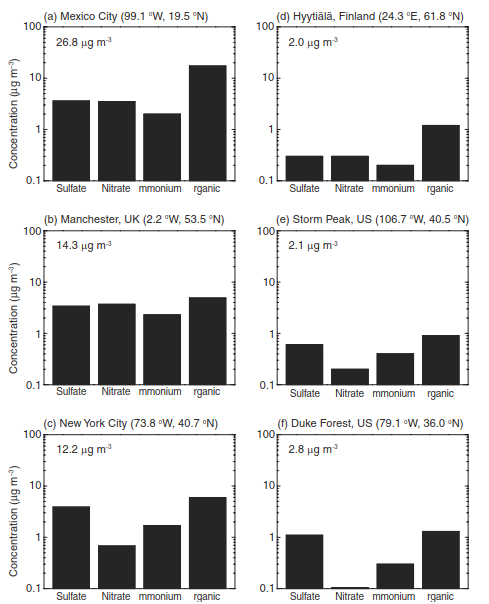
Fig. 31.1. Key aerosols, their sources, tropospheric lifetime, and climate properties. Source: From Boucher et al. (2013).
Atmospheric residence times and intercontinental transport pathways facilitate regional-to-global scale impacts. The lifetime of aerosols in the troposphere is typically on the order of days to weeks. They are removed by wet deposition in precipitation and by dry deposition from turbulent motions and gravitational settling. However, volcanic aerosols can remain in the stratosphere for several years. Plumes of desert dust and smoke can extend for several hundreds of kilometers and travel long distances. In this manner, desert dust from Africa travels across the Atlantic Ocean to the Caribbean and the Amazon, Asian dust and anthropogenic aerosols cross the Pacific Ocean to North America, and black carbon from wildfires falls on snow and ice in the Arctic.
Chemical categorization and natural versus anthropogenic source strengths quantify global aerosol budgets. Aerosols are broadly categorized as: inorganic (sulfate, SO₄²⁻; nitrate, NO₃⁻; ammonium, NH₄⁺; sea salt, NaCl); organic (containing carbon-carbon bonds); black carbon produced by incomplete combustion of fossil fuels and biomass (e.g., diesel engines during transportation, wildfires, wood and coal burning); mineral dust; and primary biogenic particles. They are further distinguished as primary or secondary aerosols. Primary aerosols originate from direct emissions of particulate matter into the atmosphere. Natural sources of primary aerosols include sea salt from ocean spray, mineral dust, black carbon from wildfires, organic carbon from wildfires, and primary biogenic particles.
· Annual source estimates of key aerosol types (Andreae and Rosenfeld 2008; Mahowald et al. 2011; Boucher et al. 2013):
· Sea salt: Total annual emission of 10,100 Tg yr⁻¹.
· Mineral dust: Total annual emission of 1,600 Tg yr⁻¹.
· Primary biogenic particles: Total annual emission of 110 Tg yr⁻¹.
· Primary organic aerosols: Total annual emission of 95 Tg yr⁻¹.
· Biomass burning component: 54 Tg yr⁻¹.
· Fossil fuel component: 4 Tg yr⁻¹.
· Biogenic component: 35 Tg yr⁻¹.
· Black carbon: Total annual emission of 10 Tg yr⁻¹.
· Biomass burning component: 6 Tg yr⁻¹.
· Fossil fuel component: 4 Tg yr⁻¹.
· Sulfates: Total annual emission of 200 Tg yr⁻¹.
· Biogenic component: 57 Tg yr⁻¹.
· Volcanic component: 21 Tg yr⁻¹.
· Anthropogenic component: 122 Tg yr⁻¹.
· Nitrates: Total annual emission of 18 Tg yr⁻¹.
· Secondary organic aerosols: Total annual emission of 28 Tg yr⁻¹.
· Biogenic component: 25 Tg yr⁻¹.
· Anthropogenic component: 3 Tg yr⁻¹.
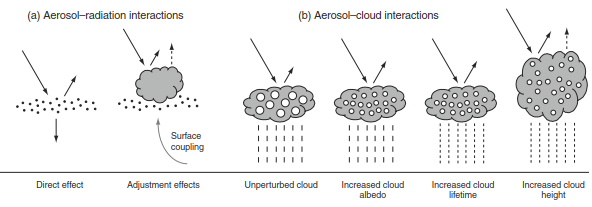
Fig. 31.2. Annual sources of aerosols. Note: Annual source estimates have large uncertainty (Boucher et al. 2013). Source: From Andreae and Rosenfeld (2008) and Mahowald et al. (2011).
Atmospheric chemistry of secondary aerosols and biogenic interactions describes gas-to-particle conversion mechanisms. Primary biogenic particles include pollen, fungal spores, bacteria, and plant debris. Secondary aerosols are produced from gaseous emissions as products of chemical reactions in the atmosphere in a gas-to-particle conversion. For example, sulfur dioxide (SO₂) emitted by volcanoes or during fossil fuel combustion produces the secondary inorganic aerosol sulfate. Sulfate aerosols also form when dimethyl sulfide (CH₃SCH₃) is produced in the oceans by phytoplankton. This is the largest natural emission of sulfur gas to the atmosphere, where it is converted to sulfate aerosols. Ammonia (NH₃) and nitrogen oxides (NOₓ) produce ammonium nitrate and ammonium sulfate aerosols. Secondary organic aerosols result from emissions of biogenic volatile organic compounds such as isoprene and monoterpenes from vegetation, which undergo chemical transformations to produce aerosols, and from chemical emissions during wildfires. Anthropogenic aerosols arise from fossil fuel combustion, which emits black carbon and organic carbon, SO₂, and NOₓ; from biomass burning (black carbon and organic carbon); and from dust created by overgrazing and deforestation.
Geographic variability in aerosol mass and urban-rural contrasts demonstrate pronounced spatial heterogeneity. There is large geographic variability in aerosol mass concentration and composition. Urban locations have considerably higher concentrations than rural locations. Several types of aerosols are common throughout the world (Boucher et al. 2013). Organic aerosols comprise a substantial fraction of aerosol mass (with diameter less than 10 µm) in many locations. Sulfate is about 10–30 percent of aerosol mass in much of the world, and the concentrations of ammonium and nitrate are less (4% and 6%, on average). Black carbon is less than 5 percent of aerosol mass in most areas, though it can be larger (12%) in urban Europe, urban Africa, and regions of South America and Asia where combustion sources are prevalent. Mineral dust is a large component of aerosol mass in South Asia and China (35%). Sea salt is dominant at remote oceanic locations (50–70% of aerosol mass).
· Submicron aerosol mass concentrations across global urban and rural observation sites (Zhang et al. 2007; Jimenez et al. 2009; Boucher et al. 2013):
· Mexico City (99.1 °W, 19.5 °N): Total concentration = 26.8 µg m⁻³.
· Manchester, UK (2.2 °W, 53.5 °N): Total concentration = 14.3 µg m⁻³.
· New York City (73.8 °W, 40.7 °N): Total concentration = 12.2 µg m⁻³ (summer).
· Hyytiälä, Finland (24.3 °E, 61.8 °N): Total concentration = 2.0 µg m⁻³.
· Storm Peak, US (106.7 °W, 40.5 °N): Total concentration = 2.1 µg m⁻³.
· Duke Forest, US (79.1 °W, 36.0 °N): Total concentration = 2.8 µg m⁻³.
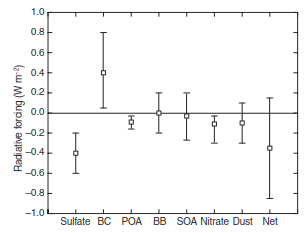
Fig. 31.3. Mass concentration of submicron sulfate, nitrate, ammonium, and organic aerosols in urban (a–c) and rural (d–f) locations. Data for New York City and Manchester are for summer. The number in each panel is the total concentration. Data from Jimenez et al. (2009). See also Zhang et al. (2007) and Boucher et al. (2013).
Regional aerosol plumes and biosphere-atmosphere coupling highlight severe environmental impacts across pristine and industrial domains. Aerosols are extensive in many regions of the world, as a brownish haze in the atmosphere over India and Southeast Asia, dust and haze plumes extending from Asia east over the Pacific Ocean, and biomass burning and dust plumes extending from North Africa west over the subtropical Atlantic Ocean (Ramanathan et al. 2001). Aerosols can also be found in seemingly remote, pristine locations of the world. One such area is the Amazon (Martin et al. 2010; Pöschl et al. 2010). Biomass burning within the basin generates numerous particles, as do primary biogenic particles from pollen, spores, bacteria, and plant debris. Copious emissions of biogenic volatile organic compounds and their photochemical oxidation in the atmosphere generate a high abundance of secondary organic aerosols. Marine aerosols are imported into the region from the Atlantic Ocean. Winds transport dust and biomass burning particles across the Atlantic from Africa. In the wet season (December–March), the heavy rainfall removes these aerosols through wet deposition and limits the occurrence of fire. However, large areas are covered by smoke from biomass burning during the dry season (June–September). A high abundance of aerosols emitted or formed within the Amazon, which serve as nuclei for clouds and precipitation, suggests an active biogeochemical coupling between the biosphere and atmosphere that sustains the hydrologic cycle (Pöschl et al. 2010).
Date added: 2026-09-24; views: 1;