
Biogenic Volatile Organic Compounds: Impacts on Atmospheric Chemistry and Climate
Biogenic Volatile Organic Compounds (BVOCs) play a crucial role in regulating atmospheric chemistry, air quality, and global climate processes through complex biogeochemical and biogeophysical interactions. Terrestrial plants actively exchange hundreds of trace organic chemical species with the atmosphere, many of which are recognized as natural scents and aromas (such as those emitted by pine and eucalyptus trees). High-precision measurements conducted over an orange grove in California identified 494 distinct compounds actively exchanged between plants and the surrounding atmosphere (Park et al. 2013).
H2 Classes and Biochemical Functions of BVOCs. Excluding methane, the major classes of BVOCs consist of isoprenoids, which are non-methane hydrocarbons (NMHCs) comprising only hydrogen and carbon atoms:
· Isoprene (C₅H₈).
· Monoterpenes (C₁₀H₁₆), composed of two isoprene units.
· Sesquiterpenes (C₁₅H₂₄), containing three isoprene units.
Other non-methane hydrocarbons include ethene (C₂H₄) and propene (C₃H₆). Another broad group encompasses oxygenated organic compounds, which contain oxygen atoms in their molecular structure:
· Methanol (CH₃OH).
· Ethanol (C₂H₅OH).
· Acetone (CH₃COCH₃).
· Acetaldehyde (CH₃CHO).
Plant physiological functions driven by BVOC biosynthesis serve essential protective and ecological adaptations. These compounds safeguard plant tissues against abiotic and biotic environmental stressors, including heat stress, ozone damage, and physical wounding. Furthermore, they act as scents to attract pollinators and function as airborne signaling molecules to deter herbivores, attract natural predators of herbivores, and activate defense mechanisms in neighboring plants (Sharkey et al. 2008; Laothawornkitkul et al. 2009; Loreto and Schnitzler 2010; Peñuelas and Staudt 2010). Approximately 1–2% of the total annual carbon uptake in net primary production is returned to the atmosphere via BVOC emissions (~1 Pg C yr⁻¹) (Guenther et al. 1995, 2012).
H2 Atmospheric Transformations and Chemistry-Climate Feedbacks. Concentration levels of isoprene, monoterpenes, sesquiterpenes, and other BVOCs in the troposphere remain relatively low (ranging from a few parts per trillion to several parts per billion), and their atmospheric lifetime is short (minutes to hours). However, they undergo rapid chemical transformations that substantially affect atmospheric chemistry and global climate system dynamics (see Fig. 31.8).
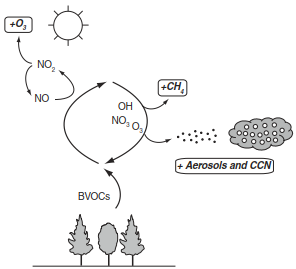
Fig. 31.8. Effects of BVOC emissions on atmospheric chemistry and climate through the photochemical production of tropospheric ozone (O₃); the oxidation of BVOCs by the hydroxyl radical (OH), the nitrate radical (NO₃), and ozone resulting in an increase in atmospheric CH₄; and the formation of secondary organic aerosols that affect climate by scattering radiation and serving as cloud condensation nuclei (CCN). Adapted from Peñuelas and Staudt (2010).
Key oxidative reactions involving biogenic compounds occur via interactions with the hydroxyl radical (OH), nitrate radical (NO₃), and ozone (O₃), yielding numerous secondary products within minutes to hours (Atkinson 2000; Fuentes et al. 2000; Atkinson and Arey 2003). These chemical pathways form critical feedbacks that govern the global climate system:
· Deplete concentrations of atmospheric OH radicals.
· Facilitate the production of secondary organic aerosols (SOAs) and tropospheric ozone.
· Extend the atmospheric lifetime of methane (CH₄) (Andreae and Crutzen 1997; Laothawornkitkul et al. 2009; Pacifico et al. 2009; Peñuelas and Staudt 2010).
Rapid oxidation of isoprene, monoterpenes, and sesquiterpenes by OH reduces the available concentration of OH radicals, which serve as the primary atmospheric sink for CH₄, thereby increasing methane's atmospheric lifetime. In the presence of sunlight and high levels of NOₓ from fossil fuel combustion, BVOCs react to form tropospheric ozone. Conversely, in low-NOₓ environments, these BVOCs react directly with ozone, leading to ozone destruction.
Organic aerosols comprise a significant fraction of total aerosol mass concentration (see Fig. 31.1), with secondary organic aerosols accounting for a large portion. Volatile organic compounds represent a chief natural precursor of SOAs, where plant emissions of BVOCs produce aerosols through oxidation with OH, NO₃, and O₃.
H2 Emission Dynamics across Major BVOC Compounds. Isoprene is the most abundant BVOC, produced by numerous tree species including oaks, poplars, and eucalyptus, though its emission rate is highly species-dependent (Keenan et al. 2009). Emission rates increase with greater sunlight and higher temperatures up to a thermal optimum. However, emissions are inhibited by elevated atmospheric CO₂ concentrations, prolonged drought stress, and exposure to ozone damage (Grote and Niinemets 2008; Laothawornkitkul et al. 2009; Pacifico et al. 2009; Peñuelas and Staudt 2010).
Foliar structural traits strongly influence isoprene production variations across different species:
· Emission rates are higher in shade-intolerant, early successional species than in shade-tolerant species.
· Emissions increase with high photosynthetic capacity, short leaf lifespan, and low leaf mass per unit area (Harrison et al. 2013).
Global emission inventories derived from numerical models estimate annual isoprene production at approximately 450–750 Tg yr⁻¹ (or 400–660 Tg C yr⁻¹) (Guenther et al. 1995, 2006, 2012; Arneth et al. 2008). Carbon accounts for ~88% of the molecular mass of isoprene and monoterpenes.
Monoterpene emissions are considerably lower in volume, totaling about 35–160 Tg yr⁻¹ (30–140 Tg C yr⁻¹). A principal species is α-pinene, found in many conifer trees (especially pine) and responsible for a distinct scent. Other common monoterpenes include β-pinene (pine-like scent) and limonene (citrus scent). Tropical and temperate broadleaf forests are significant emitters of isoprene, whereas boreal coniferous forests are strong emitters of monoterpenes.
Global BVOC emissions sum to approximately 1000 Tg yr⁻¹ (Guenther et al. 2012). Isoprene comprises fully one-half of these total global emissions (see Table 31.5).
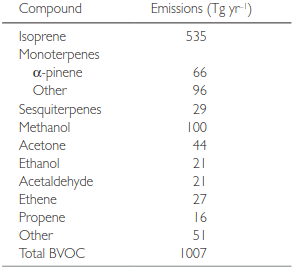
Table 31.5. Global annual BVOC emissions. Source: Adapted from Guenther et al. (2012).
H2 Geographical Distribution and Fractional Roles. Monoterpenes and sesquiterpenes comprise 16% and 3% of total global BVOC emissions, respectively. Almost one-half of total monoterpene emissions consists of α-pinene. Oxygenated BVOCs (methanol, 10%; acetone, 4%; ethanol, 2%; acetaldehyde, 2%), ethene (3%), and propene (<2%) collectively account for nearly one-quarter of total emissions.
Spatial distribution patterns of global emission sources display strong biome dependencies:
· Tropical trees emit ~80% of global isoprene and monoterpene emissions and about one-half of other BVOC emissions.
· Temperate forests account for about 10% each of global isoprene, monoterpene, and other BVOC emissions.
· Monoterpene emissions exceed isoprene emissions in temperate and boreal conifer forests.
H2 Aerosol Formation and Radiative Forcing Impacts. The formation of secondary organic aerosols from BVOCs is complex, and their precise radiative forcing retains uncertainty. However, studies find that biogenic SOAs provide a negative radiative forcing (cooling effect). This cooling impact is particularly evident in boreal forests at northern high latitudes, where conifer forests act as strong emitters of monoterpenes (Tunved et al. 2006).
Seasonal productivity cycles in conifer stands correlate closely with aerosol formation due to elevated monoterpene release (Kulmala et al. 2004). Model simulations demonstrate that boreal forest BVOC emissions exert a negative radiative forcing on climate through cloud-albedo interactions (Spracklen et al. 2008; Scott et al. 2014). Atmospheric measurements in Finland confirm a negative radiative forcing from biogenic aerosol formation over boreal forests (Kurtén et al. 2003; Lihavainen et al. 2009).
H2 Anthropogenic Disturbances and Global Climate Feedbacks. Climate warming trends are expected to increase BVOC emissions, creating a negative climate feedback due to higher aerosol concentrations that cool temperatures (Carslaw et al. 2010). However, leaf-scale responses may not manifest uniformly at regional or continental scales due to complex environmental interactions (Sharkey and Monson 2014). Inhibition of isoprene emissions by elevated atmospheric CO₂ concentrations counters the expected increase from warmer temperatures (Arneth et al. 2007; Heald et al. 2009).
Land use and cover changes driven by human activity are critical determinants of BVOC emissions. Over the twentieth century, global isoprene emissions decreased because warming-induced increases were offset by elevated CO₂ suppression and deforestation that replaced high-emitting forests with low-emitting croplands and pastures (Lathière et al. 2010; Unger 2013).
Twenty-first century land transitions will strongly govern BVOC emissions and chemistry-climate interactions. Tropical deforestation reduces isoprene emissions (Lathière et al. 2006). Land cover changes throughout this century will exert a greater effect on isoprene emissions than warming and elevated CO₂ (Guenther et al. 2006; Heald et al. 2008; Chen et al. 2009; Wu et al. 2012; Tai et al. 2013; Squire et al. 2014). Conversely, tree planting for carbon sequestration and biofuel crop expansion (oil palm, eucalyptus, poplar, willow) increases emissions (Ashworth et al. 2012; Hardacre et al. 2013). Biofuel cultivation in Europe increases ozone levels, potentially offsetting air quality improvement policies (Ashworth et al. 2013).
In the southern United States and eastern seaboard, high BVOC emissions contribute to elevated regional ozone and form a regional cooling haze (Chameides et al. 1988; Goldstein et al. 2009). Timber harvesting, forest management, and succession alter leaf area and community composition, shifting overall BVOC flux (Purves et al. 2004).
Disturbance regime shifts also impact emission dynamics:
· Fires emit large quantities of BVOCs during biomass combustion, altering regional ozone formation (Ciccioli et al. 2014).
· Pine beetle infestations (Dendroctonus ponderosae) in western North America increase monoterpene emissions under attack, temporarily enhancing SOA formation (Amin et al. 2012; Berg et al. 2013). Long-term tree mortality ultimately reduces total monoterpene emissions (Berg et al. 2013).
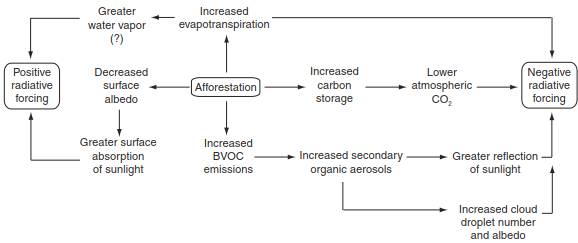
Fig. 31.9. Biogeophysical (albedo, evapotranspiration) and biogeochemical (carbon, aerosols) processes by which increased tree cover in the boreal forest affects climate. The positive radiative forcing from increased water vapor is uncertain and pertains to deciduous trees. Adapted from Spracklen et al. (2008).
Biosphere-climate feedback loops operate through increased forest productivity in a warmer, CO₂-enriched world, which enhances BVOC emissions and SOA cooling (Kulmala et al. 2004; Paasonen et al. 2013). Diffuse radiation generated by high aerosol loading further stimulates forest productivity (Kulmala et al. 2014). In a 40-year-old Scots pine stand (Pinus sylvestris) in Finland, biogenic aerosols augment the negative radiative forcing from carbon sequestration, countering positive forcing from reduced surface albedo (Kurtén et al. 2003). Comprehensive biogeophysical and biogeochemical understanding confirms the critical role of boreal forests in Earth system dynamics (see Fig. 31.9) (Spracklen et al. 2008).
Date added: 2026-09-24; views: 1;