
Climate Geoengineering: Adaptation, Mitigation, and Ecosystem Dynamics
Interdisciplinary Perspectives on Climate Geoengineering and Land Use. Geoengineering represents the purposeful, large-scale intervention in Earth's climate system designed to alter regional or global climatic conditions and counteract anthropogenic climate change. These technical methodologies are fundamentally categorized into solar radiation management (SRM) and carbon dioxide removal (CDR). When implemented on terrestrial systems, geoengineering strategies include increasing surface albedo, modifying agricultural land management to curb greenhouse gas emissions, carrying out large-scale afforestation and reforestation to expand carbon sinks, and deploying bioenergy systems to displace fossil fuel emissions. In urban environments, architectural interventions such as cool roofs (white roofs) and vegetated green roofs offer practical localized solutions to mitigate the urban heat island effect.
Biogeophysical and Biogeochemical Interactions. While the management of terrestrial ecosystems for carbon sequestration has been extensively researched, comprehensive evaluations require equal consideration of biogeophysical consequences—primarily alterations to albedo and evapotranspiration rates—alongside expected biogeochemical benefits. Throughout the twenty-first century, strategic land-use choices will yield complex biogeophysical and biogeochemical feedbacks that may either reinforce or directly counteract one another. Beyond the carbon cycle, land-use modifications significantly disrupt the cycling of reactive nitrogen, alter emissions of mineral dust and biomass burning aerosols, and change the release of biogenic volatile organic compounds (BVOCs). Because each of these factors introduces substantial chemistry-climate feedbacks, evaluating land-use impacts requires an integrative, interdisciplinary framework to prevent unintended environmental consequences.
Frameworks for Air Quality and Socioeconomic Integration. A significant proportion of biogenic emissions directly influences atmospheric chemistry and regional air quality. Consequently, policy frameworks addressing air pollution control and climate change mitigation must be integrated into a unified regulatory strategy. To successfully balance the climatic, ecological, and socioeconomic trade-offs inherent in land allocation, modern Earth system models are actively incorporating socioeconomic decision-making dynamics into their predictive frameworks.
Adaptation, Mitigation, and Geoengineering Interrelationships. Ongoing climate disruption poses severe risks to fundamental human and natural systems, compromising global food availability, freshwater resources, public health, and socioeconomic stability. Humanity relies on three primary conceptual approaches to address these challenges: adaptation, mitigation, and geoengineering. According to established scientific frameworks (Allwood et al., 2014), adaptation represents targeted adjustments within human or natural systems to moderate harm or exploit beneficial opportunities arising from climate change. Mitigation denotes direct human interventions aimed at reducing greenhouse gas sources or enhancing carbon sinks, focusing explicitly on managing emission pathways (Allwood et al., 2014).
Interactions Across Response Paradigms. In practice, significant operational overlap exists among adaptation, mitigation, and geoengineering strategies (Boucher et al., 2014). For instance, implementing urban white roofs or green roofs functions as a local adaptation to extreme heat while simultaneously modifying microclimatic conditions. Similarly, sustainable agricultural techniques such as no-till farming preserve crop yield stability in warming environments (adaptation), reduce agricultural emissions (mitigation), and increase surface albedo (geoengineering). Ultimately, regardless of classification, these approaches share the common objective of intervening in Earth's energy, hydrological, and biogeochemical cycles to minimize the adverse impacts of human-induced climate change.
Conceptual Overview of Geoengineering Technologies. Climate geoengineering encompasses both direct atmospheric management and large-scale terrestrial or oceanic interventions (Figure 33.1). Solar radiation management aims to increase overall planetary albedo to reflect incoming solar energy (Crutzen, 2006; Lenton and Vaughan, 2009; Vaughan and Lenton, 2011; Boucher et al., 2013, 2014; Caldeira et al., 2013). Conversely, carbon dioxide removal targets the extraction and long-term storage of atmospheric CO₂ through natural or engineered sinks.
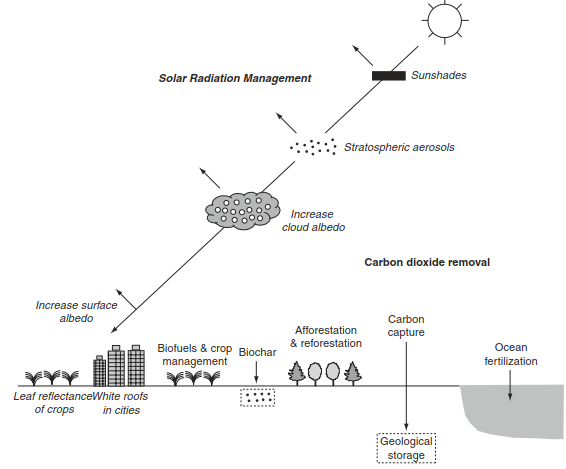
Fig. 33.1. Overview of various climate geoengineering methods to mitigate anthropogenic climate change by solar radiation management to reflect sunlight (italic text) and carbon dioxide removal (semi-bold text). Adapted from Lenton and Vaughan (2009) and Vaughan and Lenton (2011).
Mechanisms and Dynamics of Solar Radiation Management. The primary objective of solar radiation management is to increase planetary albedo, thereby decreasing absorbed solar radiation to offset greenhouse-gas-driven thermal forcing. Proposed mechanisms include deploying space-based sunshades or mirrors, increasing marine cloud albedo via sea-salt aerosol injection, and injecting sulfate aerosols directly into the stratosphere.
Climatic Trade-offs in SRM Deployment. Theoretical modeling indicates that a 4% to 5% reduction in top-of-atmosphere solar insolation could largely compensate for the global surface warming associated with a quadrupling of atmospheric CO₂ concentrations. However, SRM deployment exhibits pronounced spatial heterogeneity and induces significant shifts in global precipitation patterns, creating fundamental trade-offs between temperature normalization and hydrological disruption (Kravitz et al., 2013, 2014; Tilmes et al., 2013). Furthermore, SRM interventions introduce complex changes in extreme temperature and precipitation events (Tilmes et al., 2013; Curry et al., 2014). While planetary shades, sea-salt injection, and stratospheric sulfate aerosols effectively induce cooling, their operational efficacy and hydrological impacts vary substantially (Niemeier et al., 2013). Stratospheric aerosol injection also alters atmospheric chemistry, introducing risks such as stratospheric ozone depletion (Tilmes et al., 2008; Pitari et al., 2014).
Terrestrial and Urban Albedo Modification. Enhancing terrestrial surface albedo offers a localized mechanism for cooling regional surface climates (Ridgwell et al., 2009; Singarayer et al., 2009; Doughty et al., 2011; Irvine et al., 2011; Caldeira et al., 2013). Raising the leaf reflectance of agricultural crops can reduce solar absorption across major farming regions such as North America and Eurasia; however, biological constraints limit maximum achievable leaf reflectance. Furthermore, broad changes in land surface albedo disrupt local hydrological cycles and can reduce regional precipitation due to enhanced atmospheric subsidence (Bala and Nag, 2012). Alternative proposals include applying highly reflective materials to desert regions (Irvine et al., 2011) or installing white surfaces on urban rooftops to lower ambient urban temperatures. Because urban and agricultural albedo modifications yield localized climate effects without directly altering global atmospheric greenhouse gas concentrations, they are frequently categorized as adaptation measures rather than true global geoengineering (Boucher et al., 2014).
Carbon Dioxide Removal and Terrestrial Sink Management. Carbon dioxide removal techniques aim to extract CO₂ directly from the atmosphere by bolstering natural carbon sinks or constructing artificial removal pathways (Lenton and Vaughan, 2009; Vaughan and Lenton, 2011; Caldeira et al., 2013; Ciais et al., 2013; Boucher et al., 2014). Methods range from industrial direct air capture (DAC) paired with geological storage to ocean iron fertilization designed to stimulate biological carbon pumps.
Terrestrial Carbon Sequestration Pathways. Terrestrial ecosystems present multiple avenues for enhancing land carbon sinks. Key strategies include:
· Afforestation and reforestation initiatives that sequester atmospheric carbon into growing biomass.
· Biochar production through pyrolysis, creating a stable, recalcitrant form of carbon that provides long-term soil carbon storage.
· Bioenergy systems paired with dedicated energy crops (e.g., dedicated forests, switchgrass, miscanthus, sugarcane) that capture carbon while replacing fossil fuel emissions.
· Avoided deforestation practices, which prevent the release of stored terrestrial carbon into the atmosphere.
Intersectoral Classification of Ecosystem Interventions. Within climate policy frameworks, carbon removal strategies fulfill dual designations: they represent mitigation by directly reducing net emissions and geoengineering by intentionally manipulating Earth's carbon system. Effective management of forests, grasslands, and agricultural soils is central to global mitigation agendas (Smith et al., 2008, 2014). Straightforward land-management policies prioritize afforestation, reforestation, and avoided deforestation to maintain the global carbon balance.
Biogeochemical Cascades and Integrated System Dynamics. Quantifying the contribution of terrestrial sinks relies on understanding coupled carbon cycle-climate interactions, which dictate permissible anthropogenic emission thresholds for climate stabilization targets. Expanding land carbon sinks reduces the magnitude of fossil fuel emission cuts required to meet temperature goals. However, land-use and land-cover changes simultaneously alter physical land characteristics, modifying surface albedo, surface roughness, and the partitioning of net radiation into sensible and latent heat fluxes. Furthermore, heavy applications of synthetic nitrogen fertilizers on croplands trigger complex biogeochemical consequences throughout the nitrogen cascade. Biosphere modifications also alter biogenic volatile organic compound emissions and atmospheric trace gas exchanges, influencing aerosol formation and short-lived climate forces. Consequently, developing robust climate intervention policies requires an integrative framework that accounts for the full spectrum of biogeophysical and biogeochemical ecosystem interactions.
Date added: 2026-09-24; views: 1;