
Urban Climate Adaptation and Sustainable Built Environment Design
Urbanization Dynamics and Climate Mitigation Strategies. Urban areas represent primary spatial frameworks capable of being planned, designed, and adapted to ongoing global climate change. More than one-half of the world's population currently resides in urban settings (Seto et al., 2014). On a global scale, there are 23 megacities with over 10 million inhabitants, 449 cities with populations exceeding 1 million, and nearly 1,000 urban settlements housing 500,000 or more residents. Projections indicate that approximately two-thirds of the global population will be concentrated in urban areas by 2050. In the context of climate change mitigation, urban planning and architectural design serve as fundamental mechanisms to reduce greenhouse gas emissions (Seto et al., 2014).
The trajectory of urban development over coming decades will dictate fossil fuel consumption patterns and cumulative greenhouse gas emissions. Future growth in urban population and spatial extent necessitates active management of physical urban forms and infrastructural frameworks. Key targeted parameters include:
· Spatial extent and built-environment density.
· Building design and street network geometry.
· Functional land-use mix and zoning patterns.
· Transportation infrastructure and population mobility patterns.
Managing these structural parameters is essential to achieve substantial reductions in CO₂ and other greenhouse gases. Regarding adaptation, urban planning and design provide significant opportunities to mitigate extreme urban thermal conditions through the deployment of urban green spaces, porous pavements, high-albedo ("white") roofs, and vegetated ("green") roofs (Revi et al., 2014). Urban parks exhibit lower ambient temperatures than surrounding built areas, providing a key planning tool to alleviate the urban heat island effect (Bowler et al., 2010). Similarly, utilizing light-colored and permeable pavements instead of dark, impervious asphalt surfaces reduces temperatures through solar radiation reflection and evaporative cooling (Li et al., 2013).
Surface Albedo Enhancement in Urban Infrastructure. Increasing the surface albedo of urban structures (e.g., roofs and pavements) is a widely evaluated strategy to mitigate elevated urban temperatures. An empirical study conducted in New York City evaluated the thermal performance of white and black roofs (Gaffin et al., 2012). White roofs with an albedo of approximately 0.65 reduced peak daytime summer surface temperatures by 24 °C and decreased average daily temperatures by 5–7 °C compared to conventional black roofs. Numerical modeling further demonstrates that higher overall urban albedo directly lowers summer air temperatures (Akbari et al., 2009, 2012; Menon et al., 2010; Oleson et al., 2010; Akbari and Matthews, 2012; Jacobson and Ten Hoeve, 2012; Georgescu et al., 2013b; Li et al., 2014).
Energetic and Thermal Impacts of Highly Reflective Roofs. Lowering internal building temperatures reduces air conditioning energy demands. This outcome yields direct economic cost savings while decreasing waste heat emissions from cooling systems, which otherwise amplify the urban heat island. Many regional modeling studies simulate urban brightening by broadly elevating land surface albedo (Menon et al., 2010; Akbari et al., 2012). Conversely, Oleson et al. (2010) employed a global climate model explicitly resolving urban canyon structures, including streets, walls, roofs, and green spaces. Increasing roof albedo to 0.9 modeled highly reflective surfaces. In New York City, raising roof albedo from ~0.3 in the control simulation to 0.9 reduced the summer urban heat island by 0.5 °C. Averaged across all global urban areas, increasing roof albedo decreases daily maximum temperatures by 0.6 °C. At high northern latitudes during winter, high roof albedo is less effective due to limited solar irradiance, existing snow cover, and potential increases in building heating demands.
Functional Dynamics of Vegetated Green Roof Systems. Rooftop gardens, or green roofs, present another effective approach to alleviate urban heat (Revi et al., 2014). Green roofs operate via evaporative cooling, heat storage within the soil substrate, building insulation against thermal extremes, and canopy shading (Simmons et al., 2008; Getter et al., 2011; Coutts et al., 2013; Li et al., 2014). The effectiveness of green roofs depends on several critical design parameters:
· Soil substrate depth.
· Vegetation composition and canopy structure.
· Rainwater retention and hydrological storage capacity.
The hydrological performance of green roofs regulates the surface energy balance and partitions net radiation into sensible and latent heat fluxes. Securing the thermal benefits of green roofs requires maintaining actively transpiring vegetation cover.
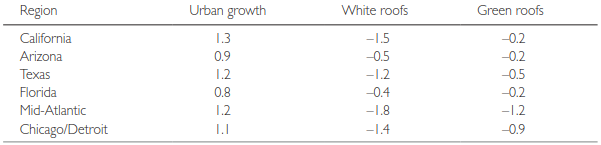
Table 33.4. Summer (June–August) temperature change (°C) in cities due to urban growth over the twenty-first century and with white and green roof adaptation strategies. Note: Temperature is the difference from the control simulation with present-day cities. Source: From Georgescu et al. (2014).
Regional Climate Modeling of Roof Adaptation Strategies. Climate model simulations assess the impact of 21st-century urban expansion across the United States for a projected population of 690 million people by 2100 (Georgescu et al., 2014). Without intervention, urban growth increases summer air temperatures by 1–2 °C in major urban regions, independent of greenhouse gas warming. Both white and green roofs mitigate this warming, but their relative effectiveness varies significantly by geographical region (Table 33.4). White roofs consistently act as a more effective cooling strategy than green roofs: in Florida, white roofs provide an additional 0.2 °C of cooling over green roofs, whereas in California the difference reaches 1.3 °C (Table 33.4). During winter, cooling from white roofs can increase building heating energy demand.
Bioclimatic Design and Natural Landscape Features. Incorporating climatic consideration into the built environment has long been a focus of architectural design (Aronin 1953; Olgyay 1963; Givoni 1976, 1998; Robinette 1983; Lowry 1988; Brown and Gillespie 1995). Hot summer periods require shade and cooling breezes, whereas cold winter conditions demand solar heat gain and wind protection. Vegetated landscapes conserve energy by blocking cold winter winds, shading summer sun, and providing evaporative cooling. Vegetated surfaces also retain and store precipitation more effectively than impervious hardscapes. Building materials and construction techniques can be adapted to reduce energy use and lower greenhouse gas emissions (Lucon et al., 2014).
Topographic, Edaphic, and Microclimatic Adaptations. Modern lifestyles have largely detached building design from natural environmental conditions. Unlike 17th-century colonists in Virginia and Massachusetts who adapted English building techniques to regional climates (Fitch 1948, 1966, 1972), contemporary societies rely on mechanical heating, air conditioning, and artificial irrigation. Nevertheless, topographic, edaphic, and ecological features create distinct microclimatic variations:
· Orographic precipitation generates sharp moisture contrasts between windward and leeward mountain slopes.
· Northeast-facing slopes in the Northern Hemisphere remain several degrees cooler than southwest-facing slopes during summer afternoons.
· Air temperature decreases by approximately 1 °C per 100 m gain in elevation.
· Cold air drains into low-lying areas at night, creating localized nocturnal temperature inversions.
· Oceans and large lakes moderate seasonal temperature swings, while sea breezes reduce summer heat.
· Tree canopies provide cooling shade, and windbreaks reduce structural heat loss from strong winter winds.
Leveraging principles from ecology and climatology enables urban planners and architects to utilize natural landscape features to optimize urban microclimates.
Date added: 2026-09-24; views: 1;