
Biosphere-Atmosphere Feedback Mechanics and Ecosystem Climate Services
Foundations of Earth System Dynamics. It is well known that life depends on climate, and that climate regulates the structure and functioning of terrestrial ecosystems is a foundational principle of geography and ecology. Anthropology demonstrates that climate was central in the development of human societies throughout history. We now know as well that life itself directly influences climate across multiple spatial and temporal dimensions. Numerous biosphere-atmosphere feedbacks are evident at long paleoclimate timescales spanning tens of thousands and millions of years, as well as at the shorter timescale of the past century.
A physical and chemical understanding of climate has expanded to a biological perspective that integrates the biogeophysical and biogeochemical functioning of plants and terrestrial ecosystems. The chemical composition of the atmosphere, alongside its temperature, water vapor content, cloud dynamics, and heat transport mechanisms, are regulated in part by the biosphere. Furthermore, human societies, socioeconomic systems, and political frameworks have emerged over the past several centuries as dominant forces shaping the planet. Added to the physical, chemical, and biological understanding of climate is a modern paradigm that interprets climate change over coming centuries through a socioeconomic lens shaped by human decisions. Life—including soil microbes, higher plant life, and human populations—stands as a primary driver governing Earth's climate system.
Theoretical Principles of Climate-Life Coevolution. The notion that plants and terrestrial ecosystems affect climate and planetary habitability is embodied in the concept of coevolution of climate and life. Numerous foundational works have explored this dynamic (Budyko 1974, 1986; Schneider and Mesirow 1976; Lovelock 1979, 1988; Schneider and Londer 1984; Schneider et al. 2004), underscoring the profound influence terrestrial vegetation exerted on the geologic history of the planet (Beerling 2007). This perspective stems from an emerging recognition that traditional physical and chemical climate models must incorporate the complex biogeophysical and biogeochemical functioning of plants and terrestrial ecosystems.
This view arises from the multitude of anthropogenic perturbations in the Earth system and their multidisciplinary consequences. Carbon dioxide (CO₂) is a principal greenhouse gas central to natural and anthropogenic climate change that additionally alters leaf physiology, disrupts ecosystem functioning, and inhibits plant isoprene emissions. Atmospheric methane (CH₄) and nitrous oxide (N₂O) represent potent greenhouse gases that directly alter atmospheric chemistry. Methane emissions generate tropospheric ozone (O₃) and decrease the oxidizing capacity of the troposphere (specifically the OH radical) via NOₓ-VOC-O₃ chemical dynamics. Nitrous oxide acts as a key agent that destroys stratospheric ozone.
Biogeochemical and Atmospheric Effects of Short-Lived Forcers. Tropospheric ozone serves as another key greenhouse gas that damages leaf tissue, decreases plant photosynthetic productivity, and suppresses the terrestrial carbon sink. Atmospheric aerosols increase planetary albedo, yielding a negative radiative forcing, while inducing indirect radiative effects by altering biogeochemical cycles—such as through ecosystem nutrient fertilization or by enhancing diffuse solar radiation.
Additional reactive nitrogen (Nr) introduced into the Earth system affects concentrations of CO₂, CH₄, N₂O, and ozone, while promoting secondary aerosol formation. Emissions of biogenic volatile organic compounds (BVOCs) alter concentrations of tropospheric ozone, the OH radical, and CH₄, driving the synthesis of secondary organic aerosols (SOAs). Underlying all these interactions is the central role of plants and terrestrial ecosystems, alongside human perturbations that disrupt natural ecosystem functioning.
Paleoclimatic Evidence and Ecosystem Coupling. Interactions between climate and life are evident in numerous terrestrial feedbacks, as systematically categorized in Table 34.1. Climate-vegetation coupling is clearly documented in past climates, where the evolution of leaf size, leaf shape, and stomatal functioning in response to elevated atmospheric CO₂ concentrations altered global climate conditions. This coupling is likewise demonstrated in climate-induced shifts in biogeography that altered surface albedo, evapotranspiration, carbon storage, and reactive gas emissions on land over the Holocene and during earlier glacial cycles.
Changes in the structure and functioning of terrestrial ecosystems over the coming century are expected to influence the future trajectory of climate change. The scientific debate is no longer whether plants and terrestrial ecosystems influence climate or whether these processes should be integrated into Earth system models. Instead, contemporary research focuses on quantifying the precise degree to which climate—from local to regional and global scales—depends directly on biospheric functioning.
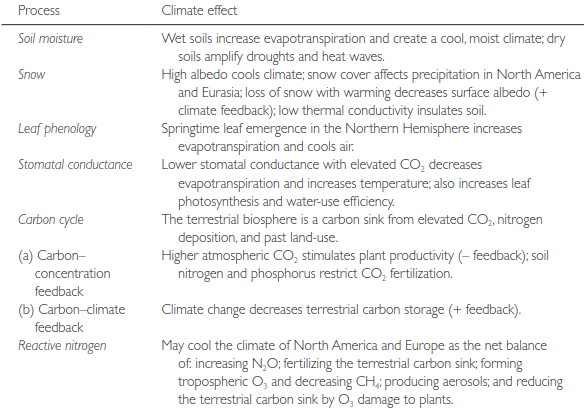
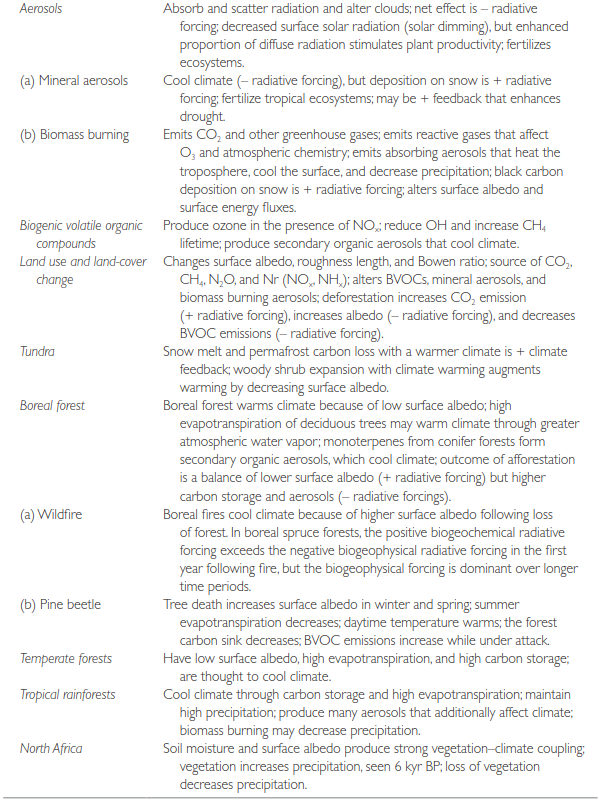
Table 34.1. Key land-atmosphere interactions that affect climate
Socioeconomic Integration in Future Climate Models. Our understanding of Earth's climate has progressed far beyond the isolated physics, chemistry, and biology of the Earth system. It is no longer practical to separate natural and human systems when evaluating climate dynamics. The influence of human populations—driven by fossil fuel combustion, agricultural expansion, deforestation, land clearing, and urbanization—on global climate and atmospheric composition is definitively established.
The climate of future Earth is not simply a physical, chemical, or biological problem. Climate change represents a fundamental socioeconomic dilemma, driven by human actions that emit greenhouse gases, aerosols, and short-lived climate forcers, alter natural landscapes, and co-opt the functioning of terrestrial ecosystems. Indeed, a key avenue of scientific inquiry focuses on establishing precisely when in the course of human history anthropogenic activities first altered the fundamental functioning of the Earth system (Ruddiman 2003, 2007, 2013).
Date added: 2026-09-24; views: 1;