
Global Afforestation and Agricultural Climate Mitigation Dynamics
Radiative Balancing in Global Afforestation Strategies. Scientific evaluation of large-scale afforestation as a climate intervention strategy focuses on the interplay between biogeochemical carbon drawdown and local biogeophysical energy dynamics. Forest management to enhance land carbon uptake serves as a major mechanism to mitigate anthropogenic CO₂ emissions, encompassing the widespread planting of trees on abandoned cropland, pastureland, or marginal land, alongside initiatives to preserve existing carbon sinks. However, forests in mid- to high latitudes exert a net warming influence on local climate primarily due to their low surface albedo relative to open cropland or grassland. While changes in evapotranspiration also modulate surface energy exchange, their precise magnitude carries higher uncertainty. Decreasing surface albedo through temperate and boreal afforestation can counteract the climate benefits gained from carbon sequestration, whereas tropical afforestation and avoided deforestation consistently yield net cooling through synergistic biogeophysical and biogeochemical mechanics.
Modeling Afforestation Scenarios Across Geographic Latitudes. To quantify these competing forcings, Arora and Montenegro (2011) executed Earth system model simulations testing five distinct afforestation scenarios across areas currently occupied by cropland that could ecologically support tree cover. These modeled deployments occurred over a 50-year period (2011–2060) and evaluated:
· 1st scenario: 100 percent global afforestation, converting all existing global cropland into forested land.
· 2nd scenario: 50 percent global afforestation, restricting forest establishment to half of global cropland area.
· 3rd scenario: 50 percent boreal afforestation, limiting tree planting strictly to high-latitude boreal zones.
· 4th scenario: 50 percent northern temperate afforestation, targeting mid-latitude temperate regions.
· 5th scenario: 50 percent tropical afforestation, concentrating afforestation within tropical latitudes.
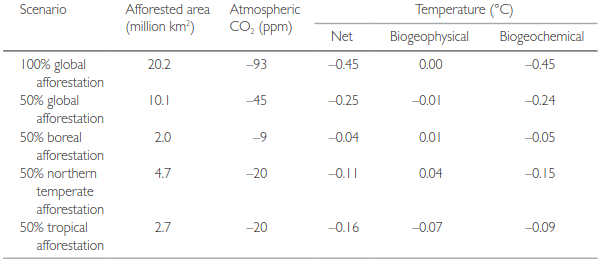
Table 33.3. Impact of afforestation on atmospheric CO₂ and global annual mean temperature. Note: Temperature is the difference of the afforestation simulations compared with a control simulation and is for the period 2081–2100. Atmospheric CO₂ is for 2100. Source: From Arora and Montenegro (2011).
Atmospheric CO₂ Drawdown and Global Thermal Responses. In the control simulation without afforestation, fossil fuel emissions drive sustained atmospheric CO₂ growth and global warming. The implementation of afforestation enhances terrestrial land carbon uptake, lowering atmospheric CO₂ concentrations relative to control levels. As summarized in Table 33.3, complete (100%) global afforestation achieves a 93 ppm drawdown in atmospheric CO₂, while partial (50%) global afforestation cuts CO₂ by 45 ppm. Between 2081 and 2100, 100 percent and 50 percent global afforestation reduce planetary warming by 0.45 °C and 0.25 °C, respectively. Under 100 percent global afforestation, this cooling is distributed globally and stems overwhelmingly from biogeochemical carbon removal (Fig. 33.5).
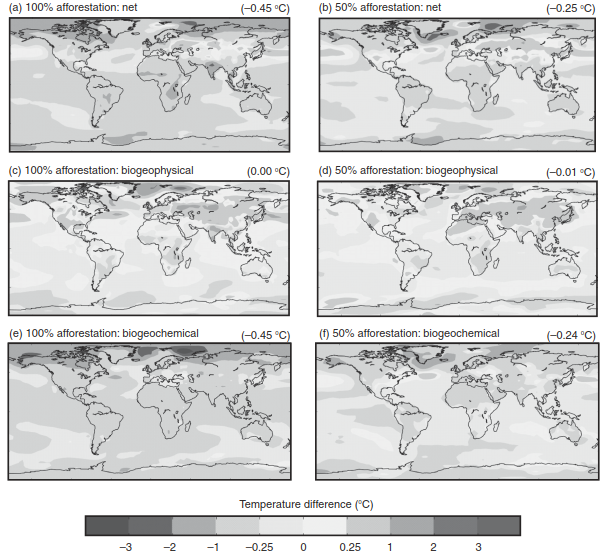
Fig. 33.5. Difference in annual mean temperature due to 100 percent afforestation (left) and 50 percent afforestation (right). Temperature difference is the change over the period 2081–2100 compared with a control simulation without afforestation. Shown are (a, b) the net effect, (c, d) the biogeophysical effect, and (e, f) the biogeochemical effect. The numbers in parentheses are the global average. Adapted from Arora and Montenegro (2011) and provided courtesy of Vivek Arora. See color plate section.
Zonal Discrepancies and Albedo Feedback Mechanisms. Although the global mean biogeophysical impact of 100 percent afforestation averages out to 0.00 °C, strong regional divergence exists (Table 33.3, Fig. 33.5). In high northern latitudes, low canopy albedo absorbs shortwave radiation, driving localized warming that accelerates sea ice loss. Under 50 percent global afforestation, biogeophysical warming becomes relatively more prominent, with albedo-driven warming dominating net temperature responses across parts of Eurasia. When normalized per unit area of land afforested, tropical afforestation reduces temperature three times more effectively (-0.06 °C per million km²) than boreal or northern temperate afforestation (-0.02 °C per million km²) (Table 33.3).
Silvicultural Canopy Management and Albedo Tuning. Mitigating climate change through forest management extends beyond expansion to altering stand structure and species composition (Luyssaert et al., 2014). Canopy albedo varies depending on stand age, canopy architecture, and species composition. In temperate conifer and deciduous forests, silvicultural thinning modifies summer canopy albedo by reducing the leaf area index, producing albedo increases up to 0.02 in visible wavebands and 0.05 in near-infrared wavebands (Otto et al., 2014). Because boreal deciduous species maintain higher albedo than conifers across summer and winter seasons, favoring deciduous trees over conifers provides clear climate benefits (Bright et al., 2014). This effect is further reinforced by higher summertime evapotranspiration rates in deciduous stands.
Agricultural Management and Greenhouse Gas Mitigation. Agricultural land-use dedicated to food, fiber, and livestock production generates substantial emissions of CO₂, CH₄, and N₂O through synthetic fertilizer application, livestock enteric fermentation, manure decomposition, flooded rice cultivation, and mechanized field operations. Optimized agricultural management can attenuate these emissions through several major pathways (Smith et al., 2008, 2014):
· 1st pathway: Increasing crop yield per unit area to minimize forest and land conversion.
· 2nd pathway: Enhancing soil carbon sequestration.
· 3rd pathway: Optimizing nitrogen fertilizer management to suppress N₂O releases.
· 4th pathway: Managing livestock and feedlots to decrease CH₄ and N₂O emissions.
· 5th pathway: Cultivating dedicated biofuel crops.
Biogeophysical Effects of Biochar and Crop Phenology. Management interventions aimed at soil carbon storage or yield optimization alter local microclimates via biogeophysical processes. Soil biochar application sequesters stable carbon but decreases soil albedo, leading to increased radiative absorption (Genesio et al., 2012; Verheijen et al., 2013). Additionally, crop cultivar selection dictates phenological parameters such as planting dates, growth duration, and harvest timing, affecting seasonal energy fluxes (Sacks and Kucharik, 2011). Earlier planting dates for maize (Zea mays) increase latent heat flux and reduce sensible heat flux during June, while shorter maturity-to-harvest windows expose low-albedo soils in October, increasing net radiation absorption.
Conservation Tillage and Albedo Modulation. No-till agriculture limits soil disturbance from mechanical plowing, enhancing soil water infiltration, organic matter retention, and crop productivity (Smith et al., 2008, 2014; Powlson et al., 2014; Pittelkow et al., 2015). Leaving crop residues on the field increases surface albedo. Post-harvest daily albedo measurements in winter wheat fields show values of ~0.2 under conventional tillage versus ~0.3 under no-till management (Davin et al., 2014). This higher albedo exerts a localized cooling influence (Lobell et al., 2006; Davin et al., 2014). Although surface crop residue reduces soil evaporation (inducing a minor warming effect), the net biogeophysical impact of no-till farming remains net cooling (Davin et al., 2014).
Biofuel Cultivation Dynamics in Temperate and Tropical Systems. Establishing dedicated biofuel crops mitigates fossil CO₂ emissions, but introduces distinct biogeophysical feedbacks. In the Midwestern and Central United States, replacing annual crops with perennial grasses (switchgrass and miscanthus) lowers growing-season surface temperatures by up to 1 °C (Georgescu et al., 2011; Anderson et al., 2013). This seasonal cooling is driven by higher surface albedo, intensified evapotranspiration, deeper rooting systems, longer leaf emergence periods, and higher water-use efficiency relative to conventional crops like maize (VanLoocke et al., 2012).
Tropical Savanna Biofuel Transitions. In the Brazilian savanna (Cerrado), land conversion from native vegetation to cropland and pastureland warms surface temperatures regionally by 1.5 °C due to reduced evapotranspiration overriding albedo increases (Loarie et al., 2011). Introducing sugarcane for biofuel production partially mitigates this thermal shift. Transitioning cropland and pasture to sugarcane cools the region by 0.9 °C through combined evapotranspiration and albedo gains (Loarie et al., 2011). Modeling confirms that converting crop/pasture mosaics to sugarcane reduces growing-season temperatures by ~1 °C (Georgescu et al., 2013a). However, post-harvest canopy removal decreases evapotranspiration, causing seasonal warming spikes that offset growing-season cooling when averaged across the full year.
Date added: 2026-09-24; views: 1;