
Forest Geoengineering: Biogeophysical and Biogeochemical Climate Impacts
Radiative Forcing and Surface Dynamics in Forest Geoengineering. Scientific investigation into intentional climate intervention via afforestation, reforestation, and the dedicated cultivation of biofuels focuses primarily on balancing radiative forcing caused by changes in surface albedo against atmospheric carbon storage. The overarching paradigm dictates that while the low surface albedo of forested canopies absorbs solar radiation and exerts a warming influence, their high capacity for carbon sequestration drives a counteracting cooling effect. This trade-off is particularly prominent across boreal and northern temperate forests, where persistent tree canopies obscure highly reflective snow cover. Conversely, high evapotranspiration rates enhance localized atmospheric cooling, a biogeophysical mechanism that operates with high efficiency in tropical forests.
Quantitative Frameworks for Ecosystem Climate Services. To systematically evaluate these opposing dynamics, researchers employ metrics that measure the net climate regulation value of diverse ecosystems (Anderson-Teixeira et al., 2012). This approach synthesizes biogeophysical effects on the surface energy budget with biogeochemical fluxes of greenhouse gases, expressing net impacts in CO₂ equivalents relative to bare ground. Biogeophysical mechanics operate directly through altered net radiation and latent heat flux. across all ecosystem types, complete vegetation removal increases surface albedo (thereby reducing net absorbed radiation) while simultaneously decreasing latent heat exchange. Consequently, evaporative cooling acts as a positive climate service, whereas localized surface warming driven by high net radiation (low surface albedo) constitutes a negative climate service. Biogeochemical dynamics encompass key greenhouse gas fluxes—specifically CO₂, N₂O, and CH₄—including annual exchanges in intact ecosystems and potential stock emissions caused by land clearing. Because standing forests store vast quantities of carbon, preventing land conversion or removing atmospheric carbon via forest growth yields a massive positive climate service (Fig. 33.2).
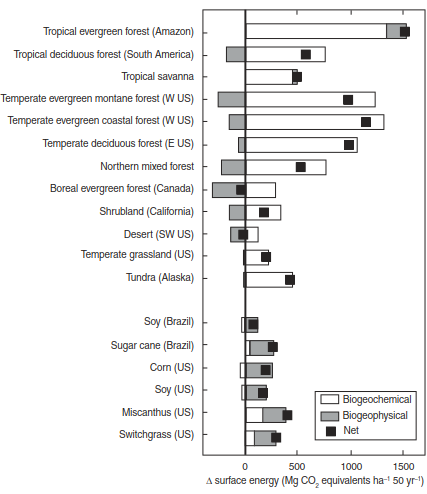
Fig. 33.2. Biogeochemical, biogeophysical, and net climate services of natural and agricultural ecosystems. Climate services are given in terms of CO₂ equivalents over a 50-year time frame and are relative to bare ground. Adapted from Anderson-Teixeira et al. (2012).
Comparative Analysis of Natural Ecosystems and Agroecosystems. On balance, natural ecosystems deliver substantially larger net climate regulation values than managed agroecosystems, a disparity primarily driven by differences in greenhouse gas storage and exchange (Fig. 33.2). Within natural terrestrial ecosystems, biogeophysical services generally play a secondary role relative to biogeochemical contributions. In most natural biomes, the evaporative cooling provided by intact vegetation is insufficient to override the warming induced by low canopy albedo, resulting in a net negative biogeophysical climate service. The principal exceptions to this pattern are tropical evergreen forests and tropical savannas. The exceptional positive climate regulation value of tropical evergreen forests underscores the critical priority of forest conservation; in contrast, the net climate value of boreal evergreen forests remains minimal because their biogeophysical warming and biogeochemical cooling virtually cancel each other out. Conversely, agroecosystems exhibit minor biogeochemical climate services, generating their net positive climate value almost entirely through robust evaporative cooling.
Simulations of Historical and Future Land-Use Pathways. Advanced climate model simulations indicate that while the global biogeophysical forcing of historical land-use and land-cover change is relatively small, its regional impact across North America and Eurasia is equal in magnitude—yet opposite in sign—to greenhouse-gas-induced climate warming. Evaluating prospective twenty-first-century land-use scenarios reinforces this conclusion. For example, simulations by Feddema et al. (2005) modeled climate trajectories under contrasting socioeconomic storylines, notably the A2 and B1 scenarios (Fig. 33.3). The A2 scenario represents a high-emission pathway characterized by escalating fossil fuel CO₂ output and massive agricultural expansion to sustain a growing global population, resulting in widespread conversion of arable land to cropland by 2100. The B1 scenario reflects the opposite extreme, featuring low CO₂ emissions, farmland abandonment, and net global reforestation during the latter half of the century.
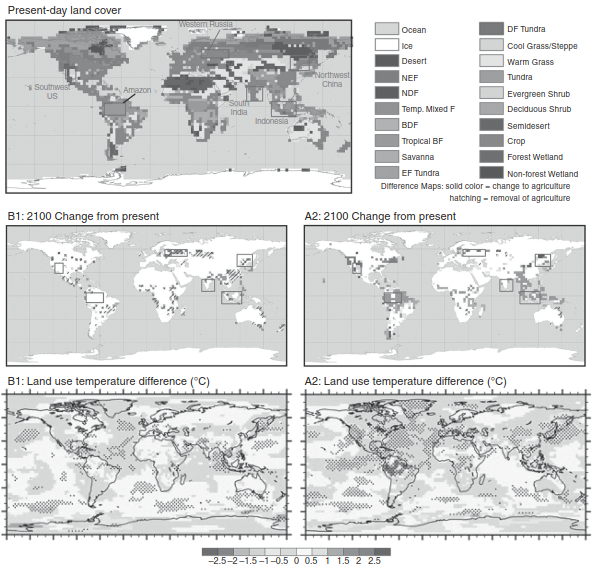
Fig. 33.3. Effect of future land cover on climate in the year 2100. The top panel shows present-day land cover as represented in a climate model (Labels – B, broadleaf; N, needleleaf; E, evergreen; D, deciduous; and F, forest). The middle panels show land-cover change at 2100 for the B1 and A2 scenarios. The bottom panels show boreal summer (June–August) temperature differences due to land-cover change in the B1 and A2 scenarios. The data were calculated by subtracting the greenhouse gas forcing from a simulation including land-cover change and greenhouse gas forcings. Stippling indicates statistically significant differences. Adapted from Feddema et al. (2005). See color plate section.
Model Outcomes and Thermal Trends under A2 and B1. In simulations isolated to greenhouse gas forcing alone, the A2 scenario generates approximately 2 °C of planetary warming in the absence of land-cover modifications. However, incorporating land-use dynamics in the A2 run drives additional summer warming (June–August) across the Amazon basin while inducing a biogeophysical cooling effect that partially mitigates warming in mid-latitude regions (Fig. 33.3). Under the low-emission B1 scenario, total warming reaches roughly 1 °C, and the associated land-use temperature shift is markedly smaller due to the widespread contraction of agricultural area by 2100.
SRES Scenario Projections and Carbon Cycle Feedbacks. Further investigations by Sitch et al. (2005) expanded this framework to analyze the A2, B1, A1B, and B2 scenarios using an Earth system model with fully coupled carbon cycle-climate feedbacks. To isolate specific forcing agents, twin simulations were executed for each scenario: one incorporating both fossil fuel emissions and dynamic land-cover change, and another holding cropland constant at 1990 levels. Atmospheric CO₂ concentrations were tracked interactively as a function of fossil fuel releases, atmosphere-ocean exchanges, and net carbon fluxes across managed and natural vegetation.
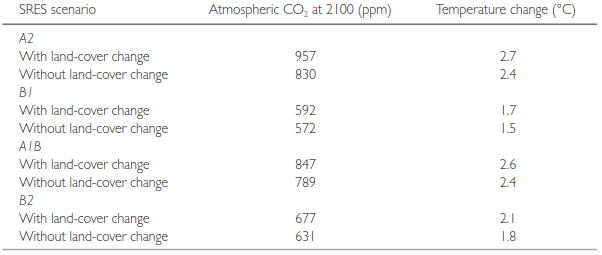
Table 33.1. Contribution of land-cover change to global annual mean temperature change over the twenty-first century. Source: From Sitch et al. (2005).
Biogeophysical versus Biogeochemical Temperature Contributions. Across all evaluated SRES pathways, land-cover change systematically inflates atmospheric CO₂ concentrations relative to static land-use baselines (Table 33.1). This land-use CO₂ penalty ranges from an increase of 20 ppm in B1 to 127 ppm in A2. Consequently, all scenarios demonstrate higher global annual mean temperature anomalies by 2100 when land-cover change is included, with total warming spanning from 1.7 °C (B1) to 2.7 °C (A2). Land-cover conversion directly contributes 0.2 °C to 0.3 °C to this total warming commitment. Notably, the critical importance of biogeophysical dynamics is highlighted by comparing A2 and A1B: both yield similar warming (~2.6–2.7 °C) despite A1B maintaining an atmospheric CO₂ level 110 ppm lower than A2 (847 ppm vs. 957 ppm). This convergence occurs because extensive northern-latitude deforestation in A2 triggers substantial biogeophysical cooling, counteracting a portion of its higher greenhouse gas warming.
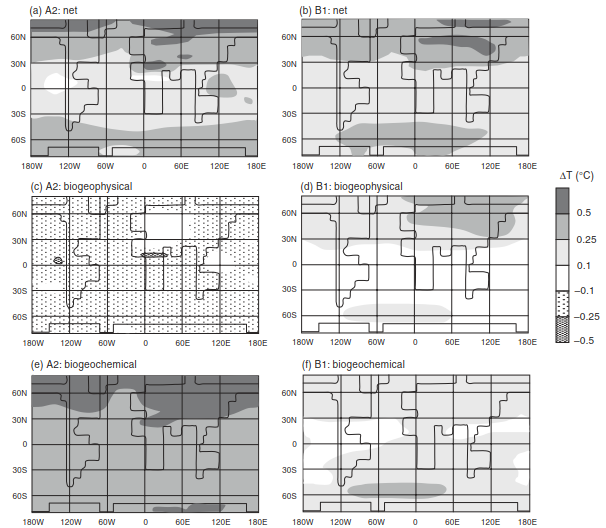
Fig. 33.4. Difference in annual mean temperature due to land-cover change for the A2 (left) and B1 (right) scenarios. Shown are (a, b) the net effect, (c, d) the biogeophysical effect, and (e, f) the biogeochemical effect. Adapted from Sitch et al. (2005).
Deconstructing Land-Cover Mechanisms under SRES Frameworks. Factorial experiments isolating biogeophysical from biogeochemical mechanisms provide deeper insight into these thermal responses (Fig. 33.4). In both the A2 and B1 scenarios, net carbon losses from land clearing drive significant biogeochemical warming, peaking in A2 (0.25 °C to 0.5 °C) due to widespread tropical deforestation. Biogeochemical warming is far more muted in B1 (0.1 °C to 0.25 °C) owing to reduced tropical clearing and active temperate reforestation. However, the two pathways diverge sharply in their biogeophysical expression. In A2, agricultural expansion causes widespread surface cooling of 0.1 °C to 0.25 °C. In B1, biogeophysical processes induce net warming—driven primarily by lower surface albedo following temperate forest regrowth. Thus, in A2, biogeochemical warming is partially offset by biogeophysical cooling, whereas in B1, moderate biogeophysical warming augments weak biogeochemical warming.
Representative Concentration Pathways and Modern Model Projections. Recent Earth system modeling using Representative Concentration Pathways (RCPs) confirms these complex forcing balances (Davies-Barnard et al., 2014b). Under RCP2.6 and RCP8.5, global trajectories feature continued deforestation and expanding cropland during the twenty-first century. In contrast, RCP4.5 assumes deliberate forest expansion to sequester carbon and meet climate stabilization targets.

Table 33.2. Change in annual mean temperature (°C) over land at the end of the twenty-first century due to land-cover change. Note: Temperature is averaged over the period 2070–2100. Source: From Davies-Barnard et al. (2014b).
Biogeophysical Forcing Superiority in Forest Expansion. The findings summarized in Table 33.2 demonstrate that large-scale afforestation under RCP4.5 actually enhances land surface warming by the end of the century. In this pathway, the biogeophysical warming caused by reduced surface albedo (+0.19 °C) substantially outweighs the biogeochemical cooling achieved through carbon sequestration (-0.08 °C), leading to a net land warming of +0.11 °C. Conversely, in RCP2.6 and RCP8.5, net land temperature shifts (+0.015 °C and +0.0035 °C, respectively) remain dominated by biogeochemical warming from land-use carbon emissions. These quantitative insights demonstrate that terrestrial forest geoengineering cannot be treated solely as a carbon accounting exercise; effective policies must fully integrate regional biogeophysical albedo dynamics to avoid counterproductive warming outcomes.
Date added: 2026-09-24; views: 1;