
Antarctica: Geology, Climate, and the World's Largest Ice Sheet
Introduction and Geography. The continent of Antarctica is uniquely distributed asymmetrically around the South Pole, lying almost entirely below the Antarctic Circle at 66° 33' 39" south. Encompassing approximately 5.46 million square miles (14 million km²), it is Earth's fifth-largest continent—equivalent to 57% of North America or 1.5 times the size of the United States. It is nearly completely concealed by a massive ice sheet, with several expansive ice shelves extending from the mainland into the circum-Antarctic waters. The continent is surrounded by the Southern Ocean, which comprises the southernmost reaches of the Atlantic, Pacific, and Indian Oceans. Following its 1820 discovery by Russian explorers Mikhail Lazarev and Fabian Gottlieb von Bellingshausen, the Scottish cartographer John Bartholomew formally named it "Antarctica" in 1890. Its modern governance is established by the Antarctic Treaty, originally signed by 12 nations in 1959 and now with 46 parties, which prohibits military activity and mining while promoting scientific cooperation and environmental protection.
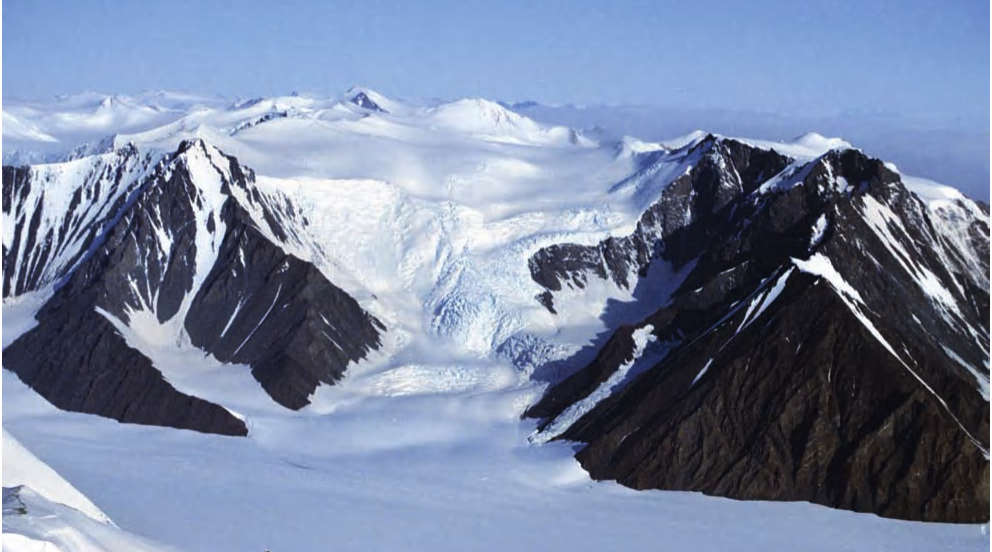
Transantarctic Mountains (North Victoria Land) in Antarctica
Geological Foundation and Major Divisions. Antarctica is bisected by the Transantarctic Mountains, a range stretching from the Ross Sea to the Weddell Sea that forms the primary geological and geographic divide. This partition separates two fundamentally distinct crustal blocks: the ancient East Antarctic Craton and the younger, assembled West Antarctica.
East Antarctica is a stable Precambrian craton, with some of Earth's oldest rocks. Its Archean cores, such as those in Enderby Land and the Vestfold Hills, contain gneisses up to 3.8 billion years old. The Napier Complex in Enderby Land records ultra-high-temperature metamorphic events around 2.5 billion years ago. This craton formed the nucleus of Gondwana and features a subdued, largely subglacial topography, deeply depressed by the overlying ice weight.
West Antarctica, in contrast, is a geologically complex region built from the accretion of several microplates and terranes, including the Antarctic Peninsula, Marie Byrd Land, and the Ellsworth Mountains terrane. It exhibits more rugged, mountainous topography and is covered by the West Antarctic Ice Sheet (WAIS), whose potential instability poses a significant future sea-level risk. The Antarctic Peninsula is the youngest addition, formed primarily during the late Mesozoic to early Cenozoic Andean orogeny, making it a tectonic extension of the South American Andes.
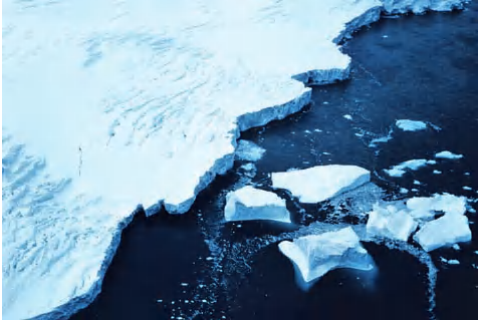
Ice calving from an ice front off Adelaide Island, Antarctica
Tectonic History and Mountain Building. The continent's major mountain ranges record distinct orogenic events. The Transantarctic Mountains were uplifted during the Ross Orogeny approximately 500 million years ago (Cambrian Period). The Ellsworth Mountains, reaching heights of 16,000 feet (4,880 m), were formed much later, around 190 million years ago in the early Mesozoic. The final assembly of Antarctica occurred as Gondwana fragmented; during this period, the tectonic margin along the Transantarctic Mountains and the Antarctic Peninsula was continuous with the convergent boundary that formed the Andes.
Paleontological Record and Paleoclimate. Antarctica's fossil record chronicles its journey across climatic zones. As part of Gondwana in the early Paleozoic, East Antarctica rested in equatorial latitudes, accumulating fossil-rich marine limestones. By the Devonian Period, it had drifted southward, supporting terrestrial plant life evidenced in sandstones of the Ellsworth Mountains. A major Late Paleozoic glaciation occurred as Gondwana centered over the pole, followed by extensive Permian swamp forests dominated by the Glossopteris flora. The end-Permian extinction ushered in a hot, arid climate. During the Mesozoic, conifer and later beech forests covered the land, inhabited by reptiles like Lystrosaurus, while ammonites swam in surrounding seas. The continent's icy isolation began in the Cenozoic Era.
Climate and Unique Environments. Antarctica holds the record for the coldest, driest, and windiest climate on Earth. The lowest temperature, -129°F (-89°C), was recorded at Russia's Vostok Station. Despite its ice cover, the interior is a polar desert, with the South Pole receiving less than 4 inches (10 cm) of precipitation annually. A notable ice-free area is the McMurdo Dry Valleys, a cold desert landscape used as a Martian analog by NASA. Here, microbial life persists in soils, and summer meltwater forms transient streams over permanent ice. The continent is frequently scoured by katabatic winds, dense, cold air currents that accelerate downhill from the high polar plateau, often reaching hurricane force.
The Antarctic Ice Cap and Global Warming. The Antarctic Ice Sheet is the planet's largest freshwater reservoir, averaging over 1 mile (1.6 km) thick and containing over 70% of Earth's fresh water. Its total melt would raise global sea levels by approximately 230 feet (70 m). Currently, the ice sheet's stability varies by region. The vast East Antarctic Ice Sheet has remained stable for millions of years and may even gain mass from increased snowfall due to global warming. In contrast, sections of West Antarctica, particularly the Antarctic Peninsula, have shown vulnerability. The collapse of the Larsen Ice Shelf in 2003 and subsequent losses from the Wilkins Ice Shelf highlight the impact of atmospheric warming on these peripheral shelves. However, the overall extent of Antarctic sea ice has shown significant variability without a clear long-term trend, and the direct impact of anthropogenic climate change on the continent's core remains complex and partially isolated from global weather systems. The West Antarctic Ice Sheet (WAIS) remains a critical focus of study due to its potential for rapid, destabilizing retreat.
Date added: 2026-07-14; views: 165;