
The Accreted Terranes of Southern Alaska: A Case Study in Convergent Margin Tectonics
The geology of Southern Alaska is defined by a complex assemblage of accreted terranes, which are distinct fault-bounded crustal fragments added to the continent over geologic time. This collage primarily consists of the inboard Wrangellia superterrane—itself a composite of the Peninsular, Wrangellia, and Alexander terranes—and the outboard Chugach-Prince William superterrane. Throughout much of the Mesozoic era, these superterranes represented the complementary components of a convergent margin: the Wrangellia superterrane formed a magmatic arc, while the Chugach-Prince William superterrane constituted a massive accretionary wedge, built above a circum-Pacific subduction zone. The boundary between these two major crustal blocks is marked by the Border Ranges Fault, a structure that initiated as a subduction thrust but has experienced complex reactivation as both a strike-slip and normal fault.
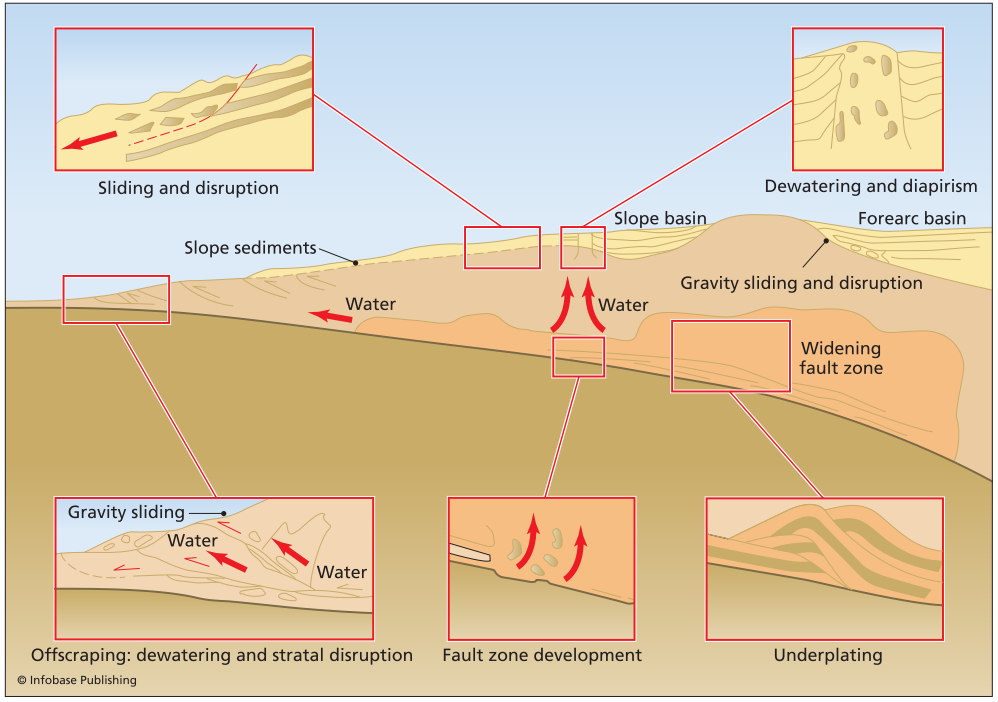
Cross section of typical accretionary wedge, showing material being offscraped at the toe of the wedge and underplated beneath the wedge. Water escapes upward through the accretionary wedge, causing the wedge material to become denser and more compacted.
Within the Chugach terrane on the Kenai Peninsula, two major lithostratigraphic units are identified. The inland unit, known as the McHugh Complex, is a structurally intricate assemblage primarily composed of basalt, chert, argillite, and greywacke, and includes several large ultramafic massifs. Radiolarian microfossils extracted from McHugh Complex cherts across south-central Alaska indicate ages ranging from Middle Triassic to Middle Cretaceous. The protracted interval of subduction-accretion responsible for forming the McHugh Complex is not precisely dated but likely spanned most of the Jurassic and Cretaceous periods. This complex has been thrust seaward over a more coherent package of trench turbidites, the Upper Cretaceous Valdez Group, along the Eagle River Fault (also called the Chugach Bay thrust).
The McHugh Complex and its lateral equivalent, the Uyak Complex on Kodiak Island, form the Mesozoic-Cenozoic accretionary wedge core of the Chugach terrane. Its vast regional extent makes it a critical archive for reconstructing Northeast Pacific tectonics, inviting comparison with other major accretionary complexes like California's Franciscan Complex and Japan's Shimanto Belt. The evolution of the McHugh Complex can be conceptualized in three broad, overlapping phases: (1) the initial formation of its igneous and sedimentary protoliths; (2) their incorporation into the subduction complex via accretion, accompanied by deformation and metamorphism; and (3) subsequent younger deformational overprints.
Fossil constraints within the McHugh Complex are sparse but informative. Critically, on the Kenai Peninsula, radiolarian chert is found depositionally overlying pillow basalt. Precise radiolarian biostratigraphy shows the chert base varies in age from Middle Triassic to Middle Cretaceous, while overlying greywacke has yielded Early Jurassic radiolarians. This stratigraphy supports a model where the basalts originated via seafloor spreading, the cherts were deposited as pelagic sediments on the ocean floor during its transit toward the trench, and the argillite and greywacke represent trench deposits immediately prior to accretion. The timing of this accretionary process, though imprecise, likely occupied much of the Jurassic and Cretaceous.
Limestones within the McHugh Complex fall into two categories. One class consists of clasts in conglomerate, with one example yielding Late Mississippian to Early Pennsylvanian conodonts, potentially derived from the Wrangellia terrane. The other, more common class comprises tectonic blocks, often occurring as severely extended boudins, which have yielded Permian fossils like fusulinids and conodonts. These fossils indicate a shallow-water, tropical, Tethyan affinity, distinct from Wrangellian faunas. These limestone blocks may represent seamount caps that were sheared off (decapitated) at the subduction zone, implying that some oceanic crust incorporated into the McHugh Complex formed as early as the Paleozoic era.
The seaward part of the Chugach terrane is underlain by the Upper Cretaceous Valdez Group. On the Kenai Peninsula, it consists of medium- to thin-bedded greywacke turbidites, black argillite, and minor conglomerate, interpreted as deep-sea trench deposits accreted soon after deposition. The Valdez Group is generally more coherent than the McHugh Complex but is deformed into regional-scale, tight to isoclinal folds and cut by a penetrative slaty cleavage. The thrust contact between the McHugh Complex and the Valdez Group features a distinctive footwall mélange of partially to thoroughly disrupted Valdez Group turbidites, forming a monomict mélange that contrasts sharply with the polymict mélanges of the overriding McHugh Complex.
During the early Tertiary (Paleogene), the consolidated Chugach accretionary wedge was intruded by near-trench plutonic rocks belonging to the Sanak-Baranof plutonic belt. This magmatic pulse migrated approximately 2,200 km along the continental margin from west to east between about 63 and 50 million years ago. This unusual near-trench magmatism is widely attributed to the subduction of the Kula-Farallon spreading center, a process known as ridge subduction.
The Mesozoic-Cenozoic rocks of this accretionary wedge are cross-cut by abundant late brittle faults. Near Turnagain Arm, four roughly coeval fault sets are observed: conjugate strike-slip faults (east-northeast-striking dextral and northwest-striking sinistral), north-northeast-striking thrusts, and less common west-northwest-striking normal faults. The thrust and strike-slip sets together caused subhorizontal shortening perpendicular to the margin, consistent with ongoing accretionary wedge deformation. The normal faults accommodated wedge extension, a common feature in critical taper wedges, and some of these brittle structures host gold-quartz veins temporally linked to the near-trench intrusives, suggesting a genetic relationship to ridge subduction processes.
Scattered throughout southern Alaska are fault-bounded ultramafic-mafic complexes, stretching over 1,000 km. These bodies, collectively termed the Border Ranges Ultramafic-Mafic Complex (BRUMC), generally consist of a sequence from dunite and peridotite upward into gabbronorite, intruded by more felsic rocks like tonalite. Prevailing models suggest most BRUMC bodies represent cumulates from the base of an intraoceanic arc, coeval with volcanic rocks preserved in the Talkeetna Mountains on the southern edge of the Wrangellia terrane. However, some ultramafic massifs on the Kenai Peninsula may represent accreted deep oceanic lithosphere, possibly from a dismembered ophiolitic sequence including cumulates, gabbro, and basalt-chert slices. Their origin remains debated, with possibilities including accreted normal oceanic lithosphere, an oceanic plateau, an immature arc, or a supra-subduction zone ophiolite formed in an extended forearc setting seaward of the early Talkeetna arc.
In summary, the accreted terranes of Southern Alaska, particularly the Chugach-Prince William superterrane, provide a world-class field laboratory for studying the long-term evolution of convergent margins. The McHugh Complex and Valdez Group exemplify the complex internal architecture of an accretionary wedge, recording episodes of subduction-accretion, ridge subduction, and subsequent brittle deformation. The presence of the Border Ranges Ultramafic-Mafic Complex adds further complexity, highlighting the diverse origins of crustal fragments ultimately amalgamated into the continental framework through the relentless processes of plate tectonics.
Date added: 2026-07-14; views: 152;