
Geology and Tectonic Evolution of the Arabian Peninsula
The Arabian Peninsula is divided into two principal geological provinces: the ancient Precambrian Arabian Shield and the overlying Phanerozoic cover sequence. The Arabian Shield forms the crystalline basement core of the landmass, a near-trapezoidal region bounded by the Red Sea to the west, the Arabian Sea and Gulf of Aden to the south, and the Arabian Gulf and Gulf of Oman to the east. This shield is exposed across the western and central peninsula, narrowing north-south but widening centrally, positioned between latitudes 12°-30° N and longitudes 34°-47° E. It constitutes the eastern portion of the Arabian-Nubian Shield, which stabilized in the Late Proterozoic around 600 million years ago before subsiding and being overlain by thick Phanerozoic sediments deposited along the margin of the ancient Tethys Ocean. The Tertiary rifting of the Red Sea subsequently split this unified shield into its separate Arabian and Nubian fragments.
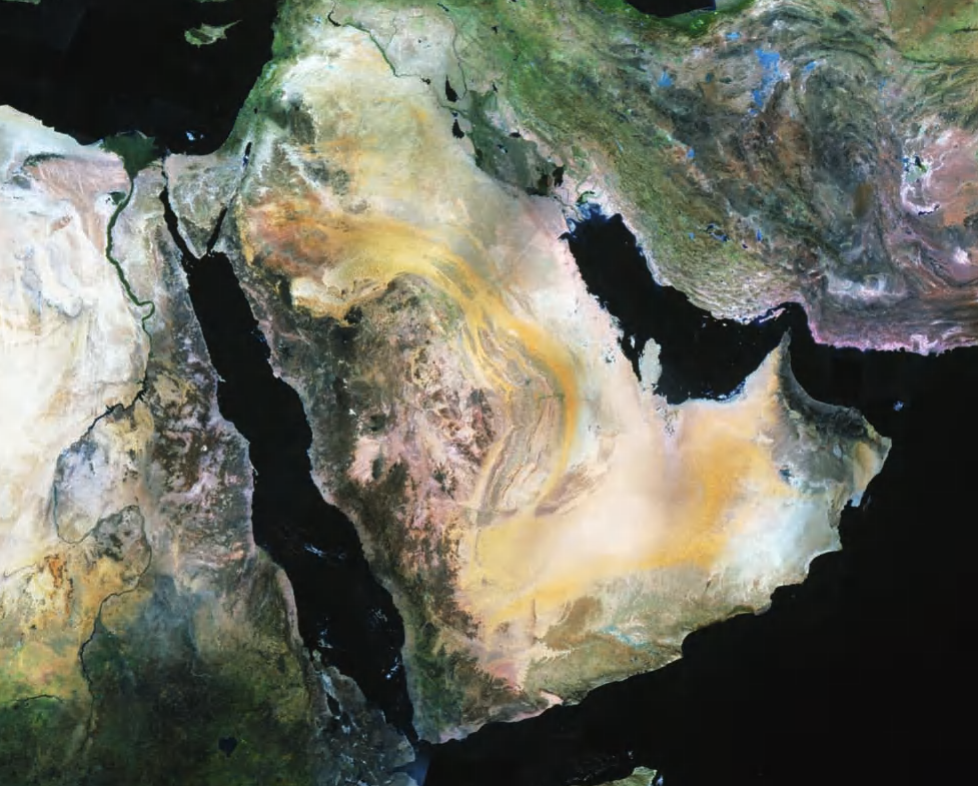
American Landsat image of Arabia. The Rub’a Khali (Empty Quarter) desert forms the great yellow sand sheet in the southern part of the peninsula, the Arabian shield forms the dark-colored terrane in the west, and the Semail ophiolite (oceanic crust and lithosphere) forms the dark area in the southeast. The fertile Mesopotamia area (in dark green, between the Tigris and Euphrates Rivers) separates Arabia from the Zagros Mountains of Iran.
The Phanerozoic cover rocks lie unconformably over the shield's eastern side, forming structures like the Tuwaiq Mountains and dipping gently eastward. While primarily covering the shield's eastern flank, younger Phanerozoic deposits also overlie parts of the shield itself, including Quaternary lava flows such as Harrat Rahat and early sedimentary sequences like the Saq, Siq, and Wajeed sandstones. These cover rocks are again prominently exposed in the tectonic uplifts of the Oman (Hajar) Mountains, a region of well-studied geology.
Tectonic Models of the Arabian Shield. The Arabian Shield comprises an assemblage of Middle to Late Proterozoic rocks, overlapped by Phanerozoic cover and punctuated by Tertiary and Quaternary volcanics related to Red Sea rifting. Its basement consists of stratotectonic units, volcanosedimentary sequences, and associated mafic to intermediate intrusive rocks, broadly categorized into layered and intrusive groups. Interpretations of these assemblages have evolved, with early models proposing volcanism in continental basins or above subduction zones. Contemporary analysis suggests many units belong to Late Proterozoic volcanic-arc systems organized into distinct tectonostratigraphic terranes.
Tectonic modeling began in the 1960s, with early workers proposing three major Late Proterozoic orogenies and a chemical evolution of plutonic rocks from calc-alkaline to peralkaline. The 1970s yielded two competing theories: a mobilistic plate tectonic model and a nonmobilistic basement-tectonic model. The plate tectonic model posits the shield originated in an oceanic environment through island arc formation over subduction zones. Conversely, the basement-tectonic model suggests an older craton rifted to form intraoceanic basins that then hosted arc systems. Both models converge on a final stage involving arc collisions, ophiolite obduction, and cratonization attached to the African craton.
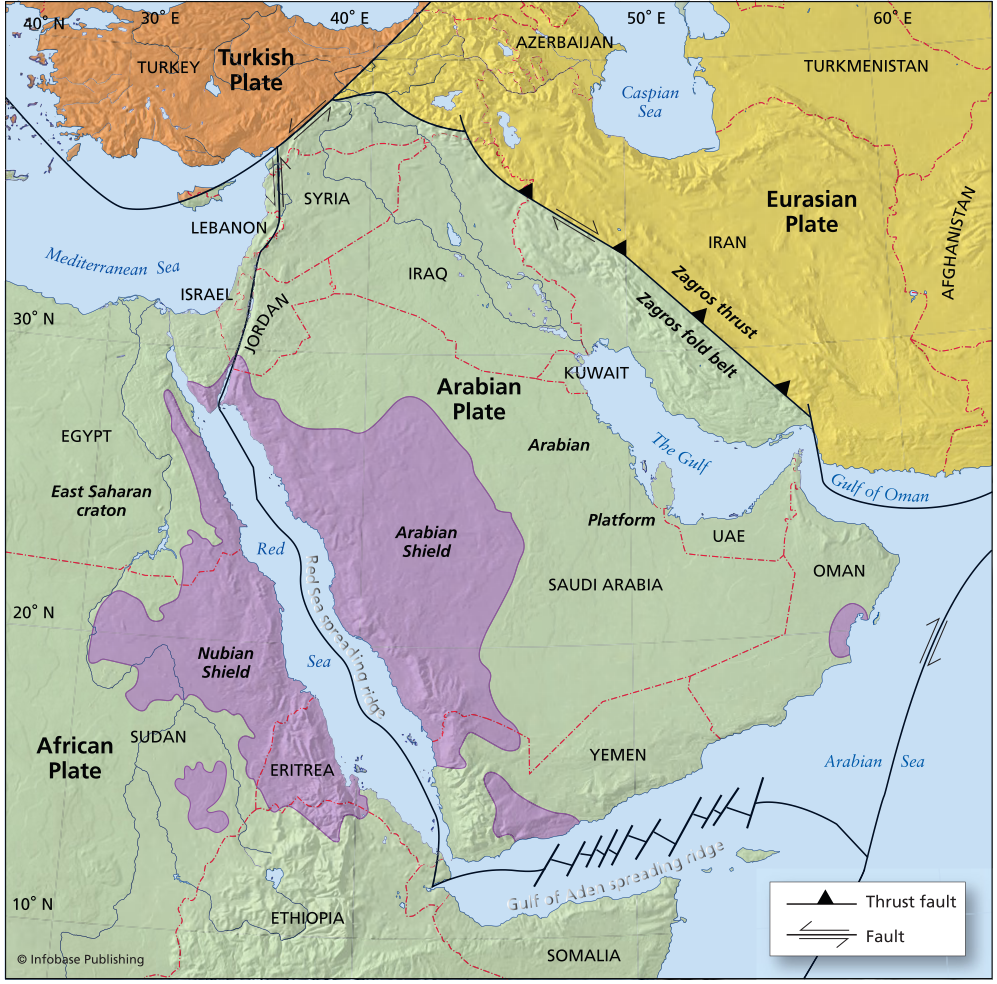
Simple map showing the geology of the Arabian Peninsula
Subsequent research in the 1980s-90s introduced a third model emphasizing microplate and terrane accretion. This model proposes an existing Early to mid-Proterozoic craton (2.0-1.63 billion years old) underwent rifting and dispersal, with its fragments incorporated as allochthonous microplates into younger units like ophiolite complexes and fore-arc strata. These components constitute five large and five small tectonostratigraphic terranes accreted between 770-620 million years ago to form a neocraton. Modern syntheses, including work by Peter Johnson of the U.S. Geological Survey, integrate these models into a framework of three Upper Proterozoic tectonic cycles.
A Three-Cycle Tectonic Classification. This unified classification divides the shield's layered rocks into three units separated by regional orogenies. The early Upper Proterozoic tectonic cycle (older than 800 Ma) encompasses rocks formed up to the combined Aqiq-Tuluhah orogeny. The middle Upper Proterozoic cycle (700-800 Ma) includes formations related to the Yafikh-Ragbah orogeny. The late Upper Proterozoic cycle (650-700 Ma) is defined by the Bishah-Rimmah orogeny. This cyclic framework provides a coherent view of the shield's assembly through successive accretionary events, culminating in its incorporation into the supercontinent Gondwana.
Date added: 2026-07-14; views: 153;