
Geological Evolution of the Arabian Platform and Oman Mountains: Stratigraphy, Tectonics, and Quaternary Uplift
The northern and eastern Arabian Peninsula comprises a thick succession of sedimentary and minor volcanic rocks known as the Arabian Platform. This platform, deposited from the Paleozoic through the Cenozoic eras, is composed of sequences of sandstone, limestone, siltstone, and evaporites. Its youngest layers consist of unconsolidated sands, silts, gravels, and sabkha deposits, extensively covering areas like Kuwait and the Gulf States. These Phanerozoic strata dip gently eastward, thickening dramatically from a few feet over the Precambrian Arabian Shield to over six miles beneath eastern Saudi Arabia, Kuwait, and Oman.
The thickest exposures of the Arabian Platform are found in the Oman (Hajar) Mountains, located on the Arabian Plate's northeastern margin. This range, situated 100-200 km from the active deformation front in the Gulf of Oman, consists of five major structural units aged from Precambrian to Miocene. These units include the pre-Permian basement, the Hajar Unit, the Hawasina nappes, the Semail ophiolite with its metamorphic sole, and postnappe structural units. The mountains exhibit juvenile topography, with peaks reaching 3 km high, deep canyons, and straight fronts indicative of active tectonic uplift.
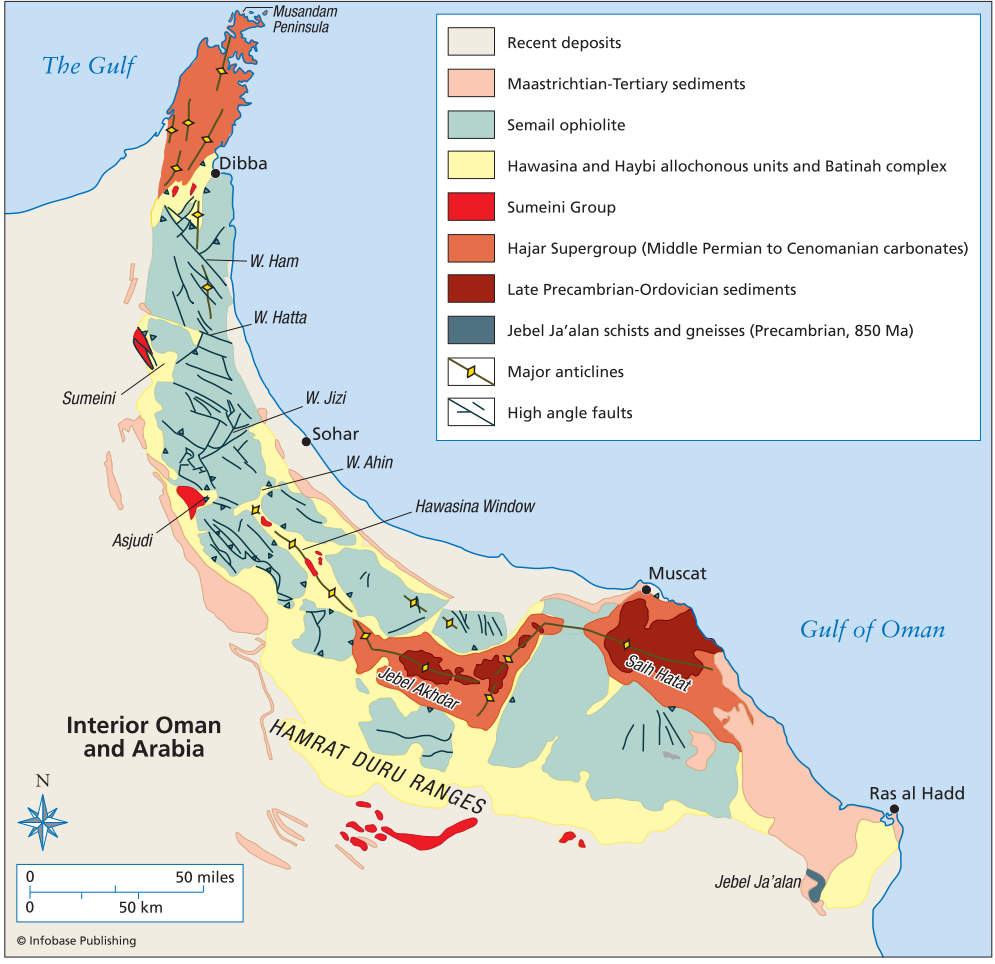
Geologic map of Oman. The world’s largest ophiolite, the semail, is shown in green colors.
This dramatic landscape results from a complex history of Cretaceous ophiolite obduction, Tertiary extension, and renewed uplift beginning in the late Oligocene. The Sayq Plateau southwest of Muscat sits at 2-3 km elevation, with Jabal Shams on its margin being Arabia's highest point. Elevations decrease northward to about 2 km on the Musandam peninsula, where slopes plunge directly into the sea. The oldest rocks, exposed in areas like Jabal Akhdar and Saih Hatat, belong to a Late Proterozoic basement gneiss correlative with the Arabian-Nubian Shield.
Overlying this basement is a Late Proterozoic/Ordovician volcano-sedimentary sequence, divided into the Huqf Group and the Ordovician Haima Group. The Huqf Group contains diamictites, siltstone, graywacke, dolostone, and intercalated mafic volcanics. The Haima Group consists of sandstones, siltstones, quartzites, and Skolithos-bearing sandstones interpreted as subtidal to intertidal deposits. These formations represent the earliest sedimentary record on the platform.
The Hajar Unit constitutes the primary Permian to Cretaceous carbonate sequence of the Arabian Platform, deposited on the southern margin of the Neo-Tethys Ocean. These carbonates form the rugged peaks of Jabal Akhdar and thrust sheets in the Western Hajar region. The unit includes the Akhdar, Sahtan, Kahmah, and Waisa Groups, overlain by the Muti Formation in the east. Equivalent groups on the Musandam peninsula are the Ruus al Jibal, Elphinstone, Musandam, and Thamama Groups.
In contrast, the Hawasina nappes are a stack of Late Permian to Cretaceous sedimentary and volcanic rocks deposited in the Hawasina basin, between the Arabian margin and the open Neo-Tethys. They include the Hamrat Duru, Al Aridh, Kawr, and Umar Groups, plus the chaotic Baid Formation. The Hamrat Duru Group features radiolarian chert, pillow lavas, and turbidites. The Al Aridh Group contains hyaloclastite, pelagic carbonates, and breccias, overlain by the Kawr Group with shallow marine carbonates.
SEMAIL OPHIOLITE. The Semail nappe is the world's largest ophiolitic sheet and displays a complete, though unusual, ophiolite stratigraphy with two magmatic sequences. The upper sequence grades downward from radiolarian cherts of the Suhaylah Formation into basaltic pillow lavas, a sheeted dike complex, layered gabbros, and cumulate dunite. The Mohorovicic discontinuity (Moho) is clearly exposed, separating these crustal rocks from the mantle sequence of tectonized harzburgite and lherzolite.
Beneath the ophiolite lies a metamorphic sole or dynamothermal aureole, formed from rocks metamorphosed under the basal thrust during emplacement. It typically consists of a lower metasedimentary horizon and an upper unit of banded amphibolites. Metamorphic grade increases upward to upper amphibolite facies at the contact with the Semail nappe. This sole provides critical evidence for the timing and mechanics of obduction.
POSTNAPPE AND QUATERNARY GEOLOGY. Postnappe units include the Late Cretaceous Aruma Group and the Tertiary Hadhramaut Group. The Aruma Group consists of the Qahlah Formation conglomerates and the Thaqab Formation breccias. The Hadhramaut Group comprises Paleocene to Eocene limestones and dolostones outcropping along the southern edge of the Batinah coastal plain.
QUATERNARY GEOLOGY OF NORTHERN ARABIA. Several levels of Quaternary fluvial terraces flank the Hajar Mountains. These are divided into an older, cemented terrace and a younger, uncemented group. The lower cemented terrace serves as a key time marker; while it overlies most structures unconformably, it is cut by some faults, proving recent tectonic activity. These terraces grade into coalesced alluvial fans (bajadas) and a narrow coastal plain along the Gulf of Oman.
TECTONIC SYNTHESIS AND UPLIFT HISTORY. The Hajar Mountains lie on the active forebulge of the collision between the Arabian Plate and the Zagros and Makran belts. The Hajar Supergroup records Permian to Cretaceous subsidence. By ~100 million years ago, spreading in the Neo-Tethys formed the Semail ophiolite crust, which was soon obducted. Metamorphic sole ages indicate thrust initiation between 105-89 Ma. The ophiolite scraped off Hawasina sediments as nappes during its westward travel, finally overriding the Arabian margin before 85-75 Ma.
Initial uplift of Jabal Akhdar and Saih Hatat domes likely began during late-stage collision, controlled by basement ramps and older horst-graben structures. Major uplift occurred in the Oligocene/Miocene, as shown by tilted strata on dome flanks. This uplift involves a complex, multi-phase history that continues today, contrasting with the subsidence of the Batinah plain. In the mountains, the Hawasina nappes typically dip northward over the Hajar Supergroup, with major valleys often eroded into weaker Hawasina shales.
South of the ophiolite, the Hamrat Duru Group rocks are complexly deformed in a foreland-fold-thrust belt, grading into the Suneinah foreland basin. A belt of anticlinal uplifts, like Jabal Salakh, brings Hajar Supergroup carbonates to the surface. Further south, the surface is covered by Miocene/Pliocene Barzaman Formation conglomerates.
The region's juvenile topography is attributed to Tertiary/Quaternary uplift. Key evidence comes from uplifted Quaternary marine terraces near Tiwi, indicating 100-500 meters of uplift. This recent uplift is superimposed on an older Cretaceous/Tertiary topographic baseline, driven by the ongoing continental collision at the Arabian Plate's northern margin.
Date added: 2026-07-14; views: 152;