
The Tectonic Evolution and Geological Framework of the Arabian Shield: Layered Rocks, Intrusions, and Structural Features
The Arabian Shield, a Precambrian geological province, is fundamentally classified into three major layered rock units, each corresponding to a distinct tectonic cycle. These are the lower, middle, and upper layered rock units. The lower layered rock unit encompasses groups formed during the early upper Proterozoic tectonic cycle (older than 800 million years ago), exhibiting continental affinity. Its volcanic rocks are characterized by tholeiitic basalt compositions, predominantly aged over 800 Ma, and are primarily located in the shield's southwestern and eastern regions. This unit includes rocks formed in an island arc environment, such as the basic tholeiitic Baish and Bahah Groups and the calc-alkaline rocks of the Jeddah Group. In certain areas, these overlie highly metamorphosed continental rocks like the Sabia Formation and Hali schists, which are interpreted as accreted fragments from a nearby craton, such as the African craton, or from rifted microplates like the Afif microplate.
Map showing the main tectonic terranes of the Arabian shield
The middle layered rock unit comprises groups deposited during the middle upper Proterozoic cycle, approximately 700 to 800 million years ago. Its volcanic assemblages are predominantly intermediate igneous rocks with a calc-alkaline nature. These rocks are widespread across the shield, with greater concentrations in the northern and northwestern sectors and more scattered outcrops in the southern and central parts. The upper-layered rock unit contains groups from the late upper Proterozoic cycle, between 700 and 560 million years ago, consisting mainly of calc-alkaline, alkaline intermediate, and acidic rocks. These younger units are primarily found in the northeastern, central, and eastern portions of the Arabian Shield, marking the final stages of Precambrian layered rock deposition.
Intrusive Rocks of the Arabian Shield. Intrusive rocks cutting the shield are divided into three chrono-tectonic groups: Pre-orogenic, Syn-orogenic, and Post-orogenic. Preorogenic intrusions exclusively cut the lower-layered rocks unit and are older than the middle unit but younger than the lower unit. Characterized by calcic to calc-alkaline composition, they are dominated by gabbro, diorite, quartz-diorite, trondhjemite, and tonalite. Located in the southern, southeastern, and western shield areas, these intrusions, dated between 700 and 1,000 million years, show geochemical and strontium isotope signatures indicative of an upper mantle magma source.
Synorogenic intrusions cut the lower and middle layered units and the preorogenic intrusions but not the upper-layered unit. Aged between 620 and 700 million years, their composition is more granitic and alkaline, including granodiorite, adamalite, monzonite, granite, and alkali granite. They typically form large batholithic bodies concentrated in the eastern, northern, and northeastern shield. Their higher initial strontium ratio suggests a magma source in the lower crust. Postorogenic intrusions, dated 620-550 million years, cut all previous units and form circular to ring-like bodies with alkaline to peralkaline compositions. This suite includes peralkaline granites like riebeckite granite, alkaline syenite, and various other granites, often in a bimodal suite with gabbro. Their variable strontium ratios also indicate a lower crustal origin.
Ophiolite Belts and Suture Zones. Mafic and ultramafic rocks conforming to ophiolite sequence definitions are grouped into six major belts, representing ancient suture zones. Four strike north, and two strike east-northeast. These belts include the Amar-Idsas, Jabal Humayyan-Jabal Sabhah, Bijadiah-Halaban, Hulayfah-Hamdah “Nabitah”, Bir Umq-Jabal Thurwah, and Jabal Wasq-Jabal Ess ophiolite belts. They are considered the boundaries between different tectonic terranes, marking zones of plate convergence. While key ophiolitic components are present, the sheeted dike complex is often obscured by metamorphism and deformation, complicating identification.
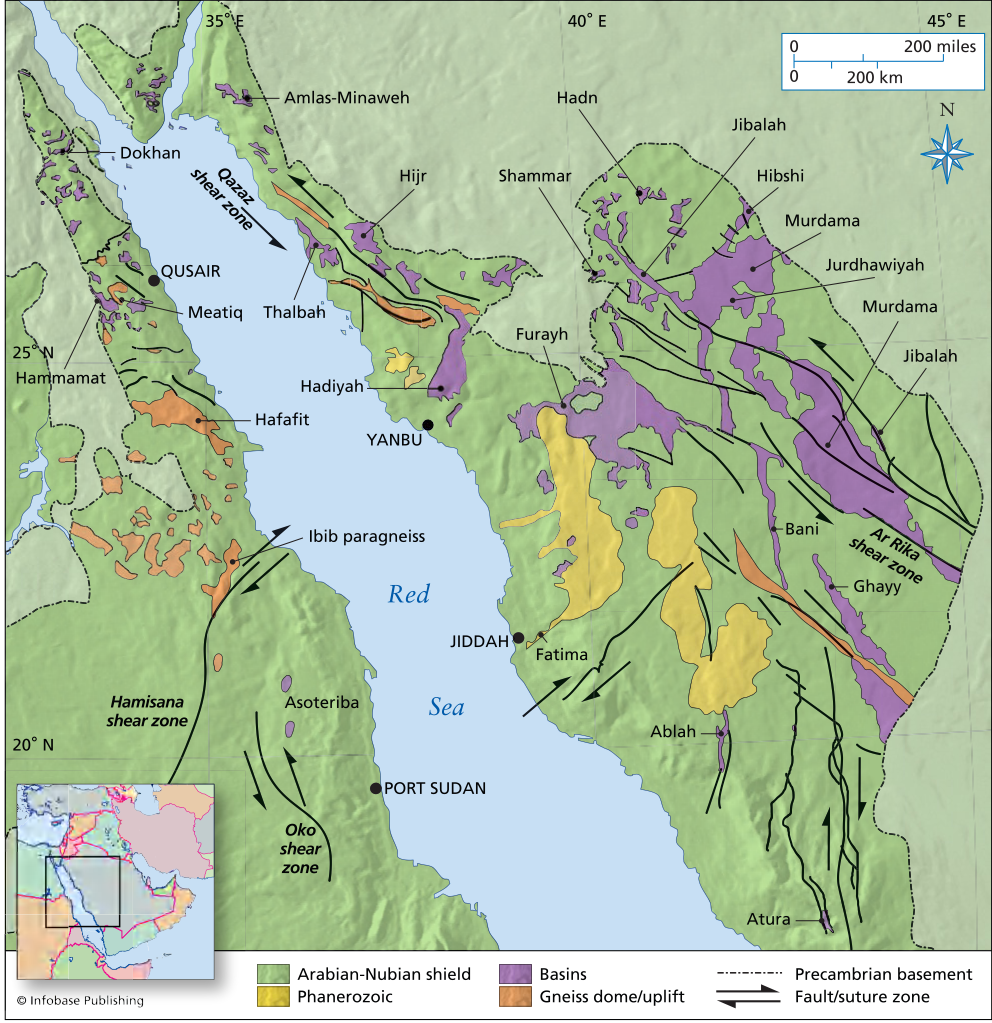
The Najd Fault System. A dominant structural feature is the Najd fault system, a 300 km wide, 1,200 km long zone of left-lateral strike-slip faults extending northwest across the shield. Active from approximately 630 to 530 million years ago, it represents the shield's last major Precambrian event, with a cumulative displacement of about 250 km. The main related rock group is the Jibalah Group, the shield's youngest Precambrian unit (600-570 Ma), deposited in grabens and pull-apart basins along the fault system. Its stratigraphy progresses from coarse clastic and volcanic rocks at the base, through stromatolitic limestone and chert, to fine clastics at the top.
Tectonic Evolution of the Arabian Shield. The shield is divided into five major tectonostratigraphic terranes—Asir, Al-Hijaz, Midyan, Afif, and Ar-Rayn—separated by four suture zones (Bir Umq, Yanbu, Nabitah, Al-Amar-Idsas). The Asir, Hijaz, and Midyan are interoceanic island arc terranes, while Afif is continental and Ar-Rayn probably continental. The sutures record collisions between these terranes; for example, the Bir Umq belt sutures the Al-Hijaz and Asir arcs, and the Nabitah zone marks the collision of the continental Afif microplate with the western island arcs.
A five-stage evolutionary model is recognized:
1. Rifting of the African craton (1,200-950 Ma): Limited records suggest rifting formed oceanic basins, possibly part of the Mozambique Ocean, potentially separating rifted fragments like the Afif microplate.
2. Island arc formation (950-715 Ma): Oceanic island arcs developed in the new basins. The oldest, the Hijaz terrane, formed 900-800 Ma. Rocks from this stage show evidence of mixing with older continental rift material.
3. Craton formation via collision (715-640 Ma): The five terranes collided along the suture zones in a diachronous manner. This period also saw the development and subsequent shutdown of major magmatic arcs, such as the Furaih and Sodah arcs. The protracted Ar-Rayn collisional orogeny along the Amar suture (700-630 Ma) may have triggered the Najd fault system.
4. Continental magmatism and deformation (640-550 Ma): Following amalgamation, post-collisional magmatic activity and the major strike-slip deformation of the Najd fault system occurred.
5. Epicontinental subsidence (post-550 Ma): Tectonic activity ceased, and the shield was peneplained, overlain by epicontinental Cambro-Ordovician sandstone. The shield remained stable except for later margin events like Tethys closure and Red Sea rifting.
Date added: 2026-07-14; views: 159;