
A suggested classification framework
Based on the experience of those who have attempted to classify permanent bodies of water, a desirable approach to creating an overarching framework would be to keep any scheme relatively simple and not overly concerned with attempting to account for every single habitat variation. Table 1.3 proposes a classification into which most temporary waters will fit. Habitat typing beyond this level can be left to the specifics of individual studies or localities (e.g. vernal pools versus autumnal pools, which differ in their time of filling; Wiggins et al. 1980). The proposal initially assigns a temporary water body to one of the existing global biomes.
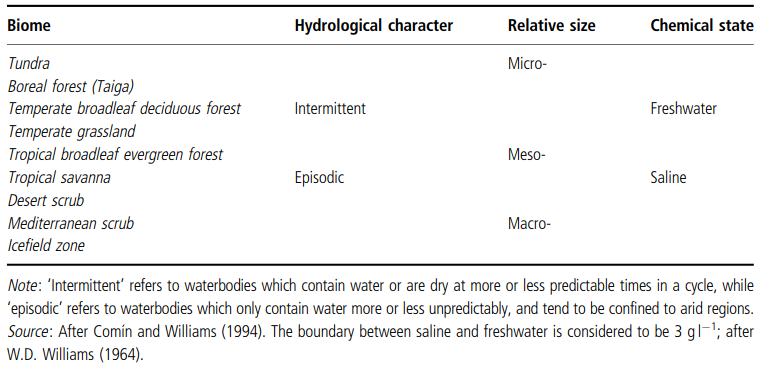
Table 1.3. Suggested classification framework for temporary water habitats
These are accepted major regional groupings of plants and animals discernible at a global scale. They represent distribution patterns that are strongly correlated with regional climate patterns and are identified according to the climax vegetation type with affiliated characteristics of successional communities, faunas, and soils. Keeley and Zedler (1998), working on vernal pools in California, have concluded that there is a close association between these specific pools and the Mediterranean climate in general, giving credence to the use of biomes as a classification parameter.
Within these biomes, waterbodies are assigned to either intermittent, or episodic categories (sensu Comm and Williams 1994), and within these to macro-, meso-, and microhabitats (sensu Decksbach 1929). As many temporary lentic waters are high in dissolved minerals, a distinction needs to be made between saline and freshwater habitats, and the boundary concentration of 3gl~1 salinity (established by W.D. Williams 1964) is a useful one. So, for example, the water-filled leaves of the pitcher plant Nepenthes would be classed as intermittent, freshwater, microhabitats from the Tropical Broadleaf Evergreen Forest; the large, shallow sloughs of the Canadian prairies would be classed as intermittent, saline, macrohabitats from the Temperate Grasslands; unpredictably flowing, headwater streams in arid regions would be classed as episodic, freshwater, mesohabitats from the Desert Scrub, or Mediterranean Scrub; unpredictable rainwater pools in east Africa would be classed as episodic, freshwater, mesohabitats from the Tropical Savanna; and rainfilled tyres would be classed as episodic, freshwater, microhabitats from whichever biome they were located in. Irregularly occurring, meltwater rivulets arising in the Antarctic (see Vincent and Howard-Williams 1986) and high Arctic (and perhaps glacial margins in high alpine regions should also be included here) would necessitate the addition of another 'biome', resulting in episodic, freshwater, mesohabitats from the Icefield Zone. Of course, once formal description has been assigned to a particular water body, for example, in the 'habitat' section of a publication, it could thereafter be shortened for stylistic convenience (e.g. intermittent saline stream; episodic rainwater pool; intermittent woodland pond).
A lesson learned very early on by limnologists was that it is not easy to assign waterbodies within strict classification schemes. Pearsall (1921) demonstrated that lakes in the English Lake District fell into a continuum of habitats. Although he was able to assign lakes at the extreme ends of this range to 'oligotrophic' and 'eutrophic' types, overall he found it difficult to establish logical boundaries in-between. The classification scheme for temporary waters outlined above, should therefore be viewed only as a reference framework within which there are likely to be many continua.
Date added: 2026-07-14; views: 143;