
Classification of temporary waters
Review of some previous classification schemes. Temporary waters are amazingly diverse in the habitats that they present for the development and sustainment of life. By way of an example, Table 1.1 lists the main types of temporary standing waters to be found in the British Isles. It subdivides these habitats into those of natural origin (e.g. peatland pools and cup fungi; Figure 1.1) and those resulting from human activities (e.g. quarry ponds and saw- pit ponds), and also distinguishes common from rarer, or regional, types. Including lotic temporary waters would swell the list considerably. Faced with such an inventory, it is perhaps little wonder that classification attempts for temporary waters are few and far between. One proposal has been based upon habitat size (micro-, meso-, and macro-; Table 1.2) but this tends to lump habitats that may support quite different communities, for example lowland, floodplain pools and alpine lakes.
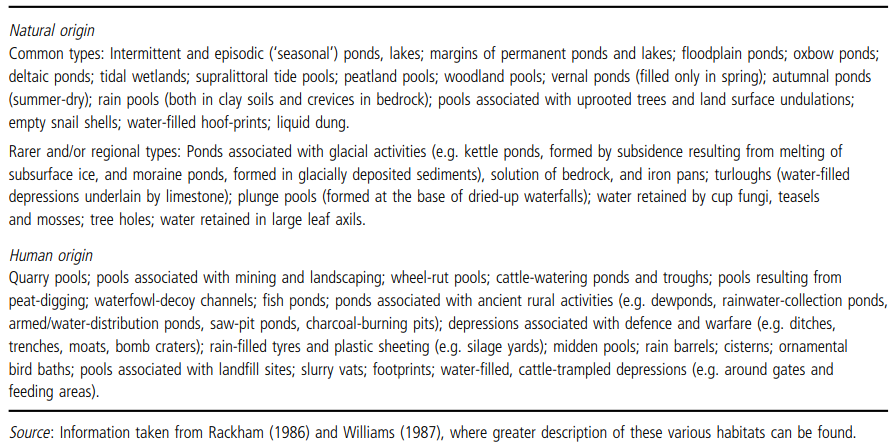
Table 1.1. The main types of temporary standing water found in Britain
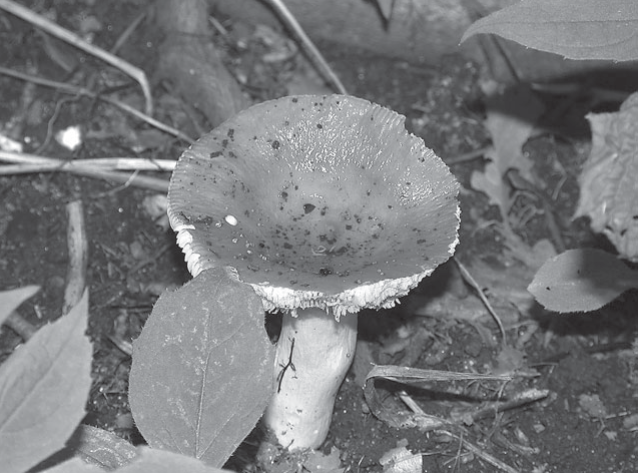
Figure 1.1. Photograph of a rainfilled cup fungus; note the accumulated particles of detritus that may serve as food for the biota, and the presence of several semi-aquatic oligochaetes

Table 1.2. Classification of temporary water habitats based on size
Length and intensity of the dry period also have been suggested as criteria, and may be more biologically relevant. Length of the dry phase can be divided simply into seasonal, annual, and greater than annual—but cyclical. Intensity of the drought is important because, for example, two habitats which both remain dry for 4 months of the year might have different moisture-retaining capacities of their substrates, allowing the survival of significantly different biotas. Climatologists have derived a number of indices for drought that may have useful application to temporary waters. One, widely used example is the Palmer Hydrologic Drought Index, which combines precipitation and temperature values with soil water content data—including outflow and storage measures (Heddinghaus and Sabol 1991). Some researchers have found significant correlations between this index and temporary water invertebrate population dynamics (Hershey et я/. 1999).
As with all systems of classification, there are bound to be exceptions which do not fit any of the categories, for example, Lake Eyre in southern Australia only fills with water every half century or so (Mawson 1950). Can this really be called cyclical? The majority of species that would colonize such a lake would die when it dried up, with perhaps only a few, highly specialized forms being able to span the 50 or so years between fill ups. The occurrence of some waterbodies in the United Kingdom affords another example of a misfit. Triops (a notostracan, or tadpole shrimp), was first recorded in 1738 from a 'temporary' pond, it was next recorded in 1837 and again in 1948, after a lapse of 111 years (Schmitt 1971). Although it did not appear, naturally, during all that time, it could be hatched from dried mud taken from the pond and rehydrated. This animal requires a period of desiccation prior to hatching and the wet British climate did not create suitable conditions very often. Whether such a pond could be truly termed 'temporary', or whether it was simply a permanent pond that dried up infrequently is debatable. Clearly it contained at least one species normally characterized as being indicative of temporary waters.
Classifications based on indicator species, or species groups also are not infallible. For example, Klimowicz (1959) attempted to classify small ponds in Poland on the basis of their molluscan faunas. Granted, some snail and bivalve species are very resistant to water loss and may be usefully assigned to different habitat types, however some, such as Musculium partumeium, are known to occur in both temporary and permanent ponds (Way et al. 1980). Colless (1957) modified a classification scheme of Laird's (1956) based on breeding habitats for mosquitoes. In it, he created two main categories—Surface Water, and Containers—the former were then subdivided into Lakes and ponds; Swamps and marshes; Transient pools; Obstructed streams; and Flowing streams; and the latter subdivided according to whether they were Large, simple containers (e.g. kerosene tins); Small simple containers (e.g. cans and bottles); or specialized containers (e.g. pitcher plants, plant axils, and crab holes). Laird later, (1988), summarized a number of other classification schemes based on larval mosquito habitats, many of them temporary.
Pichler (1939) proposed that water temperature could be used to establish a classification scheme for small waterbodies, as follows:
1. puddles—very small waterbodies up to 20 cm deep with the bottom strongly heated by the sun; practically no stratification in the summer, when, daily, the variation may be as much as 25°C (see Figure 1.2);
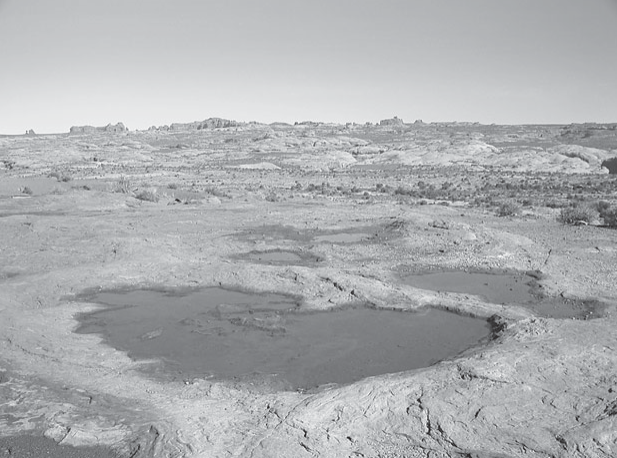
Figure 1.2. An example of rainfilled puddles, in eastern Utah; such habitats are typically less than 20 cm deep and may experience daily temperature variations as much as 25oC (Scale: diameter of the pool in the foreground is approximately 3 m; water depth is a maximum of 12 cm)
2. pools—waterbodies up to 60 cm deep, consequently less heat reaches the bottom; thermal stratification is upset daily by a turnover and the summer temperature variation may be up to 15°C at the surface and 5°C at the bottom;
3. small ponds—up to 100 cm deep with very little heat reaching the substrate; stratification is more stable but can be upset daily, summer temperature variation is up to 10°C at the surface and 2°C near the bottom.
All these characteristics were based on open ponds, thus shading by emergent vegetation would make an important difference to the scheme. In addition, differences would be expected to occur between temporary pools and streams, as water in the latter is in motion and may run through shaded and non-shaded reaches.
Other schemes have been proposed by special interest groups, such as those interested in saline lakes, where the term 'athalassohaline waters' (non-marine waters with a significant salt content; Bayly 1967; W.D. Williams 1981) has been coined to distinguish them from 'thalassohaline waters' (NaCl-rich waters with a similar concentration to sea water, or slightly diluted; Cole 1979). Poff and Ward (1990) put forward a proposal to classify streams based on their hydrological patterns. Two of their study streams were temporary and produced streamflow histories that were termed 'intermittent flashy' (Sycamore Creek, Arizona) and 'harsh intermittent' (Dry Creek, Oklahoma), respectively (Figure 1.3).
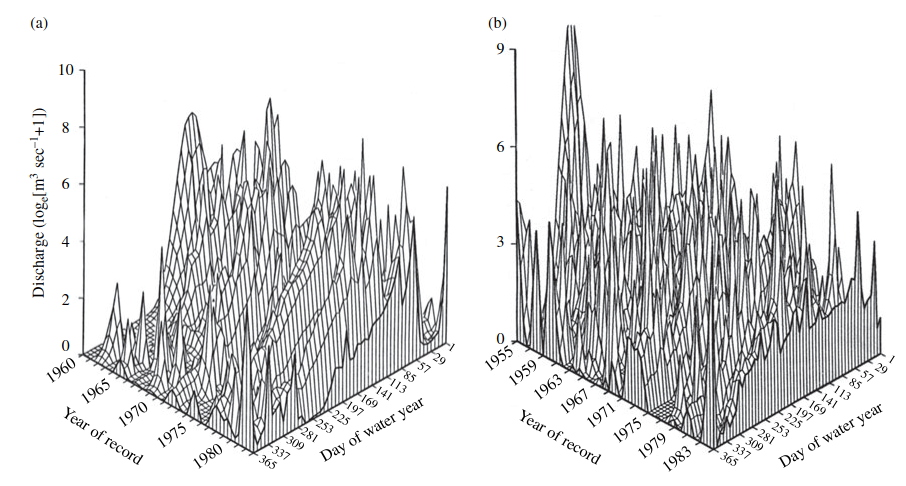
Figure 1.3. Streamflow patterns for two temporary streams, based on long-term, daily mean discharge records over several years: (a) Sycamore Creek, Arizona; (b) Dry Creek, Oklahoma (redrawn from Poff and Ward 1990)
The authors concluded that these radically different flow regimes, together with climatic and substratum differences, must strongly influence the respective biotas present. Applying a similar argument, Puckridge et al. (1998) identified 11 relatively independent measures of hydrological variability that, primarily for large rivers, could categorize river types and were related to the properties of the resident fish faunas. For example, protracted zero flows were associated with greater numbers of small and carnivorous species, and dominance of physiologically tolerant forms. Rivers with high-amplitude variation, in contrast, were dominated by small, omnivorous species, and greater numbers of 'colonizing' species. Keeley and Zedler (1998) showed that vascular plants in California could be organized according to average water duration in vernal pools (Figure 1.4).
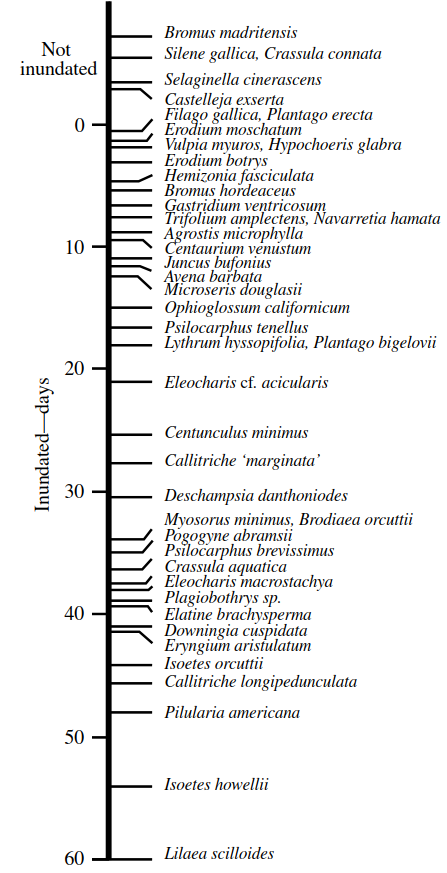
Figure 1.4. Common vernal pool plants from southern California arranged along an axis of inundation tolerance (redrawn from Keeley and Zedler 1998)
Those species experiencing little or no inundation were typically annual grasses and forbs characteristic of the surrounding grasslands, whereas those inundated for longer periods were typically those restricted to vernal pools.
There are also many temporary waters that are included within the term 'wetlands'. These transitional areas between terrestrial and aquatic systems are associated with many other names that, over the years, have become either synonymous with wetlands, or regarded as a subset of habitats, such as peatlands, swamps, marshes, bogs, fens, and floodplains. In the United States, the extent of these areas is believed to be around 42 million hectares, and so their significance is considerable (Dahl and Johnson 1991). However, such has been the subdivision of these habitats that there are now more than 70 categories described in Canada alone (Warner and Rubec 1997). The terms 'seasonal wetlands' and 'seasonal ponds' also crop up in the literature, generally with reference to habitats in temperate parts of North America and Europe. These have limited use in climate zones that are more typically non-seasonal.
While many of these schemes are helpful, the persistence of other habitat names (such as salt pans, playas, and astatic ponds) together with adoption of regional names (such as claypans, gnammas, and vegetated pans, Australia; vleis, southern Africa; dayas, North Africa; prairie potholes and tinajas, North America; ramblas, eastern Spain), has created a confusing plethora of terms (Comm and Williams 1994). Some regional names are clearly still useful in a local context. The term 'ephemeral', in particular, has been used loosely, and often interchangeably with 'intermittent' and 'temporary'. Its derivation (from the Greek 'ephemeros'—living but a day) suggests that it should be abandoned as a biological term to describe temporary waters. Hydrologists, however, define ephemeral waters as those having basins or channels which are above the water table at all times (Gordon et al. 1993). Some (e.g. Comm and Williams 1994) have suggested that the term 'temporary waters' itself has become confused (it is sometimes used to refer to 'intermittent' waters—see below); herein it is used to encompass all waters which experience cyclical drought, and also to refer to temporary waterbodies in which the precise nature of the hydroperiod is unknown.
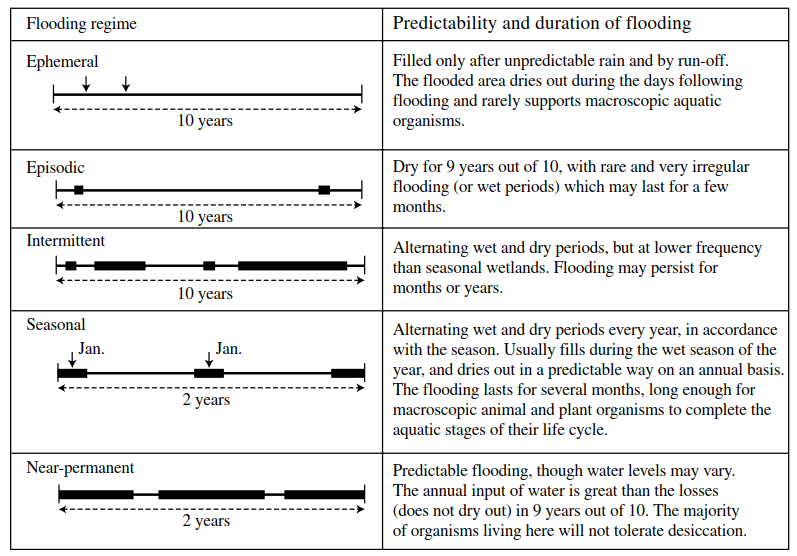
Figure 1.5. Simplified classification scheme for temporary waters (vertical arrows indicate times of water input; thick horizontal bars indicate the relative duration of the hydroperiod; based on Boulton and Brock 1999, but as modified by Yavercovski et al. 2004)
A potentially useful classification scheme for temporary wetlands has been proposed by Boulton and Brock (1999). Based on Australian waters, it focuses on the predictability and duration of flooding events (Figure 1.5). Although it recycles terms such as 'ephemeral' and 'seasonal', it defines them quite precisely.
Date added: 2026-07-14; views: 107;