
Impact of Fires on the Climate System and Atmospheric Processes
Fires as a key component of the Earth system exert a fundamental influence on air quality, atmospheric composition, and global climate through a complex set of biogeochemical and biogeophysical processes (Bowman et al. 2009). Figure 31.6 illustrates the primary mechanisms of this impact, including emissions of greenhouse gases that induce positive radiative forcing, as well as emissions of carbon monoxide (CO), nitrogen oxides (NOₓ = NO + NO₂), and volatile organic compounds (VOCs). These substances act as precursors for tropospheric ozone formation and directly affect the oxidative capacity of the troposphere via hydroxyl radicals (OH). Additionally, emissions include organic aerosols and black carbon, and lead to changes in surface albedo.
Composition and quantitative assessment of biomass emissions during combustion involve the release of long-lived greenhouse gases (CO₂, CH₄, N₂O), numerous short-lived reactive gases, and suspended particulate matter (Crutzen and Andreae 1990; Andreae and Merlet 2001; Hoelzemann et al. 2004; Akagi et al. 2011; Wiedinmyer et al. 2011). Combustion products form large-scale smoke plumes that transport across vast distances in the atmosphere, as demonstrated in Fig. 31.7. Quantitative emission volumes are determined using emission factors eᵢ (grams of species per kilogram of dry biomass burned), which vary depending on the biome, fire type, and chemical component (see Table 31.3). The calculation of total emission for a specific component Eᵢ is performed using the formula:
Eᵢ = A × B × F × eᵢ (31.1)
where Eᵢ is the emission of component i, A is the burned area, B is the biomass (fuel load), F is the fraction of biomass consumed, and eᵢ is the emission factor (Hoelzemann et al. 2004; Schultz et al. 2008; Wiedinmyer et al. 2011).
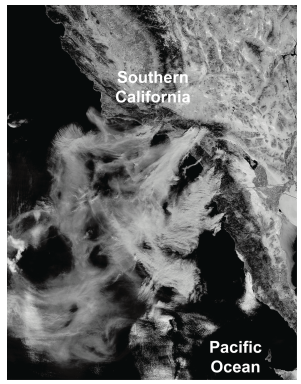
Fig. 31.7. Smoke plume from wildfires in Southern California, October 26, 2003. NASA image courtesy of Jacques Descloitres (NASA Goddard Space Flight Center, Greenbelt, Maryland) and NASA's Earth Observatory.
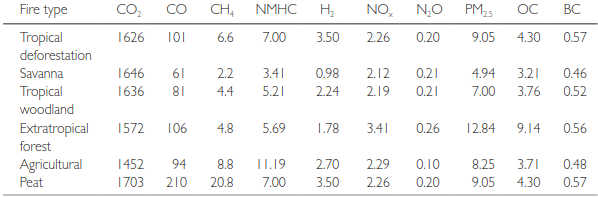
Table 31.3. Biomass burning emission factors (g per kg of dry matter burned) for various chemical species across fire types. Note: NMHC — non-methane hydrocarbons. PM₂.₅ — particulate matter with diameter less than 2.5 µm. OC — organic carbon. BC — black carbon. Source: van der Werf et al. (2010).
Chemical transformation of the atmosphere and ozone formation under the influence of fire emissions lead to profound changes in oxidative capacity. Satellite observations record high concentrations of CO, NO₂, formaldehyde (HCHO), and glyoxal (CHOCHO) in regions with intensive biomass burning (Rosenfeld et al. 2014). Emissions of NOₓ, CO, and VOCs increase tropospheric ozone levels (Jaffe and Widger 2012). Ozone formation and NOₓ emissions elevate OH radical concentrations, which destroy methane (CH₄) and reduce its lifetime. However, simultaneous oxidation of fire-emitted CO and VOCs consumes OH radicals, which conversely increases the lifetime of CH₄ in the atmosphere (Ward et al. 2012; Mao et al. 2013).
Radiative forcing and biogeochemical budgets are governed by the balance of heating and cooling factors. Aerosol emissions of black carbon and organic carbon reduce solar radiation reaching the surface, cooling it, but warm the troposphere by absorbing light. Deposition of black carbon on snow and ice induces positive radiative forcing. Indirect biogeochemical effects include the deposition of nitrogen and phosphorus onto land and iron into oceans, as well as changes in diffuse radiation (Mahowald 2011; Mahowald et al. 2011). In boreal forests, initial positive forcing from CO₂, CH₄, ozone, and black carbon is over time offset by negative forcing due to increased surface albedo after vegetation loss (Randerson et al. 2006). In the pre-industrial era (1850), the total net radiative forcing from fires was estimated at -1.02 W m⁻² (see Table 31.4) (Ward et al. 2012). Between 1850 and 2000, anthropogenic activity weakened this cooling effect by 0.5 W m⁻².
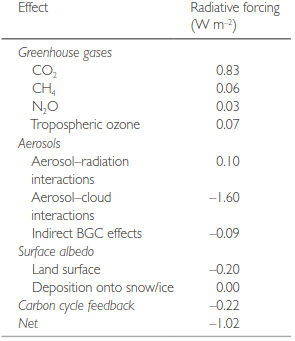
Table 31.4. Global radiative forcing of fires in the pre-industrial era (1850). Source: Ward et al. (2012).
Impact of smoke aerosols on cloudiness and precipitation is complex and depends on the cloud type (Rosenfeld et al. 2008, 2014). Smoke particles serve as cloud condensation nuclei and ice nuclei, altering cloud microphysics. Over the Amazon, smoke plumes suppress cloud cover and reduce precipitation (Andreae et al. 2004; Koren et al. 2004). Heating of the troposphere by smoke suppresses convection, decreases soil heating and evaporation, and stabilizes the lower troposphere. Reduction in cloud droplet size further inhibits precipitation formation, affecting large-scale atmospheric circulation.
Atmospheric circulation and positive drought feedbacks link regional fires to the Hadley circulation. Solar radiation absorption by black carbon over India and Southeast Asia weakens monsoons (Ramanathan and Carmichael 2008; Bond et al. 2013). In Equatorial Asia during El Niño events, peat fires intensify drought through tropospheric heating and convection suppression (Tosca et al. 2010). Modeling shows that fire aerosols reduce global surface temperature by 0.13 °C, and by more than 0.5 °C in regions of intense burning (South America, Africa, Equatorial Asia) (Tosca et al. 2013). The combination of surface cooling and tropospheric warming strengthens equatorial subsidence and weakens Hadley circulation, reducing tropical precipitation. In savannas, regular fires destroy trees, maintaining grass cover and inducing droughts, which provides a competitive advantage to C₄ grasses with high water-use efficiency (Beerling and Osborne 2006).
Date added: 2026-09-24; views: 1;