
Mineral Dust and Biomass Burning: Climate Dynamics and Feedbacks
Mineral dust mobilization and atmospheric emission dynamics govern global atmospheric aerosol loading and biogeochemical flux. An estimated 1600 Tg yr⁻¹ of mineral dust is mobilized by winds as presented in Table 31.2. This dust is entrained into the atmosphere from dry soils with sparse vegetation and where soil properties allow erosion by wind. Key determinants of dust emissions are wind speed, soil moisture, vegetation cover, and topography (Ravi et al. 2011). Another critical feature is that dust emissions are not widespread throughout arid climates, but rather are concentrated in preferential source areas with strong mobilization potential. The precise way in which these factors control dust entrainment is not well understood for global models. Annual dust emissions simulated by global models vary by a factor of ten, ranging from 500 to 4300 Tg yr⁻¹ (Huneeus et al. 2011). Anthropogenic sources of dust from crop cultivation, deforestation, and overgrazing are important, though the magnitude of these sources remains uncertain.
Anthropogenic dust contributions and global source regions demonstrate substantial human perturbation of the global dust cycle. A discernible increase in dust emissions from North Africa is evident due to human activities over the past two hundred years (Mulitza et al. 2010). Anthropogenic activities are estimated to contribute as little as 10 percent of the global dust emissions (Tegen et al. 2004; Stanelle et al. 2014) to 14–60 percent (Mahowald and Luo 2003) and 30–50 percent (Tegen and Fung 1995). A more recent analysis estimated global dust emissions to be 1535 Tg yr⁻¹, of which anthropogenic sources contributed 24 percent (Ginoux et al. 2012). Principal dust source regions extend across the drylands and deserts of North Africa, the Middle East, central Asia, and China. In these regions, large plumes of dust are carried into the atmosphere and transported great distances, as illustrated in Fig. 31.4. North Africa accounts for 55 percent of the global dust emissions (Ginoux et al. 2012).
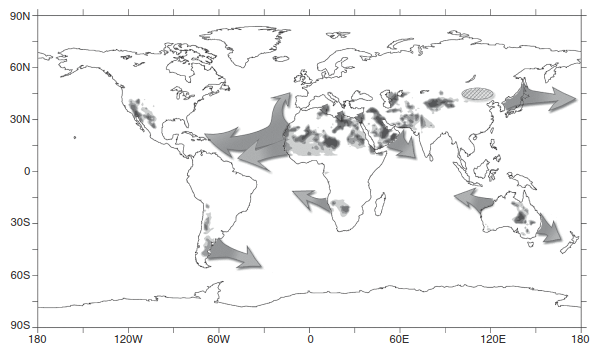
Fig. 31.4. Mineral aerosol source regions and atmospheric transport. Graphic provided courtesy of Joseph Prospero as in Mahowald et al. (2005).
Radiative mechanisms and biogeochemical impacts of dust deposition mediate complex feedbacks across terrestrial and marine ecosystems. Dust deposition is important to the ecology of the biosphere (Field et al. 2010; Ravi et al. 2011), and mineral dust additionally influences climate through a variety of radiative and biogeochemical feedbacks (Mahowald et al. 2011; Ravi et al. 2011). Dust aerosols are both scattering and absorbing and so alter the radiative heating of the atmosphere. Over snow and ice, atmospheric dust decreases top-of-the-atmosphere albedo by reducing the back-scattering of solar radiation to space that would otherwise occur because of the high albedo of snow and ice. At the surface, dirty snow from dust deposition increases the absorption of solar radiation by land, warming the surface. Mineral dust aerosols also carry nutrients such as iron and phosphorus (Jickells et al. 2005; Mahowald et al. 2005, 2008, 2009, 2011). Some of the nutrients deposited into the North Pacific are provided by dust from desert regions of Asia, and Saharan dust similarly deposits nutrients into the North Atlantic.
Trans-Atlantic transport pathways and regional ecohydrological impacts connect desert sources to distant pristine environments. The Sahara Desert is a large source of dust, and plumes of desert dust can extend for several hundreds of kilometers into the Atlantic Ocean, as depicted in Fig. 31.5. Trans-Atlantic transport of dust from North Africa to South America, the Caribbean, and southeastern United States in plumes extending over several hundred kilometers in latitude at altitudes up to 5–7 km is common (Prospero et al. 1981, 1987, 1996; Prospero and Nees 1986; Prospero and Lamb 2003). This transport and deposition of dust influences soil biogeochemistry. Saharan dust has contributed significant amounts of silicate clay and other minerals to soils of the Caribbean and eastern United States seaboard (Herwitz et al. 1996). Winds carry dust from North Africa to the Amazon (Prospero et al. 1981; Swap et al. 1992; Formenti et al. 2001; Martin et al. 2010). In these nutrient-poor soils, critical nutrients such as phosphorus and potassium are delivered in trace amounts by intermittent pulses of dust deposited during rainstorms (Swap et al. 1992; Okin et al. 2004). Thus, the productivity of parts of the rainforest is linked to events in sub-Saharan West Africa 5000 km distant. In particular, the concentration of dust in the Caribbean (at Barbados) correlates with drought in sub-Saharan Africa (Prospero and Nees 1977, 1986; Prospero and Lamb 2003), though this relationship has broken down over the past few decades (Mahowald et al. 2009; Ridley et al. 2014).
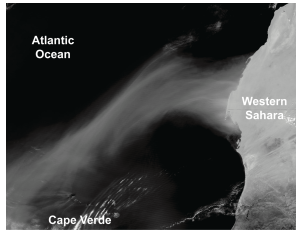
Fig. 31.5. Dust plume off the western coast of Africa extending several hundred kilometers into the Atlantic Ocean past Cape Verde, October 8, 2012. NASA image courtesy Jeff Schmaltz (NASA Goddard Space Flight Center, Greenbelt, Maryland) and provided by NASA's Earth Observatory.
Mountain hydrology and land-atmosphere drought feedbacks exhibit sensitive responses to dust forcing. Dust plays an important role in the hydrology of the western interior of the United States. This region is greatly dependent on the mountain snowpack for water. By decreasing snow albedo, dust causes earlier springtime snowmelt. Grazing, agriculture, and other human activities have degraded the land and greatly increased dust emissions in this region over the past two centuries (Neff et al. 2008). Snow in the mountains melts earlier because of high dust deposition (Painter et al. 2007, 2010, 2012). Dust from far away regions also influences the regional hydrology. Long distance transport of dust and other particles from both Asia and the Sahara Desert have been detected in the Sierra Nevada Mountains of western United States and have been implicated in cloud formation and in enhancing precipitation (Creamean et al. 2013).
In desert regions, dust aerosols may decrease precipitation by cooling the surface and promoting subsidence, thereby reducing convection, and also by aerosol–cloud interactions that reduce drop size and suppress rainfall. Dust emissions may thereby initiate a positive land-atmosphere feedback that enhances drought (Rosenfeld et al. 2001; Ravi et al. 2011; D'Odorico et al. 2013). Dieback of vegetation during drought exposes dry soil and increases dust emissions, which in turn reduces rainfall and decreases soil moisture to prolong the drought. Such a feedback may have occurred during the 1930s Dust Bowl in North America and at other times (Cook et al. 2008, 2009, 2013) and may also operate in North Africa (Nicholson 2000; Prospero and Lamb 2003; Yoshioka et al. 2007; Marcella and Eltahir 2014). An additional feedback loop may be mediated through biogeochemical cycles, whereby increased soil erosion with loss of vegetation decreases soil fertility and further reduces vegetation cover (D'Odorico et al. 2013).
Paleoclimate dust variations and multi-centennial trends underscore the long-term sensitivity of atmospheric dust loading. Over longer timescales, changing biogeography affects the amount of mineral dust in the atmosphere. Dust concentrations have varied over the past 800,000 years and were higher in glacial periods than in interglacials. This could be due to expansion of unvegetated areas in high latitudes and central Asia as a result of increased aridity and lower atmospheric CO₂ concentration (Mahowald et al. 1999, 2006), though other factors such as high winds are also possible (McGee et al. 2010). Over the twentieth century, desert dust may have doubled over much of the world as a result of climate change and anthropogenic land use (Mahowald et al. 2010). Vegetation changes with future climate change and anthropogenic land use are expected to affect dust emissions (Mahowald and Luo 2003; Tegen et al. 2004; Mahowald et al. 2006).
Biomass burning emissions and coupled climate feedbacks integrate greenhouse gas dynamics with short-lived forcing agents. Fires release long-lived greenhouse gases (CO₂, N₂O, CH₄), short-lived reactive gases (CO, NOₓ, VOCs), and organic and black carbon aerosols into the atmosphere, as shown schematically in Fig. 31.6. Smoke emissions influence atmospheric chemistry by forming O₃ and altering the OH radical sink for CH₄. Direct aerosol-radiation and aerosol-cloud interactions modulate climate forcing, while aerosol deposition onto oceans, snow, and ice drives indirect biogeochemical effects and albedo changes.
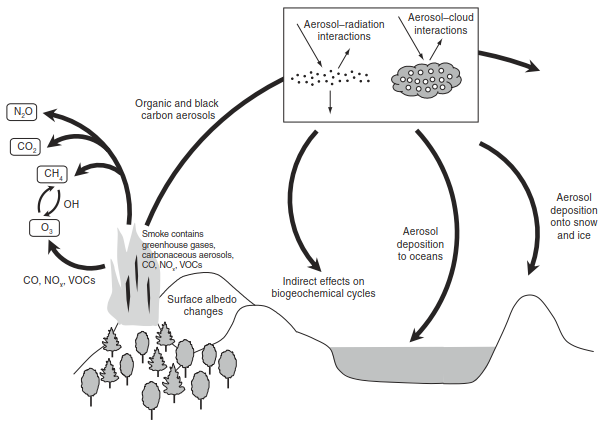
Fig. 31.6. Schematic illustration of the radiative effects of fire. Adapted from Ward et al. (2012). See also Carslaw et al. (2010) and Mahowald et al. (2011) for a review.
Date added: 2026-09-24; views: 1;