
Global Climate Impacts and Dynamics of Anthropogenic Reactive Nitrogen
Anthropogenic production of reactive nitrogen and future global trends have increased substantially over the industrial era, and the total amount of reactive nitrogen (Nr) in the Earth system is likely to continue rising in the future. Global anthropogenic fertilizer usage is projected to reach 90–190 Tg N yr⁻¹, depending on population growth, food demand, improvements in agricultural efficiency, and other socio-ecological factors (Erisman et al. 2008). This projected range represents up to twice the current global usage. Furthermore, global livestock production is also expected to grow substantially (van Vuuren et al. 2011). As a direct consequence of these agricultural trends, global nitrous oxide (N₂O) emissions will continue to increase.
A depiction of a future Earth without climate change policy intervention—represented by the Representative Concentration Pathway RCP8.5—describes large population growth, modest gains in energy efficiency, high fossil fuel energy consumption, and large increases in agricultural land to meet global food demand. Under RCP8.5, emissions of N₂O increase substantially due to expanded fertilizer use and the progressive intensification of agricultural production. A modest climate policy intervention scenario (RCP6.0) similarly describes increased N₂O emissions over the twenty-first century as global cropland area expands to feed a growing population. Emissions decline only under stringent policy scenarios that promote low radiative forcing, such as RCP4.5 and RCP2.6. However, even in these mitigation scenarios, the atmospheric concentration of N₂O continues to increase over the course of the twenty-first century.
United States climate metrics and energy emission trajectories highlight significant contrasts across sector-specific forcing mechanisms (Pinder et al. 2012). While global energy consumption is expected to increase in the future, nitrogen oxide (NOₓ) emissions could decline as a result of stringent air pollution control policies, improvements in fuel efficiency, and structural changes in energy systems (van Vuuren et al. 2011). Conversely, emissions of ammonia (NH₃) are expected to increase globally due to growth in livestock production (van Vuuren et al. 2011).
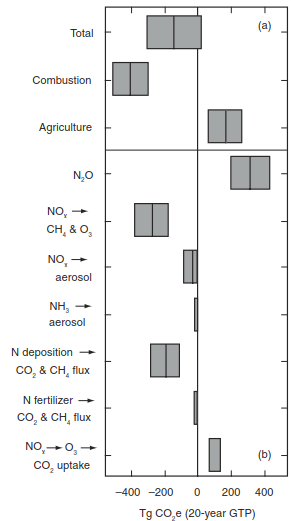
Fig. 30.4. Climate impacts of Nr emissions in the United States expressed in Tg CO₂ equivalents on a 20-year global temperature potential basis. The width of the bar shows the range and the black line is the best estimate. (a) Total forcing and the contribution from combustion and agriculture. (b) Individual forcing components. Adapted from Pinder et al. (2012).
Global deposition patterns and future policy mitigation strategies reflect complex interactions between atmospheric transport, chemical transformations, and socio-economic drivers. Global nitrogen deposition is expected to remain relatively constant at a rate near present-day levels throughout the twenty-first century. This overall stability arises because of increased NHₓ deposition balanced by decreased oxidized nitrogen (NO_y) deposition (Ciais et al. 2013). Regionally, nitrogen deposition is projected to decline across North America and Europe while increasing across Asia. These projected regional shifts in Nr deposition carry low confidence due to uncertainties in emission inventories, atmospheric transport modeling, and deposition process representations.
Key factors determining future Nr emissions include air pollution control measures, agricultural development trajectories, and comprehensive climate change mitigation policies (van Vuuren et al. 2011). Economic activities that emit Nr are likely to grow in the future. Emissions of N₂O and NH₃ depend primarily on agricultural activities, including fertilizer application rates and livestock production practices. The future trajectory of agriculture depends on population growth, socioeconomic development, and global demand for food and fiber, whereas emissions of NOₓ depend on broader trends in energy production and transportation.
Policy interventions and biogeochemical trade-offs in Earth system models demonstrate that anthropogenic alterations to the nitrogen cycle are driven by the same fundamental processes that influence CO₂ emissions: population growth, increasing energy usage, greater demand for food and fiber, and land-use changes to feed growing populations. Policy interventions and socioeconomic developments that limit CO₂ emissions will also reduce the amount of Nr in the Earth system. Moreover, environmental policies targeting the influence of Nr emissions on air quality and water quality may enable management of excess Nr in the Earth system for climate change mitigation. Such policy measures include (Galloway et al. 2008):
· Reducing fossil fuel combustion.
· Implementing technological improvements to reduce NOₓ emissions in fossil fuel combustion systems.
· Decreasing fertilizer usage by increasing the nitrogen-use efficiency of crops and improving fertilizer application management (optimizing timing, place, and rate of application) to reduce N₂O emissions.
· Managing livestock manure to reduce N₂O emissions and NH₃ volatilization.
· Enhancing management of human sewage treatment systems.
Nitrogen management of agricultural systems presents many tractable solutions, provided adequate economic and regulatory incentives are in place to encourage their widespread adoption (Robertson and Vitousek 2009). Climate change mitigation policies must carefully balance the multiple conflicting effects of interventions. For instance, high nitrogen application to cultivate biofuel crops could cancel the CO₂ sequestration benefits of biofuels by contributing to increased N₂O emissions and elevated ground-level tropospheric ozone.
Much of our current understanding of the climate effects of anthropogenic Nr stems from syntheses of field manipulation experiments in response to nitrogen additions or greenhouse gas inventory analyses. However, the full representation of climate–nitrogen interactions in Earth system models remains incomplete. Observational estimates of carbon gain in forest ecosystems following nitrogen addition are highly variable, though it is generally accepted that nitrogen enrichment stimulates plant growth and decreases organic matter decomposition rates, thereby increasing terrestrial carbon storage and providing a negative radiative forcing. Field experiments show that low nitrogen availability can restrict plant productivity responses under elevated CO₂ enrichment.
Global terrestrial biosphere models incorporating coupled carbon–nitrogen biogeochemistry simulate less carbon gain under elevated atmospheric CO₂ concentrations compared to carbon-only models. Nevertheless, substantial variability exists among Earth system models regarding both their response to nitrogen enrichment and the nitrogen downregulation of CO₂ fertilization, with little scientific consensus on how to parameterize key aspects of carbon–nitrogen biogeochemistry (Zaehle and Dalmonech 2011). Nor do current models fully replicate observed historical changes in carbon and nitrogen cycles under elevated CO₂ (Zaehle et al. 2014). Moreover, a comprehensive representation of the full radiative forcing of anthropogenic Nr, including complex chemistry–climate interactions, is lacking in the current generation of Earth system models. Improving the understanding and modeling of nitrogen in the Earth system remains a critical requirement for accurately simulating anthropogenic climate change over the coming century. A complete understanding of the effects of increased Nr on climate requires a multidisciplinary integration of biogeochemical and ecological processes with an understanding of their effects on atmospheric chemistry, composition, and radiative forcing, alongside socioeconomic drivers of global nitrogen use.
Date added: 2026-09-24; views: 1;