
Reactive Nitrogen in the Earth System: Climate Interactions and Cascades
Overview of Reactive Nitrogen and Global Climate. Reactive nitrogen (Nr) dynamics represent a critical variable in Earth system science, directly influencing the global climate system through interconnected biogeochemical pathways. The cycling of reactive nitrogen has escalated significantly since the preindustrial era due to anthropogenic activities. By definition, reactive nitrogen includes all chemically active nitrogen compounds except dinitrogen gas (N₂). These encompass gaseous species such as ammonia (NH₃), nitrous oxide (N₂O), nitric oxide (NO), and nitrogen dioxide (NO₂); inorganic ionic species including ammonium (NH₄⁺), nitrite (NO₂⁻), and nitrate (NO₃⁻); as well as various organic nitrogen compounds. Within atmospheric and environmental chemistry, generalized expressions are employed: NHₓ represents reduced nitrogen compounds (NHₓ = NH₄⁺ + NH₃), NOₓ denotes nitrogen oxides (NOₓ = NO + NO₂), and NO_y incorporates all oxidized nitrogen species including NOₓ, nitric acid (HNO₃), organic nitrates, and related molecules. Nitric acid itself functions as a primary atmospheric oxidation product of NO₂.
Natural and Anthropogenic Nitrogen Flows. Biogeochemical nitrogen inputs in unperturbed natural ecosystems originate predominantly from atmospheric lightning and biological nitrogen fixation (BNF), which convert inert atmospheric N₂ into bioavailable forms. Natural gaseous losses occur through microbial nitrification and denitrification, releasing NO, N₂O, and N₂ back into the atmosphere, alongside ammonia volatilization, which represents the loss of gaseous NH₃ to the atmosphere. Since the onset of the industrial era, this baseline balance has been substantially disrupted by human additions of Nr generated via industrial operations and agricultural activities. Anthropogenic sources comprise chemical fertilizer production and application, cultivation of legume crops and other nitrogen-fixing species, fossil fuel combustion, and various industrial manufacturing processes.
Global Reactive Nitrogen Budget. Anthropogenic sources of reactive nitrogen currently add over 200 Tg N yr⁻¹ to the Earth system, an amount approximately equal to total natural creation rates. As detailed in Table 30.1, these anthropogenic and natural inputs drive large atmospheric fluxes of NOₓ and NH₃, which are subsequently redeposited onto terrestrial land surfaces and oceanic waters as NO_y and NHₓ via dry deposition of gases and aerosols and wet deposition in precipitation.
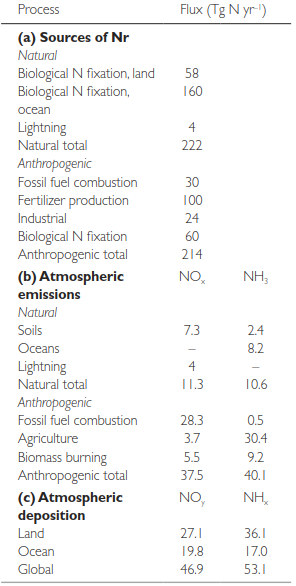
Table 30.1. Global nitrogen budget with (a) creation of Nr from N₂ by natural and anthropogenic sources, (b) natural and anthropogenic emissions of NOₓ and NH₃, and (c) atmospheric deposition of NO_y and NHₓ. Source: From Ciais et al. (2013)
Anthropogenic NOₓ and NH₃ Emission Pathways. Soils and lightning discharges naturally release minor quantities of NOₓ into the atmosphere. However, human activities contribute three-quarters of the total 49 Tg NOₓ-N added to the atmosphere annually. The primary anthropogenic drivers of NOₓ emissions are fossil fuel combustion, biomass burning, and fertilizer usage, with fossil fuel combustion alone accounting for 75 percent of all human-driven NOₓ emissions. Once emitted into the atmosphere, NOₓ undergoes oxidation to form nitric acid (HNO₃) and organic nitrates within hours to days, subsequently forming tropospheric ozone and secondary aerosols. Deposited NOₓ onto land surfaces occurs in various chemical configurations collectively classified as NO_y.
Atmospheric Ammonia Dynamics and Aerosol Chemistry. Emissions of atmospheric ammonia (NH₃) yield a reactive nitrogen flux of 51 Tg NH₃-N yr⁻¹, matching the magnitude of global NOₓ emissions. While natural sources emit a small portion of atmospheric NH₃-N, agricultural operations represent the dominant source. Approximately 80% of the 51 Tg NH₃-N yr⁻¹ emitted originates from the volatilization of livestock wastes, synthetic fertilizer application, and biomass burning. Volatilization converts soil and waste ammonium ions (NH₄⁺) into gaseous NH₃. In the atmosphere, gaseous NH₃ reacts with sulfuric acid (H₂SO₄, generated via SO₂ oxidation) and HNO₃ to yield ammonium sulfate and ammonium nitrate secondary aerosols. Gaseous NH₃ and its derivative aerosols return to land surfaces through dry and wet deposition, collectively referred to as NHₓ deposition.
Environmental Impacts and the Nitrogen Cascade. Accumulation of reactive nitrogen across environmental reservoirs triggers widespread ecological disruptions known as the nitrogen cascade (Galloway et al. 2003, 2008). Natural and anthropogenic NOₓ and NH₃ emissions supply approximately 100 Tg N yr⁻¹ to the atmosphere, while atmospheric deposition of NO_y and NHₓ returns an equivalent flux of reactive nitrogen back to terrestrial and marine ecosystems. This elevated nitrogen loading drives the acidification of soils, rivers, and lakes; accelerates biodiversity loss; alters the structure and function of terrestrial, freshwater, and marine ecosystems; pollutes drinking water sources; causes coastal eutrophication; and degrades regional air quality.
Radiative Forcing and Greenhouse Gas Dynamics. Anthropogenic nitrogen additions substantially alter the atmospheric concentration of major greenhouse gases and climate-forcing agents. As illustrated in Fig. 30.1, the most direct warming mechanism occurs through increased emissions of nitrous oxide (N₂O). Fossil fuel combustion, agricultural Nr inputs (via synthetic fertilizer and manure applications), biomass burning, and related human activities drive N₂O emissions into the atmosphere. Total anthropogenic sources of N₂O are now equal in magnitude to natural terrestrial sources. In the stratosphere, N₂O plays a dual role by contributing to greenhouse warming and participating in catalytic reactions that destroy stratospheric ozone (O₃).
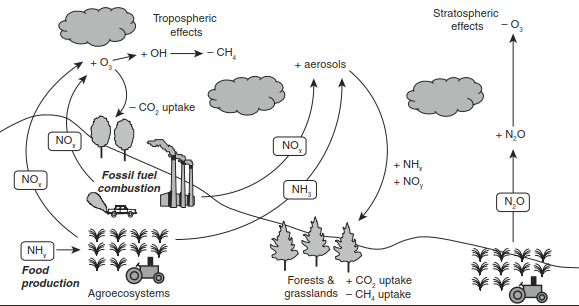
Fig. 30.1. Figure/scheme title: Nitrogen and climate interactions in the nitrogen cascade. Fossil fuel combustion, food production, and other human activities add NOₓ, NH₃, and N₂O to the atmosphere, with consequences for tropospheric and stratospheric ozone, aerosols, N₂O, CH₄ destruction, Nr deposition, and terrestrial CO₂ uptake. Adapted from Erisman et al. (2011). See also Galloway et al. (2003, 2008), Gruber and Galloway (2008), and Hertel et al. (2012).
Terrestrial Carbon Sinks and Methane Oxidation. Deposition of NHₓ and NO_y onto terrestrial ecosystems enhances net carbon storage by stimulating plant growth and forest productivity. However, elevated Nr deposition concurrently modifies methane (CH₄) dynamics in terrestrial soils. Well-drained aerobic soils function as an active sink for atmospheric CH₄ through methanotrophic oxidation. Additional reactive nitrogen deposition suppresses bacterial CH₄ consumption rates, thereby increasing atmospheric methane concentrations. Conversely, in wetland environments, added Nr can stimulate plant productivity, potentially elevating CH₄ emissions. High concentration of tropospheric ozone additionally causes foliar damage to plants and suppresses terrestrial CO₂ uptake.
Tropospheric Photochemistry and Secondary Aerosols. Atmospheric chemistry perturbations caused by short-lived NOₓ and NH₃ emissions play a complex role in radiative climate forcing. While NOₓ and NH₃ have little to no direct radiative forcing effect, they react to form secondary sulfate and nitrate aerosols that scatter incoming solar radiation. Furthermore, in the presence of carbon monoxide (CO) and volatile organic compounds (VOCs), NOₓ reactions drive the photochemical formation of tropospheric ozone (O₃). Tropospheric O₃ functions as a potent greenhouse gas. Concurrently, these photochemical pathways generate hydroxyl radicals (OH), expanding the troposphere's oxidation capacity and increasing the atmospheric destruction rate of CH₄. Because these cooling and warming mechanisms act in opposing directions, the overall net radiative effect of anthropogenic reactive nitrogen on climate remains uncertain.
Date added: 2026-09-24; views: 3;