
Stratospheric and Tropospheric Atmospheric Chemistry of Reactive Nitrogen
Stratospheric Ozone Depletion and Nitrous Oxide Dynamics. Stratospheric ozone depletion is driven significantly by reactive nitrogen species, among which nitrous oxide (N₂O) plays a predominant role. In the stratosphere, N₂O acts as a primary anthropogenic ozone-depleting substance (Ravishankara et al. 2009). The destruction of atmospheric N₂O occurs mainly through solar photolysis, which accounts for approximately 90% of total N₂O loss:
· N₂O + hν → N₂ + O (Eq. 30.1)
where hν represents a single photon of electromagnetic radiation. The remaining 10% of N₂O breakdown proceeds via chemical reactions with excited atomic oxygen (O):
· N₂O + O → 2NO (Eq. 30.2)
· N₂O + O → N₂ + O₂ (Eq. 30.3)
Reaction (30.2) is exceptionally critical to stratospheric ozone chemistry. The nitric oxide (NO) radical produced via Reaction (30.2) catalytic destroys stratospheric ozone (O₃) through the following reaction sequence:
· NO + O₃ → NO₂ + O₂ (Eq. 30.4)
· NO₂ + O → NO + O₂
The overall net catalytic ozone destruction cycle is summarized as:
· O₃ + O → 2O₂ (Eq. 30.5)
These reactions destroy one molecule of ozone without consuming the catalytic NO or NO₂ molecules.
Tropospheric Ozone Photochemistry and NOₓ Regulators. Tropospheric chemistry and radiative forcing are strongly governed by short-lived reactive nitrogen gases, specifically NOₓ and NH₃. In contrast to long-lived greenhouse gases such as CO₂, CH₄, and N₂O, short-lived reactive nitrogen species drive rapid atmospheric transformations that control hydroxyl radical (OH) concentrations, consume methane, and form secondary aerosols. Tropospheric ozone (O₃) is both a major greenhouse gas and a harmful air pollutant that damages human health and vegetation. Photochemical production of tropospheric ozone relies on the oxidation of carbon monoxide (CO), methane (CH₄), and nonmethane volatile organic compounds (VOCs) in the presence of NOₓ.
Nitrogen oxides serve as key regulators of tropospheric ozone via rapid interconversion between NO₂ and NO. The primary source of atomic oxygen required for ozone formation in the troposphere is the photolysis of NO₂:
· NO₂ + hν → NO + O (Eq. 30.6)
Atomic oxygen immediately combines with molecular oxygen (O₂) in the presence of a third body (M) to form ozone:
· O + O₂ + M → O₃ + M (Eq. 30.7)
However, ozone is concurrently consumed via reaction with NO to regenerate NO₂:
· NO + O₃ → NO₂ + O₂ (Eq. 30.8)
This rapid daytime interconversion cycle is expressed as:
· NO₂ --(hν + O₂)--> NO + O₃ (Eq. 30.9)
Because Reaction (30.8) consumes ozone as quickly as it is generated via Reactions (30.6) and (30.7), this rapid cycling does not yield net ozone production on its own. Net ozone accumulation occurs when alternative chemical pathways oxidize NO to NO₂ without consuming ozone.
Carbon Monoxide Oxidation and Hydroperoxy Radicals. Net tropospheric ozone accumulation is initiated when carbon monoxide (CO) is oxidized by the hydroxyl radical (OH):
· CO + OH → CO₂ + H (Eq. 30.10)
The resulting hydrogen atom (H) rapidly binds with molecular oxygen to yield the hydroperoxy radical (HO₂):
· H + O₂ + M → HO₂ + M (Eq. 30.11)
The hydroperoxy radical then oxidizes NO to NO₂ without destroying ozone:
· HO₂ + NO → OH + NO₂ (Eq. 30.12)
Subsequently, NO₂ undergoes photolysis via Reactions (30.6) and (30.7) to produce ozone. The overall coupled oxidation cycle is represented by:
· CO + OH --(O₂)--> HO₂ + CO₂
· HO₂ + NO → OH + NO₂ (Eq. 30.13)
· NO₂ --(hν + O₂)--> NO + O₃
The net chemical conversion consumes CO and O₂ in the presence of sunlight and NOₓ to yield CO₂ and O₃ (CO + 2O₂ → CO₂ + O₃) without consuming OH or HO₂.
Volatile Organic Compound Oxidation and Methane Lifetimes. Volatile organic compounds (VOCs) in the presence of NOₓ similarly drive tropospheric ozone accumulation (as shown in Fig. 30.2a). Oxidation of hydrocarbons (RH) by OH yields organic peroxy radicals (RO₂), which convert NO to NO₂ in a manner analogous to HO₂ radicals:
· RO₂ + NO → RO + NO₂ (Eq. 30.14)
where R represents a hydrocarbon functional group (e.g., CH₃).
Methane (CH₄) represents a fundamental VOC whose atmospheric oxidation cycle (shown in Fig. 30.2b) illustrates these radical interactions. Methane destruction in the troposphere begins with OH oxidation:
· CH₄ + OH → CH₃ + H₂O (Eq. 30.15)
The resulting methyl radical (CH₃) combines instantaneously with molecular oxygen:
· CH₃ + O₂ + M → CH₃O₂ + M (Eq. 30.16)
The methyl peroxy radical (CH₃O₂) then reacts with NO to produce the methoxy radical (CH₃O) and NO₂:
· CH₃O₂ + NO → CH₃O + NO₂ (Eq. 30.17)
Reaction (30.17) is a pivotal step in ozone production because it converts NO to NO₂ without consuming ozone. The resulting NO₂ undergoes photolysis to yield ozone. Next, CH₃O reacts with molecular oxygen to produce formaldehyde (HCHO) and a hydroperoxy radical:
· CH₃O + O₂ → HCHO + HO₂ (Eq. 30.18)
The generated HO₂ converts an additional NO molecule to NO₂ (via Eq. 30.12), regenerating OH. Thus, the complete oxidation of one methane molecule consumes two NO molecules, generates two NO₂ molecules, and ultimately forms two ozone molecules. Formaldehyde itself undergoes further OH oxidation and photolysis to produce additional ozone.
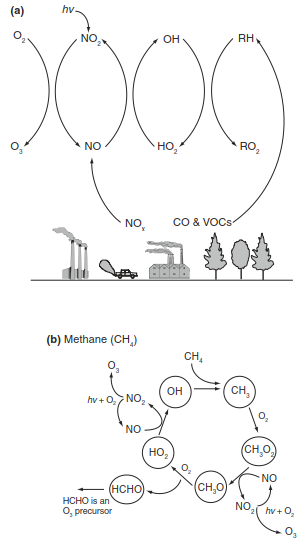
Fig. 30.2. Figure/scheme title: Processes by which Nr in combination with volatile organic compounds (VOCs) produce ozone. (a) General illustration of VOC-NOₓ-O₃ chemistry and the oxidation of RH to RO₂ by OH. For methane, R = CH₃. (b) Specific illustration for methane. The cycle begins with the hydroxyl radical (OH) oxidizing methane. The OH radical is regenerated in reactions with two NO that produce two NO₂, each of which forms one O₃. The net result of the cycle is to oxidize one methane molecule and form two ozone molecules. Additional reactions yield formaldehyde (HCHO), which produces more ozone.
Regimes of Ozone Sensitivity and VOC/NOₓ Ratios. Ozone production sensitivity depends nonlinearly on the relative ambient concentrations of VOCs and NOₓ (Chameides et al. 1988):
· VOC-limited regime (low VOC/NOₓ ratio): Commonly found in polluted urban environments, ozone generation is constrained by VOC availability. Increasing VOC concentrations enhances ozone formation, whereas increasing NOₓ concentrations can actually suppress local ozone levels.
· NOₓ-limited regime (high VOC/NOₓ ratio): Typically present in rural and unpolluted atmospheric environments, ozone production is strictly limited by NOₓ availability. In this regime, ozone generation is proportional to NOₓ concentrations and largely insensitive to changes in VOC levels.
Biogenic VOC emissions from vegetation play a critical role in ozone formation across regions with significant NOₓ pollution.
Hydroxyl Radical Dynamics and Atmospheric Oxidation Capacity. Hydroxyl radicals (OH) act as the primary chemical detergent in the troposphere, controlling the atmospheric lifetime of many pollutants and greenhouse gases (Prinn 2003). The principal source of tropospheric OH is the photolysis of ozone by solar ultraviolet radiation:
· O₃ + hν → O + O₂ (Eq. 30.19)
While most excited oxygen atoms (O) recombine with O₂ to reform ozone, a fraction reacts with atmospheric water vapor to generate OH radicals:
· O + H₂O → 2OH (Eq. 30.20)
Hydroxyl radicals react rapidly with atmospheric constituents, exhibiting an atmospheric lifetime on the order of seconds. By oxidizing CO, CH₄, and nonmethane VOCs, OH removes these species from the atmosphere. Consequently, emissions of NOₓ enhance tropospheric OH levels, thereby accelerating methane destruction and reducing its atmospheric lifetime.
Secondary Aerosol Formation Mechanisms. Atmospheric aerosol formation represents another vital pathway through which reactive nitrogen influences tropospheric chemistry and radiative forcing. Emitted NOₓ and NH₃ participate in complex chemical networks that yield secondary ammonium nitrate and ammonium sulfate aerosols. Gaseous ammonia reacts with gas-phase nitric acid (HNO₃, derived from NOₓ oxidation) to form solid or aqueous ammonium nitrate:
· NH₃(g) + HNO₃(g) ⇌ NH₄NO₃(s) (Eq. 30.21)
Ammonium nitrate formation is favored in regions with elevated NH₃ and HNO₃ concentrations alongside low sulfate levels. Under conditions of high relative humidity, ammonium nitrate dissolves to form an aqueous solution of NH₄⁺ and NO₃⁻ ions rather than remaining a solid salt.
Sulfuric acid (H₂SO₄), formed via atmospheric sulfur dioxide (SO₂) oxidation, competes strongly for available ammonia. In ammonia-poor atmospheric environments, sulfuric acid reacts sequentially with NH₃ to yield ammonium bisulfate and ammonium sulfate:
· NH₃(g) + H₂SO₄(g) ⇌ (NH₄)HSO₄(s) (Eq. 30.22)
· NH₃(g) + (NH₄)HSO₄(g) ⇌ (NH₄)₂SO₄(s) (Eq. 30.23)
In ammonia-rich environments, any excess ammonia remaining after neutralizing sulfuric acid reacts with nitric acid to form secondary NH₄NO₃ aerosols.
Date added: 2026-09-24; views: 3;