
Impacts of Anthropogenic Reactive Nitrogen on Global Climate
Anthropogenic reactive nitrogen and radiative forcing mechanisms play a fundamental role in regulating Earth's global climate system through complex alterations in atmospheric chemistry, aerosol dynamics, and greenhouse gas concentrations. Extensive scientific reviews demonstrate that anthropogenic additions of reactive nitrogen (Nr) derived primarily from fossil fuel combustion and agricultural activities exert both warming and cooling effects on global radiative forcing (Galloway et al. 2008; Arneth et al. 2010; Erisman et al. 2011). The overall net climate impact represents a delicate balance between positive radiative forcing (warming) driven by nitrous oxide (N₂O) emissions and tropospheric ozone production, and negative radiative forcing (cooling) induced by atmospheric aerosols, enhanced terrestrial carbon storage, and reduced atmospheric methane (CH₄) concentrations.
Carbon dioxide dynamics in terrestrial forest ecosystems are strongly modulated by atmospheric reactive nitrogen deposition. When anthropogenic Nr is deposited onto nitrogen-limited forest ecosystems, it stimulates plant productivity and enhances carbon storage in terrestrial vegetation and soils. This enhanced sequestration leads to a reduced rate of accumulation of anthropogenic CO₂ emissions in the atmosphere, thereby directly decreasing the positive radiative forcing attributable to atmospheric carbon dioxide.
Methane photochemistry and oxidation mechanisms are significantly altered by reactive nitrogen compounds. The complex atmospheric oxidation chemistry involving volatile organic compounds, nitrogen oxides, and ozone (VOC–NOₓ–O₃) generates hydroxyl radicals (OH), which serve as the primary chemical sink for atmospheric methane. Methane is a potent greenhouse gas with a global warming potential over a 100-year time horizon that is 28 times greater than that of CO₂, alongside an atmospheric lifetime of approximately 12 years (Myhre et al. 2013). By accelerating atmospheric CH₄ depletion, emissions of NOₓ effectively reduce the positive radiative forcing of methane, representing the dominant mechanism through which reactive nitrogen impacts methane balances. Secondary effects stemming from changes in CH₄ production and consumption dynamics within agricultural and natural soils remain poorly understood.
Nitrous oxide emissions and atmospheric radiative forcing represent a major warming driver linked to anthropogenic reactive nitrogen additions. Agricultural fertilizer and manure applications to soils, fossil fuel combustion, biomass burning, and additional industrial activities significantly increase global N₂O production. Nitrous oxide is a powerful greenhouse gas with an atmospheric lifetime of 121 years and a 100-year global warming potential 265 times that of CO₂ (Myhre et al. 2013). Consequently, additional N₂O emissions exert a strong positive radiative forcing on the global climate system.
Tropospheric ozone generation and plant productivity impacts are directly linked to ambient NOₓ emissions. The photochemical oxidation of carbon monoxide (CO), methane (CH₄), and nonmethane VOCs in the presence of NOₓ leads to net tropospheric ozone formation. Tropospheric ozone acts as a greenhouse gas that imparts a positive radiative forcing. Furthermore, elevated ground-level ozone concentrations damage foliage and reduce plant productivity, which diminishes the capacity of terrestrial ecosystems to sequester anthropogenic CO₂ emissions and indirectly enhances climate warming (Collins et al. 2010).
Stratospheric ozone depletion and ultraviolet radiation interactions involve distinct reactive nitrogen pathways. Transport of N₂O into the stratosphere results in catalytic ozone destruction. Because stratospheric ozone exerts a minor negative radiative forcing on Earth's surface climate, the depletion and net loss of stratospheric ozone translates into a positive radiative forcing.
Aerosol formation pathways and surface diffuse light scattering contribute substantially to climate cooling. Atmospheric emissions of NOₓ and ammonia (NH₃) react to form secondary inorganic aerosols, including ammonium sulfate and ammonium nitrate, as well as secondary organic aerosols. These airborne particulate aerosols impart a direct negative radiative forcing by scattering incoming solar radiation back into space and altering cloud condensation processes. Furthermore, atmospheric aerosols increase the proportion of diffuse solar radiation penetrating deeper into forest canopies, which stimulates light use efficiency and terrestrial CO₂ uptake, although this canopy effect remains smaller than direct aerosol-radiation and aerosol-cloud interactions.
Surface albedo variations and forest canopy optics represent a complex, poorly understood nitrogen-climate interaction. Variations in foliage nitrogen content alter surface radiative reflectivity across temperate and boreal forest biomes (Ollinger et al. 2008; Hollinger et al. 2010). Higher canopy nitrogen concentrations correlate positively with increased canopy albedo, driven by a relationship between leaf nitrogen levels and canopy near-infrared reflectance. This suggests a potentially significant role for nitrogen in climate regulation via solar radiation absorption, though the exact biophysical mechanisms—whether driven by canopy structural changes or environmental co-variations—remain subject to ongoing research (Wicklein et al. 2012; Knyazikhin et al. 2013; Ollinger et al. 2013; Leonardi et al. 2015).
Net radiative balance and anthropogenic climate forcing estimates reflect competing warming and cooling mechanisms. Overall, reactive nitrogen is estimated to reduce positive anthropogenic radiative forcing by a small net amount. According to Erisman et al. (2011), increased N₂O and ozone-induced plant damage increase radiative forcing, whereas Nr deposition and NH₃ and NOₓ emissions reduce forcing. The overall net climate impact of reactive nitrogen on the global radiative balance is estimated at -0.24 W m⁻², within a wide uncertainty range from +0.2 to -0.5 W m⁻², compared to total net anthropogenic radiative forcing of 2.3 W m⁻² (Myhre et al. 2013).
Terrestrial carbon sink responses versus nitrous oxide warming highlight major biogeochemical trade-offs. Reviews of experimental field studies demonstrate that increased N₂O emissions diminish, but do not fully offset, the positive climate benefits of nitrogen-stimulated carbon uptake (Liu and Greaver 2009). Regional assessment models for Europe (Butterbach-Bahl et al. 2011) and the United States (Pinder et al. 2012) indicate that negative radiative forcing from enhanced carbon sequestration generally offsets positive radiative forcing from N₂O on short timescales. However, global modeling analyses indicate a contrary long-term pattern, where positive radiative forcing from N₂O emissions exceeds negative radiative forcing from terrestrial CO₂ sequestration (Zaehle et al. 2011).
· 1st stage: Evaluation of global land-cover changes, carbon dioxide fertilization effects, and reactive nitrogen additions on global terrestrial biogeochemistry.
· 2nd stage: Quantification of radiative forcing contributions across CO₂ and N₂O atmospheric budgets.
Using a global terrestrial biosphere model with coupled carbon-nitrogen biogeochemistry, Zaehle et al. (2011) demonstrated that anthropogenic Nr inputs from fertilizer application and atmospheric deposition accounted for approximately 20% of net terrestrial carbon storage between 1996 and 2005, while simultaneously driving the majority of global N₂O emission increases.
Fig. 30.3. Biogeochemical contribution of anthropogenic Nr and other global environmental changes to the present-day radiative forcing of (a) CO₂ and (b) N₂O. Shown are the individual contributions of land-cover change, CO₂ fertilization, climate change, and Nr additions as well as the total radiative forcing. Adapted from Zaehle et al. (2011).
Regional variability in reactive nitrogen climate impacts demonstrates strong spatial heterogeneity across latitude bands. Anthropogenic Nr additions significantly enhance carbon storage in the 30–60° N temperate band, accounting for up to 25% of net carbon gains in eastern North America, central Europe, India, and China. Conversely, N₂O emissions show the largest agricultural increases in the 20–40° N tropical and subtropical regions.
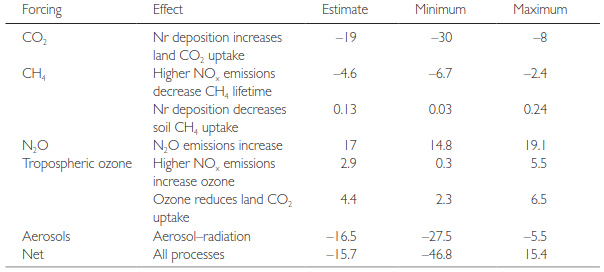
Table 30.2 Global radiative forcing (mW m⁻²) attributed to European anthropogenic Nr emissions. Note: Aerosol–cloud interactions were not estimated. Source: From Butterbach-Bahl et al. (2011).
European anthropogenic reactive nitrogen budget estimates illustrate a net cooling effect on global climate. Butterbach-Bahl et al. (2011) assessed European anthropogenic Nr emissions and determined a net negative radiative forcing of -15.7 mW m⁻². Total positive warming forcing of 24 mW m⁻²—comprising N₂O emissions (17 mW m⁻²), tropospheric ozone production (2.9 mW m⁻²), plant ozone damage (4.4 mW m⁻²), and reduced soil methane uptake (0.13 mW m⁻²)—is countered by negative forcing equal to -40 mW m⁻². The primary cooling contributors include carbon uptake from nitrogen deposition (-19 mW m⁻²), secondary atmospheric aerosol cooling (-16.5 mW m⁻²), and reduced methane lifetime (-4.6 mW m⁻²). However, net European estimates carry high uncertainty, spanning from weak warming (+15.4 mW m⁻²) to strong cooling (-46.8 mW m⁻²).
United States climate impact metrics and temporal dynamics reveal distinct sectoral contrasts between industrial combustion and agricultural emissions (Pinder et al. 2012). Over a 20-year timeframe, Nr exerts an overall cooling effect in the United States, dominated by NOₓ–O₃–CH₄ atmospheric chemistry and enhanced terrestrial carbon sequestration. Fossil fuel combustion emissions yield net cooling through NOₓ pathways, whereas agricultural emissions drive net warming primarily through N₂O generation.
Temporal evolution of short-lived versus long-lived climate forcing agents determines the long-term climate trajectory of reactive nitrogen. Because atmospheric lifetimes of cooling aerosols and NOₓ photo-products are short, their cooling influence becomes negligible on a 100-year time horizon. Over 100-year timeframes, the net global effect of reactive nitrogen transitions from cooling to persistent warming because nitrous oxide remains active in the atmosphere for over a century.
Date added: 2026-09-24; views: 2;