
The Strategic, Political, and Military Dynamics of Pre-Conquest Gaul
Caesar’s Initial Strategic Priorities and the Geo-Political Structure of Gaul. In 58 BC, the precise trajectory of Julius Caesar’s military campaigns remained uncertain. Assigned Cisalpine Gaul and Illyricum as his initial proconsular provinces, with Transalpine Gaul added following the unexpected death of its governor, Caesar may originally have intended to direct his forces toward a Balkan campaign. This potential expedition was aimed at suppressing the rising power of Burebista, the Dacian King, who was consolidating a vast empire centered around modern Transylvania. The wealthy, unexplored territories of the Balkans offered tremendous military prestige. Although ongoing geopolitical events shifted Caesar’s operational focus toward Gaul, the strategic objective of checking Dacian power remained a priority throughout his life; he was preparing a major expedition against Dacia in 44 BC when he was assassinated.
Ethno-Linguistic Division and Socio-Political Organization. In the first century BC, the geographical expanse of Gaul spanned modern France, Belgium, and portions of the Netherlands, extending from the Rhine to the Atlantic coast. It did not constitute a unified nation. As Caesar famously outlined in the opening passage of his Commentaries on the Gallic War (Commentarii de Bello Gallico), the territory was divided among three distinct ethno-linguistic groups:
- Aquitanians: Inhabited the southwest bordering the Pyrenees, sharing cultural and linguistic ties with the Iberians.
- Belgians: Controlled the northern and northeastern regions.
- Celts (Gauls): Occupied central Gaul, referred to as Galli by the Romans and Celts by themselves.
Each major group comprised numerous independent sub-units. The fundamental political building block was the clan (pagus), several of which formed a tribe (civitas). While scholars debate whether civitas is better translated as "state" or "tribe," these political bodies grew in prominence during the century preceding Caesar’s arrival, reinforcing long-standing kinship and ritual ties. Political authority within tribes varied: while some retained traditional monarchies, most were governed by oligarchic senatorial councils and annually elected magistrates. For instance, Rome’s chief ally, the Aedui, were led by a supreme magistrate called the Vergobret, who served a non-renewable one-year term to prevent dynastic autocracy. This system closely mirrored Mediterranean republican governance structures.
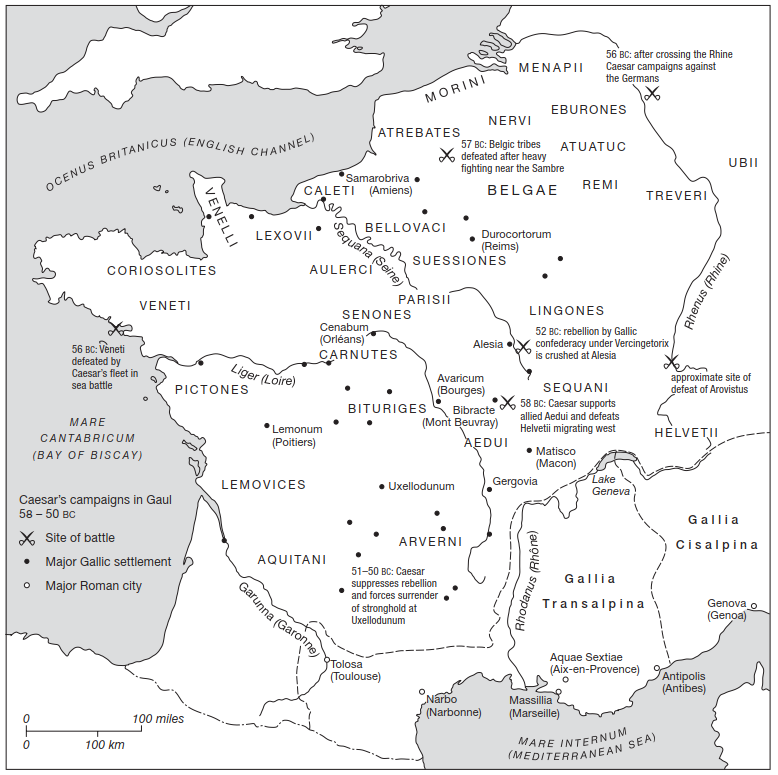
Fig. 1. Caesar's campaigns in Gaul (58–50 BC) depicting tribal territories, major settlements, and key battle sites.
Archaeological Perspectives and the Germanic Boundary. Although Caesar defined the River Rhine as a strict boundary separating the Gauls from the Germanic tribes, archaeological evidence reveals a more nuanced reality. Material culture—such as pottery styles, metalwork, and settlement layouts—shows continuous stylistic overlaps across the Rhine, particularly in central areas. Modern scholars emphasize that archaeology reflects material consumption rather than strict ethnic identity. Gauls and Germans maintained distinct linguistic and cultural identities, perceiving each other as foreign despite shared material traits or geographical proximity.
Socio-Economic Development and Mediterranean Trade Networks. Long-standing contact between Gaul and the Mediterranean had significant historical precedence, including the Gallic sack of Rome in 390 BC and the subsequent Roman subjugation of the Po Valley. Around 125 BC, Rome conquered Transalpine Gaul to secure a land corridor to Spain, a campaign led in part by Cnaeus Domitius Ahenobarbus, who constructed the vital strategic highway, the Via Domitia. Rome established a major colony at Narbo (modern Narbonne) in 118 BC, turning it into a thriving commercial hub.
The Italian Trade Expansion and Urbanization (Oppida). Commercial exchange flourished as luxury goods from Italian latifundia flowed over the Alps. Italian wine was the primary trade commodity; estimates suggest that over 40 million wine amphorae were traded into Gaul during the first century BC alone. In exchange for Italian wine and luxury items, Gallic elites supplied raw materials—such as British tin—and large numbers of slaves. This trade catalyzed structural changes across Gaul, fostering political centralization and the growth of fortified urban centers known as oppida. Key settlements, such as the Aeduan capital at Bibracte (Mont Beuvray)—which spanned 135 hectares—became centers for administrative governance, regional trade, standardized coinage minting, and specialized manufacturing.
Social Structure, Religion, and Military Culture. Gallic society was strictly stratified, dominated by a warrior aristocracy (equites) and a priestly class known as druids. The general population held little political autonomy, remaining bound to powerful chieftains.
The Role and Influence of the Druids. Druids served as guardians of religion, judicial arbitration, and tribal custom. Their authority rested on years of oral training; they deliberately refrained from committing their doctrines to writing to preserve memory and maintain exclusive control over sacred knowledge. Druids held a unified annual assembly in the territory of the Carnutes, though their political ability to unite factional tribes remained limited. They taught the doctrine of the immortality of the soul, which reinforced martial valor among warriors. They also presided over religious rituals, including ritual offerings and human sacrifices—often utilizing large wicker constructs—though the extent of such practices remains a subject of ongoing historical analysis. Head-hunting was widely practiced among warriors, as documented by classical authors like Poseidonius and Strabo, and corroborated by archaeological finds at sites like Entremont and Ribemont-sur-Ancre.
Gallic Warfare and Military Equipment. Gallic armies relied heavily on individual bravery and the prestige of martial retinues rather than formal military drill or logistical networks.
| Equipment Category | Gallic Warrior Standards JPGЕщё 1 | Roman Legionary Standards JPGЕщё 2 |
| Armor Protection | Limited; mail armor (lorica) reserved for elites. Most fought with shields only. | Standardized iron mail armor (lorica hamata) and bronze/iron helmets. |
| Primary Shield | Large oval/wooden shields. | Plywood-constructed scutum with metal boss (22 lbs). |
| Melee Weapons | Long slashing swords. | Double-edged thrusting/slashing steel gladius. |
| Ranged Weapons | Javelins and spears; specialized missile troops (allies). | Heavy throw-javelin (pilum) with bending iron shank. |
| Cavalry/Mobility | High-quality native cavalry led by aristocratic chieftains. | Relied almost entirely on foreign auxiliary cavalry (auxilia). |
Pre-Conquest Political Instability in Gaul. Prior to Caesar's arrival in 58 BC, the geopolitical landscape of Gaul was volatile. Transalpine Gaul had recently put down a major uprising by the Allobroges in 60 BC. Concurrently, an intense conflict persisted between the Aedui and the Sequani for dominance over the strategic Rhône-Saône trade corridor. Around 71 BC, the Sequani enlisted the aid of the Germanic king Ariovistus, who defeated the Aedui and settled his followers on Gallic lands. Although the Aeduan druid Diviciacus traveled to Rome to request Senate intervention, Rome initially offered only diplomatic gestures, recognizing Ariovistus as a "friend of the Roman people" during Caesar’s consulship in 59 BC. These internal tribal divisions and regional rivalries created a highly unstable environment that Caesar was able to leverage during his subsequent military campaigns.
Date added: 2026-09-24; views: 2;