
Sea Ice Decline: Arctic Climate Change Indicator and Record Lows
Sea ice emerges when seawater freezes. Because ice is less dense than water, it generally floats on the surface. The majority of the world’s sea ice can be found in the Arctic and the Southern Oceans. Scientists use the density of sea ice as a major indicator for global climate change.
As levels of atmospheric greenhouse gases increase, Arctic sea ice will continue to decline, said Mark Serreze, a glaciologist with the National Snow and Ice Data Center. “While the Arctic is losing a great deal of ice in the summer months, it now seems that it also is regenerating less ice in the winter,” said Serreze. “With this increasing vulnerability, a kick to the system just from natural climate fluctuations could send it into a tailspin” (Environment News Service 2006). In the late 1980s and early 1990s, shifting wind patterns from the North Atlantic Oscillation flushed much of the thick sea ice out of the Arctic Ocean and into the North Atlantic where it drifted south and eventually melted, he said.
In addition, beginning in the mid-1990s, scientists observed pulses of relatively warm water from the North Atlantic entering the Arctic Ocean, further speeding ice melt. Serreze said, “This is another one of those potential kicks to the system that could evoke rapid ice decline and send the Arctic into a new state” (Environment News Service 2006). “As the ice retreats, the ocean transports more heat to the Arctic and the open water absorbs more sunlight, further accelerating the rate of warming and leading to the loss of more ice,” Marika Holland, National Center for Atmospheric Research (NCAR) scientist, explained. “This is a positive feedback loop with dramatic implications for the entire Arctic region” (Environment News Service 2006).
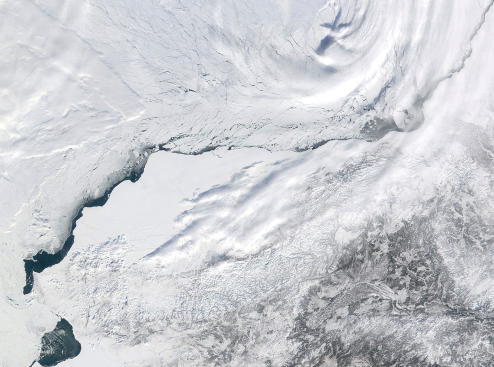
Seasonal ice in the Beaufort Sea off the Alaska North Slope begins its spring retreat. Scientists studying Arctic sea ice over the course of the century have documented that the sea ice retreats farther in the summer and does not advance as far in the winter as it did a half-century ago. Both global warming and natural variation in regional weather systems have been proposed as causes (NASA).
At the annual American Geophysical Union meeting in San Francisco during December 2007, scientists reported that water temperatures near Alaska and Russia were as much as 9° F above average. A study by scientists at the University of Washington said that the sun’s heat made the greatest contribution to the record melting of the Arctic ice cap at the end of summer 2007. Sunlight added twice as much heat to the water as was typical before 2000. Relatively warm water entering the Arctic Ocean from the Atlantic and the Pacific Oceans also was a less important factor, said Michael Steele, an oceanographer at the University of Washington. Energy from the warmer water delays the expansion of ice growth as it warms the air. Wieslaw Maslowski of the Naval Postgraduate School in Monterey, California, correctly anticipated an ice-free surface in parts of the Arctic Ocean in the summer by 2013.
The speed of ice breakup can sometimes be astonishing. For example, the 100-foot- thick Ayles shelf of floating ice, roughly 25 miles square, that had extended into the Arctic Ocean from the north coast of Ellesmere Island in the Canadian Arctic for roughly 3,000 years, was detached during the summer of 2005, because of wind and waves in warming water. “The break-up was observed by Laurie Weir of the Canadian Ice Service in satellite images of Ellesmere and surrounding ice on and after Aug. 13, 2005. In less than an hour, a broad crack opened and the ice shelf was on its way out to sea” (Revkin 2007). Year by year, in an irregular fashion, the Arctic is becoming warmer and greener.
The maximum extent of Arctic sea ice reached a record low on February 25, 2015, according to the National Snow and Ice Data Center, at 14.54 million square kilometers (5.61 million square miles). The year’s maximum also reached fifteen days earlier than the 1981 to 2010 average (March 12). A record low sea ice maximum extent does not always lead to a record low summertime minimum extent, NASA commented. “The winter maximum gives you a head start, but the minimum is so much more dependent on what happens in the summer,” said Walt Meier, a sea ice scientist at NASA’s Goddard Space Flight Center.
Scientifically, the yearly maximum is not as interesting as the minimum because it is highly influenced by weather. We’re looking at the loss of thin, seasonal ice that is going to melt in the summer anyway, and it won't become part of the permanent ice cover. With the summertime minimum, when the extent decreases, it’s because we’re losing the thick ice component, and that is a better indicator of warming temperatures. (NASA Earth Observatory 2016)
When the Arctic’s sea ice reached its annual maximum extent on March 24, 2016, at 14.52 million square kilometers (5.607 million square miles), less of the area was covered than at any other similar point on the satellite record (since 1979), continuing a steady erosion. The thirteen smallest maxima have all occurred in the past thirteen years, according to the National Snow & Ice Data Center (NSIDC) and NASA. The low sea ice maximum coincided with record high air temperatures in December, January, and February in the Arctic and around the planet. According to Walt Meier, a sea ice scientist at NASA’s Goddard Space Flight Center, the atmospheric warmth contributed to the low ice extent, as air temperatures along the edges of the ice pack—where sea ice is thin—were nearly 10° F (6° C) above average. Wind patterns in the Arctic were also unfavorable; southerly winds in January and February brought warm air and also prevented ice cover from moving toward lower latitudes.
Since 2016 , sea ice levels continued to decline, although at an uneven range. In the Southern Ocean, for instance, continuing to decline setting records in both 2022 and 2024, when it dropped below a surface of 800,000 square miles. Scientists continue to be alarmed and estimate that between 1980 and 2023, sea ice lost between thirteen and fifteen percent of its planetary cooling effect.
FURTHER READING: Environment News Service. 2006. “Arctic Sea Ice Melt Accelerating.” http://www.ens-newswire .com/ens/oct2006/2006-10-04-02.asp. Accessed March 14, 2018.
NASA Earth Observatory. 2016. “Annual Peak of Arctic Sea Ice Hit a Record Low.” http://earthobservatory.nasa.gov/IOTD/view.php?id = 87831&src = eoa-iotd. Accessed March 14, 2018.
Revkin, Andrew C. 2007. “Arctic Update: Resilient Bears, Shrinking Ice.” The New York Times, April 13. http://dotearth.blogs.nytimes.com/2007/12/12/arctic-update-resilient-bears-vanishing -ice/index.html. Accessed January 13, 2008.
Revkin, Andrew C. 2008. “Arctic Ocean Ice Retreats Less Than Last Year.” The New York Times, December 30. http://www.nytimes.com/2008/09/17/science/earth/17ice.html
Date added: 2026-02-14; views: 343;