
Suez Canal: History, Construction, and Global Impact
Constructed between 1859 and 1869, the Suez Canal is a 120-mile-long, 254-foot-wide waterway that links the Mediterranean Sea with the Red Sea, and, by extension, the canal links the European nations with the nations bordering the Indian Ocean and nations in the Far East. Located within the boundaries of Egypt, the canal was constructed by an “International Commission” of European powers headed by Ferdinand de Lesseps (180594), a French national. In 1956 the canal was nationalized by the Egyptian leader Gamal Nasser (1918-1970), and access to the canal was blocked to nations considered hostile to Egypt’s national interests. Nationalization precipitated the “Suez Crisis,” which led to war between Egypt and the nations of Israel, Britain, and France. Today, canal operations are managed by the “Suez Canal Authority,” which continues to abide by the “Convention of Constantinople” of 1888.
Archaeological remains show ancient efforts to construct a canal linking the Nile River with the Red Sea, and up to the eleventh century CE, a canal linked the Nile with the Red Sea. With Portuguese navigation around the continent of Africa in the fifteenth century, efforts were renewed to expedite the shipping of goods between the Mediterranean and the Red Sea. With the French military campaign in Egypt in 1798, studies by archaeologists, scientists, and cartographers suggested the feasibility of a canal, which the French dictator Napoleon Bonaparte (1769-1821) considered. The project was abandoned, however, based on the incorrect belief that locks would be required, a notion later dispelled. French interest in a canal continued into the nineteenth century, and in 1854 Ferdinand de Lesseps, a French national, obtained the concession for a canal from the Egyptian khedive, or viceroy. To fund and manage construction, the Compagnie Universelle du Canal Maritime de Suez (Universal Maritime Suez Canal Company) was established and shares were sold to European investors. Britain opposed the canal because they feared it would threaten their empire in the Far East, and they accused the Suez Canal Company of using slave labor. The company did in fact use forced (corvee) labor, a practice that was eventually disbanded under international pressure. Ironically, the first vessel to pass through the completed canal was the British naval ship HMS Newport. Under cover of darkness, Newport’s captain George Nares snuck his vessel to the front of the line of ships waiting for the canal’s opening the next day, and Egyptian and French officials were unable to prevent the Newport from being the first to traverse the Suez Canal.
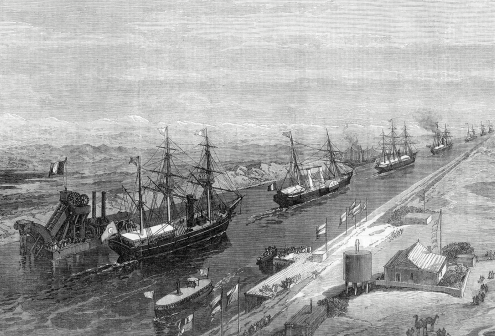
An image of the opening of the Suez Canal in Egypt, from The Illustrated London News, 1869. The Suez Canal provides a much shorter route between Europe and the Indian Ocean, saving thousands of miles in distance and significant travel time (The Illustrated London News Picture Library).
The canal was opened under French control on November 17, 1869. Ship traffic was lighter than expected, and the canal suffered financial difficulties, which De Lesseps tried to offset by reinterpreting the definition of a “net ton.” This resulted in the “Commission of Constantinople” in 1873, which established a universal standard of measurements for goods shipped through the canal. Although the canal was originally jointly owned by the Egyptian khedive and European investors, a financial crisis in 1875 forced Egypt to sell its shares at a discounted price to the British government, thus giving control of the canal to European shareholders.
Along with the earlier opening of the United States’ transcontinental railroad, the Suez Canal made an instant economic impact, because now the world could be traversed much more quickly. The Panic of 1873 was caused in part by the opening of the canal, because goods once stored at the Cape of Good Hope in southern Africa were now shipped through the Suez Canal, causing financial ruin for British shipping interests in Africa. The Urabi Revolt against the Egyptian khedive resulted in the direct British military occupation of Egypt in 1882. Tensions between the French and the British were settled by the “Convention of Constantinople” of 1888, which declared the canal a “neutral zone” to be protected by the British. During the First World War, the British prevented an Ottoman (modern-day Turkey) takeover of the canal, and the canal was closed to the Axis powers during the Second World War.
In 1956, Egyptian leader Gamal Nassar nationalized the canal, setting off the “Suez Crisis.” British, French, and Israeli forces attacked Egypt, and both the United States and the Soviet Union threatened reprisals if anti-Egyptian forces continued their attacks. Since nationalization, the Suez Canal has been administered by the Suez Canal Authority (SCA), which recognizes the principles of the Convention of Constantinople, in particular, the commitment “to afford and maintain free and uninterrupted navigation for all nations within the limits of and in accordance with the conditions of the Convention of Constantinople of 1888.” The SCA is currently heading a project to upgrade and improve the canal to allow for expanded shipping traffic well into the future.
FURTHER READING: Karabell, Zachary. 2003. Parting the Desert: The Creation of the Suez Canal. New York: Knopf Doubleday.
Obieta, Joseph and Richard Baxter. 1960. The International Status of the Suez Canal. Chicago: Springer Publishers.
Shea, William H. 1977. “A Date for the Recently Discovered Eastern Canal of Egypt.” Bulletin of the American Schools of Oriental Research 226: 31-8.
Date added: 2026-02-14; views: 356;