
Surfing History: From Ancient Polynesia to Global Sport
Surfing is a recreational activity and a competitive sport where surfers ride on the face of a breaking ocean wave toward the shore while standing on a surfboard or other wave-riding craft. There are an estimated twenty million surfers worldwide, and the surfing business is now a $10-billion global industry. In the last half-century, a surfing subculture has developed in the United States and throughout the world, from Iceland to Indonesia. Media coverage of surfing events, such as the World Surf League, has become more frequent, with big wave surfing becoming very popular with spectators. Surfing has spawned a number of offshoot sports, including bodyboarding, skateboarding, windsurfing, and skimboarding. From its origins in early Polynesian societies to its worldwide popularity today, surfing has become one of the most well-known ocean activities.
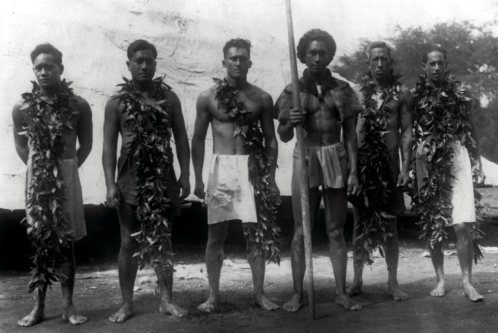
The “father of modern surfing” and Olympic gold medalist swimmer Duke Kahanamoku (fourth from left) stands with his fellow swimmers wearing lei, the traditional garlands of Hawaiian culture (Library of Congress).
HISTORY OF SURFING. Though the precise origins of surfing are unknown, the earliest and most substantial evidence of surfing is found in ancient Polynesian societies, particularly Tahiti and Hawai‘i. Historians believe that surfing likely began in earlier phases of Austronesian migrations throughout the Central and Eastern Pacific Ocean, particularly the Fiji, Tonga, and Samoa phase of the settlement of the Pacific Islands, which is often considered the birthplace of much of Polynesian culture and language. According to anthropologist Ben Finney, only in Tahiti and Hawai‘i were surfing practiced by people of all ages and social standing.
Of these islands, surfing developed most extensively in Hawai‘i, where by 1200 CE, it had become one of the most important social and recreational activities for communities across the archipelago. Surfing was integrated into nearly every aspect of Hawaiian society. Heiau, or temples, were dedicated to surfing; priests developed rites to encourage large swells; contests were held to honor gods; artists memorialized wave riding in petroglyphs; and stories of surfing and renowned men and women surfers are enshrined in Hawaiian oral traditions. Although all levels of Hawaiian society surfed, the ruling ali'i class had exclusive surfing spots, or breaks, reserved for royalty by kapu (imposed restriction). Three types of surfboard (papa he'e nalu) were common in early Hawai‘i: the olo, which were massive longboards up to 20 feet in length; the paipo, which was the smallest of the three types and used mostly by children; and the alaia, a mid-size board of 6 or 7 feet long, which was the most commonly used board.
With the influx of Euro-American explorers and traders and, eventually, American colonization in the nineteenth century, surfing as a Hawaiian pastime declined sharply. Many factors contributed to this decline, but the tremendous decrease in the native Hawaiian population due to introduced diseases and other factors related to Euro- American exploration, trade, and colonization led to a drastic reduction in the number of Hawaiians able to surf. Surfing, however, continued to be an important part of Hawaiian culture and history. By the early twentieth century, North American tourism in annexed Hawai‘i boomed, and surfing was more fully introduced to a non-Hawaiian audience. In the 1920s and 1930s, foreign audiences were enamored by the Hawaiian surfer and Olympic swimmer Duke Kahanamoku, who came to serve as an informal ambassador of the sport and is often called the “father of modern surfing.” Kahanamoku introduced modern surfing to Australia, New Zealand, and the United States during his visits to New Jersey and California and inspired a future generation of surfers.
In the years since the introduction of surfing beyond the shores of Hawai‘i, surfing has become a global sport and individual pastime. Today, the United States, primarily California and Hawai‘i, and Australia are the centers of a multibillion-dollar surfing industry and are home to the majority of the surfing population. In 1959, Surfer magazine published its first issue, and during the 1960s, surfing culture began to become more mainstream. Surfing and beach party movies—such as Ride the Wild Surf (1964), the story of three surfers in Oahu; Gidget (1959), based on the life of surfer Kathy Kohner-Zuckerman; and The Endless Summer (1966), the story of two surfers on a worldwide surfing trip—helped to promote surfing culture in general and particularly in Southern California. Musical groups such as Dick Dale and the Del-Tones, Jan and Dean, and the Beach Boys (especially their 1962 album Surfin” Safari) also helped promote surfing culture through their music. Today, surfing has spread around the world, with local and foreign surfers enjoying waves along almost every coastline. By 2021, surfing had become an approved sport at the Tokyo Olympics. It has already been approved for the Paris (2024) and Los Angeles (2028) Olympic Games. Ironically, the 2024 competition will be held in Tahiti (French Polynesia).
FURTHER READING: Clark, John R. 2011. Hawaiian Surfing: Traditions from the Past. Honolulu: University of Hawai‘I Press.
Finney, Ben and James Houston. 1996. Surfing: A History of the Ancient Hawaiian Sport. San Francisco: Pomegranate Books.
Warshaw, Matt. 2010. The History of Surfing. San Francisco: Chronicle Books.
Date added: 2026-02-14; views: 382;