
Submarine Evolution: From Early Submersibles to Nuclear-Powered Vessels
The dream of diving under enemy ships or exploring the ocean’s depths is age-old. Unlike vessels traversing the sea over the waterline, submerged craft are of more recent origin. Historians refer to early attempts at submerged travel as submersibles—crafts transported and supported by larger vessels or platforms. Actual submarines—underwater vessels that can operate independently for more extended periods—emerged only at the end of the nineteenth century.
In the sixteenth and seventeenth centuries, there were attempts to develop short- distance underwater attack vessels, most of which remained in the testing phase. During the American Revolutionary War, a small submersible, the Turtle, operated by a single individual, attempted and failed to affix explosive charges on British ships in New York harbor. Almost ninety years later, in 1864, the first submerged boat managed to sink a surface vessel during the American Civil War. The Hunley had a crew of eight, seven to operate the hand-cranked propeller. Testing the submersible took its toll as thirteen crewmembers died on test dives. The first submerged kill came at an equally steep price. According to the latest research on the matter, the Hunley’s crew died instantly from the wave of the explosive charge when it rammed and sunk the USS Housatonic.
The late nineteenth century witnessed many countries investing in this new maritime technology. Novelist Jules Verne, for instance, drew inspiration for his Twenty Thousand Leagues Under the Sea from inspecting one of the French prototypes. Irish engineer John Holland developed the first reliable submarines and sold his designs to the US and British navies. He combined a gasoline engine for surface running on the surface with an electric motor that powered the vessel while submerged. Improving on the original plans, introducing the periscope, and a diesel engine for greater reach ensured that the submarine played a crucial role in the global conflict of the twentieth century.
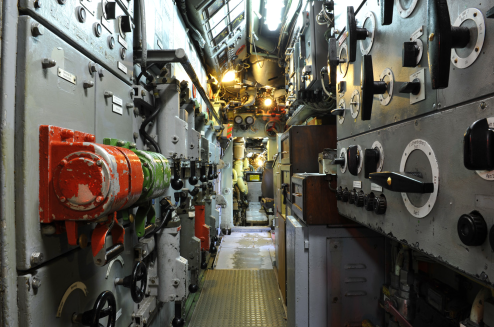
Control room of German submarine U11, which served in the West German armed forces from 1968 to 1998 (jdanne/Dreamstime.com).
When the First World War broke out in August of 1914, the British and the French navies had the most submarines to their name. The German Kriegsmarine quickly caught up with their opponents and developed structural designs allowing deeper diving. At the onset of the conflict, German submarines were employed in a Kleinkrieg—minor conflict—that sought to sink British warships to diminish the considerable surface vessel gap between the German and British navies. When that plan failed, the German Admiralty called for unrestricted submarine warfare, which sank Allied and neutral shipping around the British Isles. This campaign was only moderately successful, and its indiscriminate sinking of neutral and enemy vessels ultimately prompted the United States to declare war on Germany in April 1917, turning the tide in the conflict. Allied forces responded to Germany’s deployment of their stealth underwater force by creating a convoy system that combined merchant vessels with warships for more protection.
The interwar period saw few changes to submarine warfare. German engineers, partially due to the provisions resulting from the Treaty of Versailles, concentrated on improving the designs on the submarines. Meanwhile, the United States Navy emphasized a greater reach of their submerged vessels through lightweight design. When the Second World War broke out in Europe in September of 1939, the German Admiralty quickly returned to its strategy of crippling shipments to Britain. To counter the convoy system used effectively by the Allies during the First World War, the German side opted for a Wolfpack Tactic—a coordinated attack by several submarines, usually as a night-time surfaced raid. Allied powers responded by increasing their anti-submarine tactics that involved the successful deployment of depth charges, developed during the First World War, with detection through improved radar and sonar technology. German U-boats may have roamed the Atlantic in the early stages of the war, but growing submarine losses marked the Battle for the Atlantic following 1942. Introducing the snorkel mast to provide air, while submerged, to the crew and the diesel engines brought some relief. Towards the end of the war, entirely electronic submarines saw service but could not make a difference. When the war turned to the Pacific Theater, especially following 1941, submarines were successfully deployed by the US Navy to interrupt the stretched Japanese supply lines. The Japanese Navy resisted the convoy system, so successful in the Atlantic realm, until 1943, allowing American submerged vessels to take a heavy toll on Japanese merchant ships. Ironically, the Americans adopted the Wolfpack Tactics developed by the Germans in the Atlantic to stifle the Japanese merchant marine.
Toilet Malfunction Leads to the Sinking of a German Submarine. In April of 1945, shortly before the end of the Second World War, German submarine U-1206 was operating near the coast of Scotland. Equipped with a high-pressure plumbing system that allowed waste to be discharged directly into the ocean, the submarine avoided the standard septic tank that stored refuse for the duration of the voyage. Omitting such a tank and allowing for additional space was an obvious advantage. On the other hand, such high-pressure systems operated best on or near the surface and became more demanding while submerged at greater depth, which German submarines were forced to do towards the war’s end. When a toilet on U-1206 malfunctioned and an engineer was called in to fix the problem, he accidentally turned the wrong valve, leading to a mixture of saltwater and human waste spilling into the submarine. To make matters worse, the liquid spread to the battery compartment, where the chemical reaction released lethal chlorine gas. Given emergency orders to surface, U-1206 was soon spotted by British planes. Under fire, the captain ordered the crew to evacuate and scuttled the vessel to prevent sensitive technology from falling into Allied hands. Fortunately, except for four drowned crew members, the majority of the U-1206 crew survived the ordeal and were captured by British vessels. Rainer F. Buschmann
The Cold War brought further technological development. Following the development of non-fossil fuel-dependent engines, the United States developed its first nuclear-powered submarine in 1955. In 1958, the USS Nautilus—named after the submarine in Jules Verne’s novel—became the first to reach the North Pole while diving under the sea ice. Nuclear- powered subs have the great advantage of range, speed, and stealth. Since there is no need to surface for air for their engines, this type of submarine can stay submerged for long periods. Nuclear-powered engines also provide much greater submerged speed and range than their fossil fuel counterparts. Disadvantages include the high cost of these vessels, which means that in the twenty-first century, only a handful of nations can afford such expensive submarines: China, France, India, Russia, the United Kingdom, and the United States. Moreover, coolant leaks, accidents, and shipbreaking of old nuclear submarines present prominent environmental hazards that significantly affect the world’s oceans. Since the early 1960s, atomic submarines have also been equipped with strategic ballistic missiles, many of them carrying nuclear warheads, which increases both the lethality and the environmental threat of these stealth vessels.
While submarines have served mostly military purposes since the nineteenth century, the next century saw the development of submersible technology. Modern submersibles, unlike submarines, are employed less in military operations and more in the exploration of the deep sea. Another entry in this dictionary will explore this critical topic.
FURTHER READING: Fontenoy, Paul E. 2007. Submarines: An Illustrated History of their Impact. Santa Barbara: ABC- CLIO.
Parrish, Thomas. 2004. The Submarine: A History. New York, NY: Viking Books.
Redford, Ducan. 2010. The Submarine: A Cultural History from the Great War to Nuclear Combat. London: I. B. Tauris.
Date added: 2026-02-14; views: 328;