
Shipbreaking: Global Industry, South Asia’s Beaches, Hazards, and the Hong Kong Convention
Shipbreaking, which is also known as ship recycling, occurs once a vessel has reached the end of its existence. The average lifespan of modern engine-powered ships is about twenty- five to thirty years, after which they become too expensive to maintain, and the older version is replaced by a newer one. Vessels that have outlived this lifespan are transported to specialized facilities where they are broken down for recyclable materials and spare parts. Shipbreaking yards may resemble ship graveyards, but this term is deceiving since 95 percent of a ship is recycled, and very little is left of the vessel once the process is completed. Most current ship depositories are outside the industrialized West: Bangladesh, China, India, Pakistan, and Turkey. Of the estimated 50,000 merchant vessels that roam the sea, over 1,000 ships are recycled each year.
Until the mid-nineteenth century, shipbreaking was less problematic as the mostly wooden ships were sunk, burned, or left to decay by the elements. On occasion, the metal fittings and the timbers of the hulls were reused in house construction. The best example is the half-timbered houses dating from medieval and early modern times in northern Europe. As the nineteenth century progressed, an increasing shift to metal construction and fossil-fueled engines raised new challenges for recycling by introducing hazardous materials. Realizing the potential of using scrap metal to feed rapid industrialization, many European countries started to acquire ships at the end of their service life. The world wars drastically increased the number and size of naval vessels. At the same time, the decades after the Second World War witnessed the introduction of new types of vessels—notably containerships—and new countries that would shelter vessels under their national flag to avoid taxation and the strict maritime laws of the owner’s country.
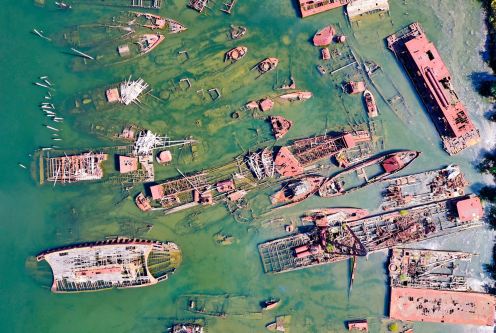
Aerial view from above of abandoned ships at Arthur Kill Boat Graveyard in Staten Island, New York (Demerzel21/Dreamstime.com).
The upside of modern shipbreaking seems obvious: it provides and sustains a large local labor market, supplies scrap and recycled metals for local industry, and offers an outlet for aging and, in many cases, polluting vessels. On the other hand, the downsides result from the fact that even if 95 percent of the ship is recycled, the remaining 5 percent have hazardous materials that threaten the lives of the laborers involved in the process and the local environment surrounding the shipbreaking facility. While the shipbreaking industry started as a highly industrial activity performed by highly trained and well-paid personnel, the business has, in some ways, devolved by moving away from the industrialized West. Before the 1960s, shipbreaking was a highly industrial endeavor performed in Western and Eastern European facilities and the United States. These countries had specialized facilities and a skilled labor pool that could mitigate pollution. Today, only highly specialized vessels, especially those belonging to the navy, still need to be broken down there. By the 1960s, Turkey began to undercut labor costs, as did China, South Korea, and Taiwan in the 1970s. By the mid-1980s, the industry shifted to South Asia, where the countries of Bangladesh, India, and Pakistan provided a cheap labor pool, a year-round climate conducive to shipbreaking, and an extensive coastline to facilitate the process. Vessels are beached at low tide and broken down while being dragged up the beach using ropes and hundreds of workers. Unlike South Asian nations, most countries have outlawed tidal beaching. The labor employed in South Asia is generally unskilled, and the International Metalworker Federation now considers shipbreaking one of the most dangerous occupations. Besides hazardous materials—asbestos, for instance, causes lung cancer and mesothelioma— workers frequently get injured by falling materials and explosions caused by flammable gases ignited through welding. China has avoided utilizing the cheaper alternative of South Asia by requiring its sizable merchant fleet to be recycled in Chinese ports.
The mounting violations brought about the Convention of Safe and Environmentally Sound Recycling of Ships—also known as the Hong Kong Convention (HKC) in 2009. Technically, this Convention sought to protect the environmental health of those workers performing this dangerous task. Likewise, it sought to influence the construction and operation of vessels to make recycling less complicated. The problem emerged with the enacting of this convention. It needed to be ratified by at least fifteen countries that accounted for 40 percent of the global merchant shipping fleet and a combined ship recycling value of no less than 3 percent. While the number of fifteen countries needed to ratify the treaty was quickly exceeded, the problem that over 50 percent of the merchant marine is controlled by four countries—China with Hong Kong, Liberia, the Marshall Islands, and Panama—and four countries—Bangladesh, China, India, and Pakistan—controlling over 90 percent of the shipbreaking made passing the required tonnages a problematic business. With Panama ratifying the Convention in 2016, the world’s largest shipping country accepted the terms. On the shipbreaking side, Turkey approved the HKC in 2017, and India approved it in 2019. Bangladesh held out because of its edge over neighboring India, which had a near absence of hazardous laws for attracting recyclable vessels to its shores. It was only in the summer of 2023 that Bangladesh ratified the HKC, while Liberia, with a large merchant navy, joined simultaneously. With these countries joining the HKC, the number of contracted states increased to twenty-two, with a combined gross tonnage of almost 46 percent of the global merchant fleet. These states also united to achieve about 3.3 percent of the required volume of recycled vessels. This milestone meant that HKC had finally reached its targets and would come into effect in June of 2025, over fifteen years after it passed.
Shipbreaking as a Videogame. The global awareness of shipbreaking has even given rise to a video game called Ship Graveyard Simulator, released in 2022. Its success led to a second edition released a year later. The game features a traditional rags-to-riches storyline where a player can assume the identity of a poor individual residing in the developing world who can amass wealth through recruiting and the proper selection of tools. Unfortunately, the trail of toxins and environmental issues left behind by the process is absent from the simulator, which could add to the game’s educational value beyond amassing wealth. Rainer F. Buschmann
Shipbreaking is an industry that has provided both a vital labor market and plenty of scrap metal and parts for the countries that perform this complex operation. This operation is also performed under difficult, life-threatening conditions, making shipbreaking one of the most dangerous professions. The hazardous materials recovered from the ships present further potential for contaminating the land and the sea surrounding the facilities. Only time can tell whether implementing the Hong Kong Convention in 2025 will bring the much-needed improvement. Rainer F. Buschmann
FURTHER READING: Ahmed, Ishtiaque . 2022. “The Origin and Evaluation of the Shipbreaking Regime in India: A Critical Perspective.” In Ocean Yearbook 36, edited by Aldo Chircop , Scott Coffen-Smout and Moira L. McConnell. Leiden, NL: Brill.
Galley, Michael. 2014. Shipbreaking: Hazards and Liability. Cham: Springer.
International Maritime Organization. 2023. “Hong Kong Ship Recycling Convention Set to Enter in Force.” https://www.imo.org/en/MediaCentre/PressBriefings/pages/Hong-Kong-Convention -set-to-enter-into-force-.aspx. Accessed September 22, 2023.
Mishra, Shreya. 2018. “Non-Entry into Force of the Hong Kong International Convention for the Safe and Environmentally Sound Recycling of Ships, 2009: An Analysis from the Perspective of India, Pakistan, and Bangladesh.” Journal of International Maritime Safety, Environmental Affairs, and Shipping 2 (1): 22-30.
Puthicherril, Tony George. 2010. From Shipbreaking to Sustainable Ship Recycling: Evolution of a Legal Regime. Leiden, NL: Martinus Nijhoff.
Date added: 2026-02-14; views: 349;