
The Global Carbon Cycle: Earth's Vital Climate Regulation System
The carbon cycle is a fundamental biogeochemical process encompassing the continuous exchange of the element carbon between Earth's major reservoirs: the atmosphere, hydrosphere, biosphere, and lithosphere. As a primary building block of life, carbon exists in organic forms within all living organisms and in inorganic forms throughout the physical environment. This dynamic cycle is ultimately driven by solar energy and is critical for regulating planetary climate. Its balance determines atmospheric composition, ocean chemistry, and the very conditions that support life on Earth.
Carbon flux between these spheres is governed by several key processes which, under natural conditions, maintain a relative equilibrium. The biological processes of photosynthesis (assimilation) and respiration (dissimilation) cycle approximately 100 billion metric tons of carbon annually. Concurrently, carbon dioxide (CO₂) is exchanged directly between the atmosphere and oceans, while geological processes sequester carbon through the precipitation and dissolution of carbonate compounds, forming sedimentary rocks over immense timescales.
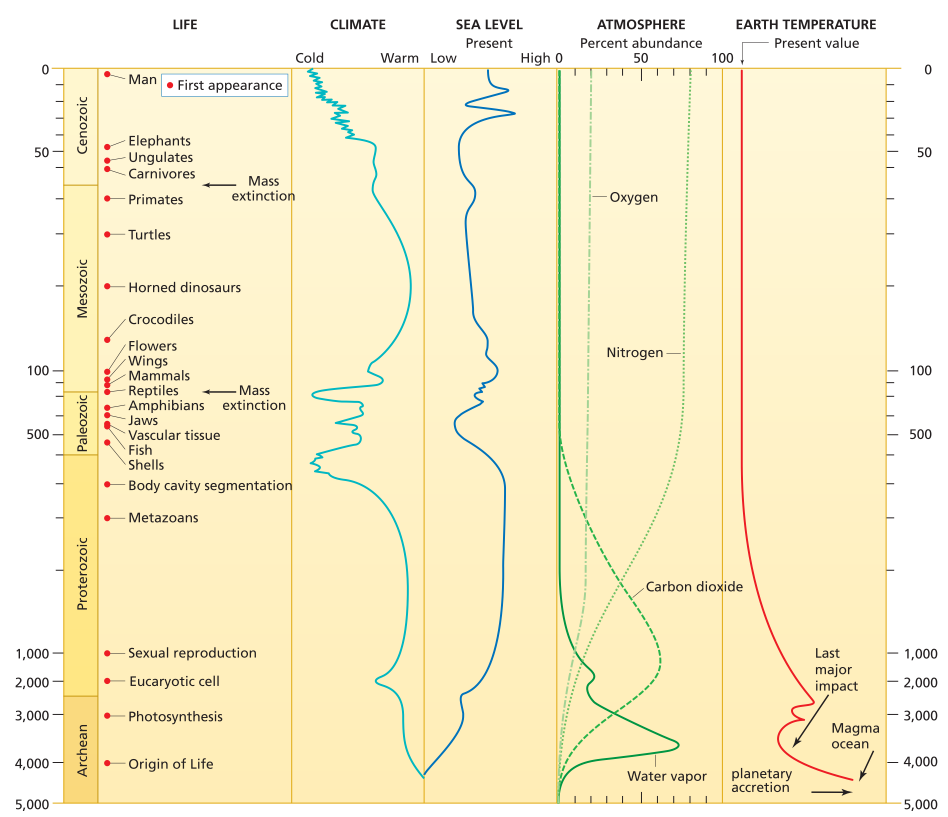
Graphs showing changes of CO2, O2, and temperature in the atmosphere with time (modeled after Kent Condie and Robert Sloan)
Atmospheric Carbon and Climate Regulation. In the atmosphere, carbon primarily exists as the long-lived compounds carbon dioxide and methane (CH₄), and the shorter-lived carbon monoxide. A well-established scientific correlation exists between global mean temperature and atmospheric CO₂ concentration, with higher CO₂ levels driving the greenhouse effect. A critical ongoing scientific investigation centers on the causality in this relationship: whether increased carbon flux from natural cycles forces warming, or whether warming itself amplifies carbon release from reservoirs like oceans and permafrost. Unambiguously, however, anthropogenic emissions since the Industrial Revolution have significantly increased atmospheric CO₂, directly contributing to measurable global warming and demonstrating humanity's capacity to alter this cycle.
The Ocean: Earth's Dominant Carbon Sink. The world's oceans constitute the planet's largest active carbon reservoir, holding over 60 times more carbon than the atmosphere. This oceanic carbon is categorized as dissolved inorganic carbon (the largest pool) and dissolved organic carbon. Ocean structure is stratified into three key layers influencing carbon storage: a well-mixed surface layer (approx. 75m thick), a middle thermocline zone where temperature decreases sharply, and deep cold-bottom waters. In polar regions, cold, CO₂-rich saline water sinks, trapping carbon in the deep ocean for millennia. A significant portion of this deep-sea carbon may be stored in gas hydrate formations—ice-like solids encasing molecules like methane and CO₂ under high pressure and low temperature. While identified as a vast potential energy resource, destabilizing these hydrates risks releasing enormous quantities of greenhouse gases.
Carbon enters the deep ocean through physical solubility pumps and the biological pump. Surface layer photosynthesis accounts for 30-40% of global carbon fixation by vegetation. Approximately 10% of this organic carbon sinks as "marine snow," transferring carbon from surface waters to the deep oceanic reservoir before it can be respired back to CO₂.
Geological and Terrestrial Carbon Reservoirs. The vast majority of Earth's carbon is sequestered in sedimentary rocks, principally limestone and dolostone. This geological reservoir interacts with the active surface cycle over million- to billion-year timescales through tectonic processes like uplift, weathering, and subduction. These slow cycles are linked to the supercontinent cycle, where continental collisions expose massive carbonate platforms to chemical weathering, gradually releasing carbon back into the system.
On land, the biosphere—encompassing living biomass, dead organic matter (litter), and soil—holds substantial carbon. Forests and arctic tundra are particularly crucial reservoirs. Living vegetation stores carbon comparable to the atmospheric pool, while litter and soil organic matter hold roughly double that amount. Annually, terrestrial plants absorb about 100 gigatons of carbon via photosynthesis, releasing half through respiration and incorporating the remainder into plant tissue and soil.
Anthropogenic Impact and Future Climate Implications. Understanding the intricacies of the global carbon cycle is paramount for predicting and mitigating human-induced climate change. Scientists actively model complex feedbacks, such as the carbon fertilization effect, where increased atmospheric CO₂ may stimulate plant growth, potentially creating a negative feedback loop by enhancing carbon drawdown. Current research focuses on quantifying natural versus anthropogenic fluxes and the system's response to perturbations. Key questions address the future stability of ocean sinks, the vulnerability of permafrost and hydrate stores, and the overall capacity of Earth's systems to buffer continued emissions, all critical for shaping effective climate policy and forecasting future climate scenarios.
Date added: 2026-07-14; views: 107;