
The Cenozoic Era: Geology, Climate and the Cretaceous-Tertiary Extinction Event
The Cenozoic Era, spanning from 66 million years ago to the present, represents the emergence of the modern Earth. Derived from the Greek for "recent life," it is often called the Age of Mammals. This era is formally divided into the Paleogene, Neogene, and Quaternary periods, encompassing epochs from the Paleocene to the current Holocene. Modern ecosystems took shape during this time, characterized by the rapid diversification and expansion of mammals, birds, advanced mollusks, and angiosperms like grasses. While terrestrial life transformed dramatically, marine biota experienced more subtle evolution, with the notable exception of the origin and diversification of whales.
The dawn of the Cenozoic followed the catastrophic Cretaceous-Tertiary (K-T) boundary extinction event, which demarcates the end of the Mesozoic Era. This mass extinction is widely attributed to a massive asteroid impact on the Yucatán Peninsula near Chicxulub, dated to 66 million years ago. The event caused the abrupt demise of dinosaurs, ammonites, marine reptiles, and approximately 26% of all biological families. Evidence for an impact includes global iridium anomalies in boundary clay layers—a rare element abundant in meteorites. The concentration found is equivalent to that delivered by a meteorite roughly 6 miles (9.5 km) in diameter, forming a compelling "smoking gun" for the impact hypothesis.
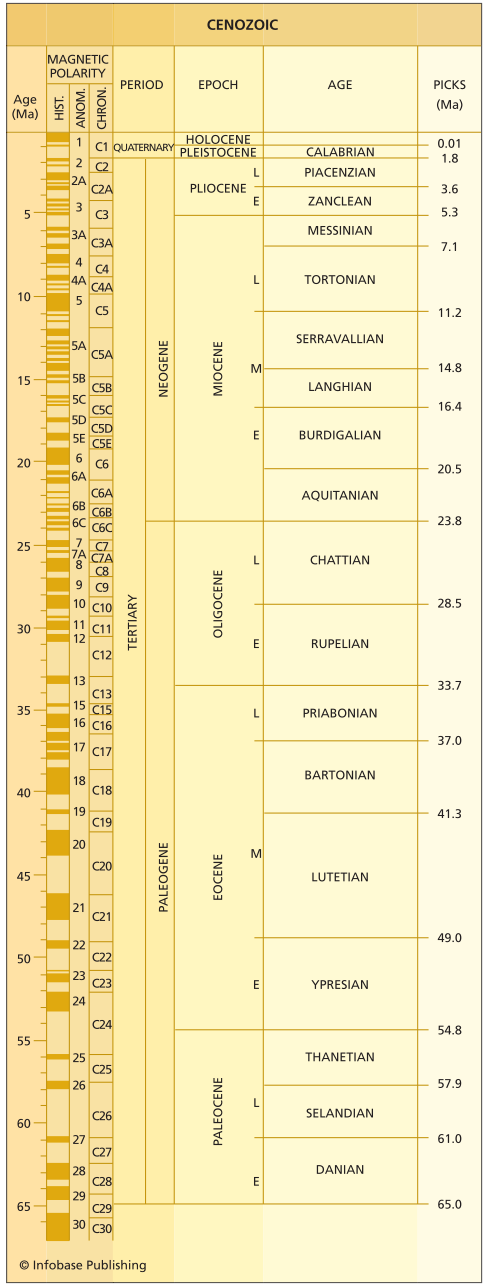
Cenozoic timescale
Geological features strongly support the Chicxulub crater as the impact site. This structure, half-submerged in the Gulf of Mexico, is precisely dated to 66 million years. Surrounding evidence includes widespread tsunami deposits across the Gulf Coast and a vast field of impact spherules. The impact would have generated tsunamis hundreds of feet high, whose sedimentary records are found inland. The crater's age, size, and associated deposits directly correlate it with the extinction horizon that ended the reign of the dinosaurs.
Concurrent with the impact, immense volcanic eruptions known as the Deccan Traps flood basalts were occurring in western India. Erupting over about one million years, these volcanics released vast volumes of gas, stressing the global biosphere. Many scientists conclude that this volcanic-induced climate change weakened ecosystems, which were then pushed over the brink by the Chicxulub impactor. Thus, the K-T boundary extinction likely resulted from this one-two punch of sustained volcanic activity and a sudden, catastrophic asteroid impact, a consensus view in contemporary geoscience.
Cenozoic tectonics profoundly reshaped the planet's geography and climate. Key events included the continued opening of the Atlantic Ocean, the closure of the Tethys Ocean, and the formation of the Alpine-Himalayan Mountain System. In North America, tectonic activity transitioned from shallow subduction and uplift of the Rocky Mountains to crustal extension forming the Basin and Range Province and the initiation of the San Andreas Fault transform margin.
The collision of continental plates during the closure of the Tethys Ocean thrust fragments of oceanic crust, known as ophiolites, onto continental margins. Prominent examples include the Semail ophiolite in Oman and the Troodos complex in Cyprus. The ongoing convergence between Africa-Arabia-India and Eurasia continues to uplift the Alpine-Himalayan chain and the Tibetan Plateau. This uplift drastically altered atmospheric circulation, intensifying the Indian Ocean monsoon and creating rain shadows that led to the formation of vast deserts like the Gobi.
Cenozoic climate transitioned from early warmth—a period of prolific global oil formation—to a pronounced cooling trend. By the mid-Oligocene (around 35 million years ago), the Earth entered an "ice house" climate state, culminating in the glacial cycles of the Pleistocene epoch. These cycles featured repeated glacial and interglacial stages, with the most recent glacial maximum peaking 18,000 years ago. During this peak, massive ice sheets covered much of Northern North America and Europe.
The current Holocene Epoch, beginning 11,700 years ago, represents an interglacial period within the ongoing ice house climate. The rapid climatic shifts of the Pleistocene, with over 50 major and minor glacial cycles in the last 1.5 million years, underscore the instability of Earth's climate system. Since the last glacial maximum, sea levels have risen approximately 500 feet (150 m). Modern anthropogenic global warming introduces a new variable, with potential scenarios including significant ice melt and sea-level rise that could, in turn, trigger feedback loops altering planetary reflectivity and potentially influencing future glacial cycles.
Date added: 2026-07-14; views: 112;