
Plate Tectonics and Climate: How Earth's Moving Plates Drive Long-Term Climate Change and Sea Level Fluctuations
The rigid outer shell of the Earth, known as the lithosphere, is fragmented into roughly a dozen major tectonic plates. These plates, extending 60-100 miles (100-160 km) deep, consist of either oceanic crust, continental crust, or a hybrid of both. Their movement and interaction at divergent, convergent, and transform boundaries form the basis of the theory of plate tectonics, a primary driver of long-term geological and climatic evolution. At divergent boundaries, plates separate, allowing magma from the mantle to rise and create new oceanic crust along the global mid-ocean ridge system. This process of seafloor spreading is the planet's most voluminous source of volcanism, releasing enormous quantities of carbon dioxide (CO2) and other gases into the atmosphere and oceans.
The intensity of mid-ocean ridge volcanism has fluctuated dramatically throughout Earth's history, exerting a powerful control on global climate. Periods of rapid seafloor spreading correlate with high atmospheric CO2 levels, creating greenhouse conditions and globally warm climates. This volcanism also increases the volume of the ocean basins, as hotter, newly formed crust is more elevated. This displaces seawater, causing eustatic sea-level rise that inundates continental shelves. The rising seas submerge rocks, removing them from the chemical weathering cycle, which is a key process for removing atmospheric CO2. Thus, active ridge systems create a feedback loop that promotes further global warming.
Convergent boundaries, where plates collide, provide a counterbalancing cooling mechanism. Here, one plate is typically subducted beneath another, generating a magmatic arc of volcanoes (either an island arc or Andean arc). When continents collide, vast sequences of sedimentary rocks—especially carbonates like limestone—are uplifted and exposed. Atmospheric CO2 dissolves in rainwater to form weak carbonic acid, which weathers these rocks. The resulting calcium ions combine with bicarbonate in the oceans to form new calcium carbonate (CaCO3), effectively sequestering CO2 in oceanic sediments. Therefore, major continental collisions are associated with CO2 drawdown and global cooling.
In contrast, transform boundaries, where plates slide past one another, have negligible direct impact on long-term climate as they involve neither significant volcanism nor large-scale rock uplift. The climatic influence of plate tectonics operates on timescales of millions to tens of millions of years, forming the background for Earth's long-term climate cycles. The production of CO2 at ridges and arcs and its consumption through weathering and sedimentation create a slow, planetary-scale carbon thermostat. Variations in the rate of seafloor spreading are a leading hypothesis for explaining the onset of major ice ages, with slow spreading reducing the volcanic CO2 supply and tipping the planet into colder icehouse conditions.
Supercontinents and Climate. The tectonic plate motion periodically amalgamates most continental landmasses into supercontinents, a cyclical process known as the supercontinent cycle. This cycle, repeating every 300-500 million years, has profoundly influenced climate over Earth's history. Notable supercontinents include Rodinia (formed ~1 billion years ago), Gondwana (~600-500 million years ago), and the most recent, Pangaea (which broke up starting ~160 million years ago). The cycle predicts that supercontinent breakup is associated with global warming due to increased ridge volcanism and CO2 output, while supercontinent assembly correlates with global cooling from enhanced weathering on uplifted continental collisional belts.
The supercontinent cycle is the dominant control on eustatic sea-level change over geological time. Sea level has fluctuated by hundreds of meters, reaching a high stand approximately 1,970 feet (600 m) above present during the Ordovician and Cretaceous periods. During continental breakup, the total length of mid-ocean ridges increases, and faster spreading rates produce a larger volume of topographically high young crust. Both mechanisms increase the ridge system's volume, displacing seawater and causing a major transgression (sea-level rise). Conversely, during continent-continent collisions, the uplift of massive mountain belts like the Himalayas removes material from the ocean basins, leading to a regression (sea-level drop). The current India-Asia collision is estimated to have lowered global sea level by about 33 feet (10 m).
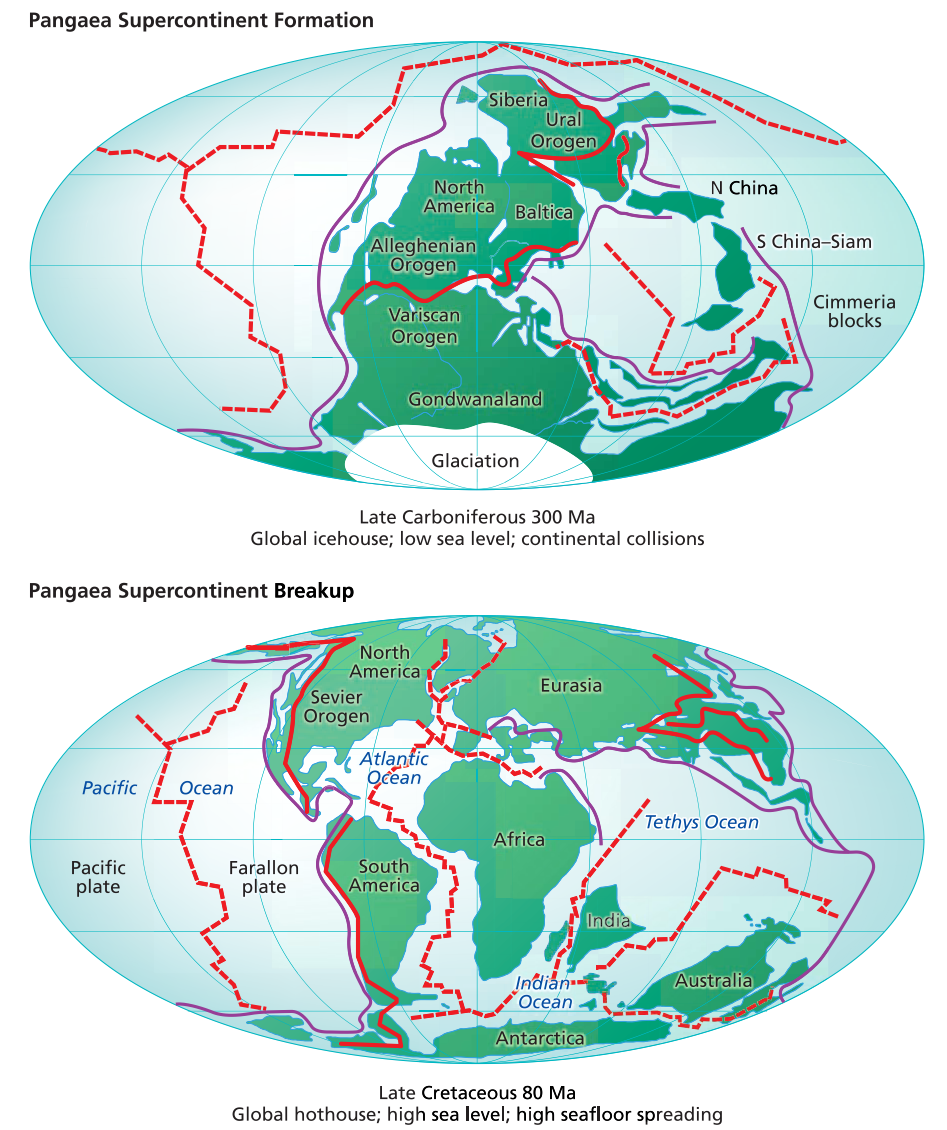
Maps of continental positions during cold and warm climates showing the relationship between climate and tectonics
Caption: This figure contrasts continental configurations during cold and warm periods, illustrating the tectonic-climate link. The Late Carboniferous (~300 Ma) shows the assembled Pangaea with widespread Gondwanaland glaciation, low sea levels, and an icehouse climate. The Late Cretaceous (~80 Ma) depicts Pangaea's active breakup, a vast Tethys Ocean, high sea levels from rapid seafloor spreading, and a global hothouse climate.
Additional factors, such as midplate volcanism from hotspots (e.g., Hawaiian Islands), can also displace water and contribute to sea-level changes, though their effect is generally smaller than that of the ridge system. In summary, the episodic assembly and dispersal of continents dictate long-term cycles of climate and sea level: continental fragmentation promotes warming and high sea levels (transgressions), while continental amalgamation favors cooling and low sea levels (regressions). These slow, tectonic-scale processes set the stage upon which the more rapid orbital and anthropogenic climate changes of today are superimposed.
Orbital Forcing and Ocean Cycles: Medium-Term Climate Drivers from Milankovitch to El Niño
While plate tectonics sets the long-term climatic background, medium-term climate variations—operating on scales from millennia to decades—are primarily governed by astronomical cycles and oceanic processes. The most significant of these are Milankovitch cycles, systematic changes in Earth's orbital and rotational characteristics that alter the distribution of solar radiation. These cycles, with periodicities of 100,000, 41,000, and 23,000/19,000 years, have been the dominant pacemaker for the advance and retreat of glaciers over the past several million years, driving the alternating glacial and interglacial periods of the current ice age.
Astronomical Forcing of the Climate. Medium-term climate changes, particularly the cyclical glaciations of the past 2.8 million years, are primarily forced by three interacting astronomical variables. The first is orbital eccentricity, which describes the shape of Earth's orbit around the Sun and varies on a 100,000-year cycle, modulating the intensity of seasonal contrasts. The second is axial tilt (obliquity), which fluctuates between 21.5° and 24.5° over a 41,000-year period; greater tilt amplifies seasonal differences. The third is axial precession, a 23,000-year wobble that determines which hemisphere is tilted toward the Sun during perihelion (closest approach), thereby affecting seasonal severity. The combined effect of these Milankovitch cycles predicts a current trend toward Northern Hemisphere cooling, though this natural signal is now overwhelmed by anthropogenic forcing.
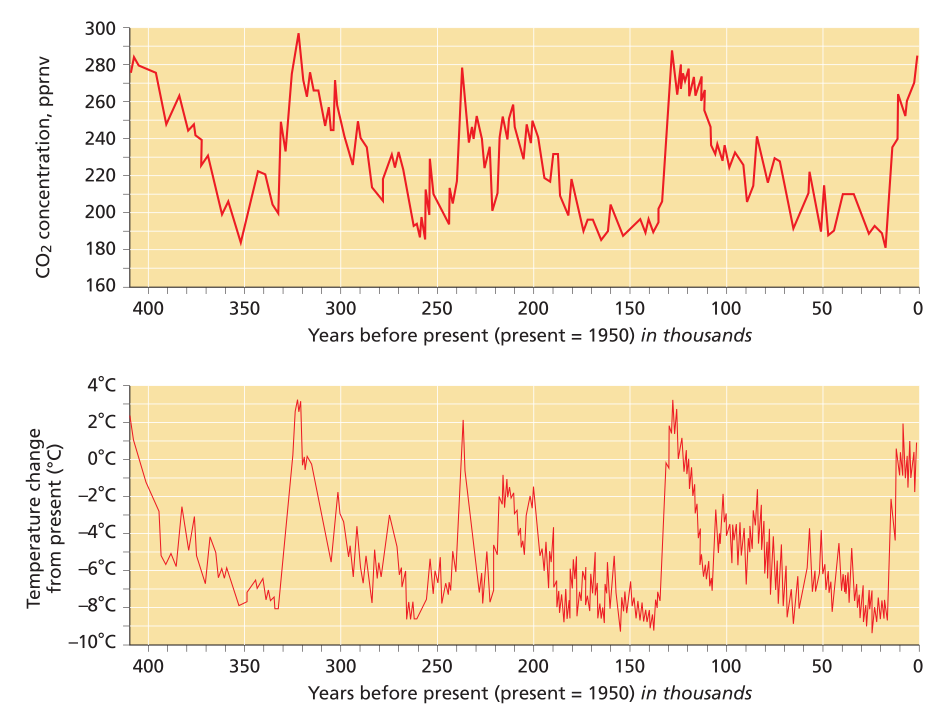
Temperature and CO2 changes in past 400,000 years based on Antarctic ice cores
The climatic transition from the last glacial maximum illustrates the power of these orbital drivers. A timeline of key events includes:
- 18,000 years ago: Global climate begins to warm, initiating glacial retreat.
- 15,000 years ago: Continental ice sheet advance halts, and eustatic sea-level rise commences.
- 10,000 years ago: Ice Age megafauna, including mammoths and mastodons, undergo mass extinction.
- 8,000 years ago: The Bering Strait land bridge is submerged, isolating human and animal populations between Asia and North America.
- 6,000 years ago: The Holocene Climatic Optimum, a period of peak warmth, occurs.
- Cumulative Change: Over this 18,000-year span, global average temperature rose approximately 16°F (10°C), and sea level increased by about 300 feet (91 m).
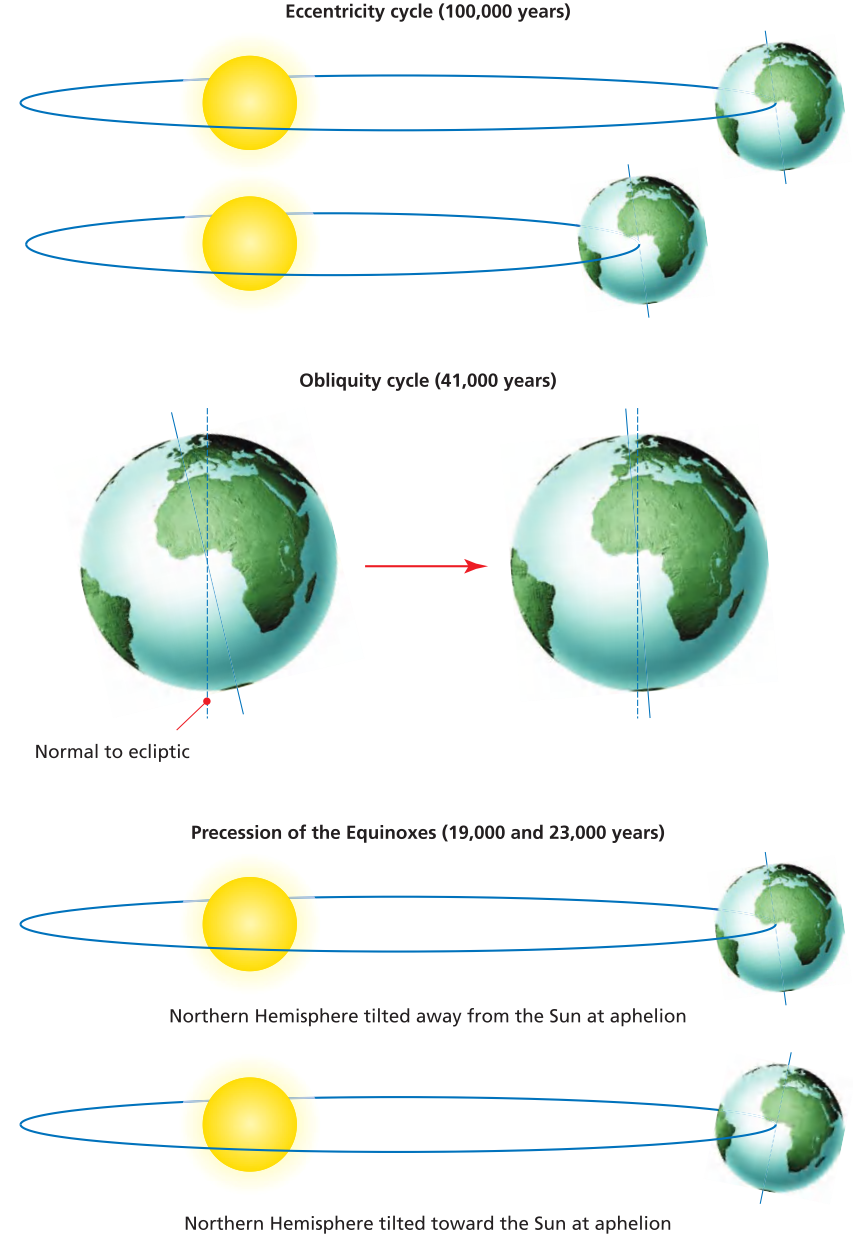
Orbital variations that lead to variation in the amount of incoming solar radiation, including eccentricity, obliquity (tilt), and precession of the equinoxes
Short-Term Oceanic and Atmospheric Oscillations. On decadal to annual timescales, changes in ocean and atmospheric circulation become the principal climate modulators. The global thermohaline circulation—a deep-ocean conveyor belt driven by differences in water temperature and salinity—redistributes vast amounts of heat. Disruptions to this system, which can occur within 5-10 years, have the potential to trigger abrupt regional climate shifts, such as plunging warm regions into prolonged cold spells. The most potent shorter-term oscillation is the El Niño-Southern Oscillation (ENSO), a periodic warming (El Niño) and cooling (La Niña) of the eastern tropical Pacific that alters weather patterns globally, causing floods, droughts, and temperature anomalies.
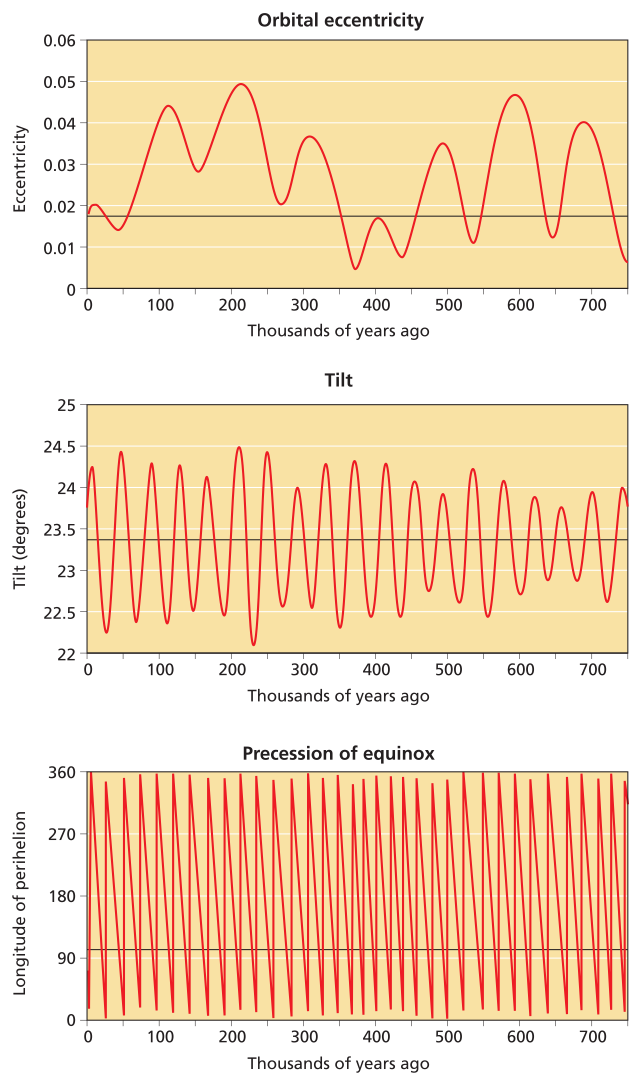
Milankovitch cycles related to changes in eccentricity, obliquity (tilt), and precession of the equinoxes. All of these effects act together, and the curves need to be added to each other to obtain a true accurate curve of the climate variations because all these effects act at the same time.
The climate signal predicted by Milankovitch theory is further complicated and modulated by these oceanic feedbacks and other factors like atmospheric dust, ice sheet albedo, and greenhouse gas concentrations. Evidence for orbital forcing is preserved in the geological record as rhythmic sedimentary layers, or cyclothems, observed in formations like the Dolomite Mountains of Italy and Proterozoic sequences in Canada. Predicting future climate requires integrating these medium-term natural cycles with the unprecedented short-term forcing from human emissions. While orbital geometry suggests a gradual descent into the next glacial period over thousands of years, the current anthropogenic perturbation risks overriding this natural cycle, potentially leading to rapid warming with the ever-present risk of abrupt climatic disruptions, such as a collapse in thermohaline circulation, that could have severe ecological and societal consequences.
Date added: 2026-07-14; views: 115;