
Earth's Climate History: Natural Cycles, Tectonic Drivers, and Modern Warming
Earth's climate has undergone dramatic transformations throughout geological time, fluctuating between extremes of a frozen "snowball Earth" and scorching, arid "hothouse" conditions. The planet has experienced periods where it resembled a hot, wet sauna, contrasting sharply with episodes of global glaciation. Today, as highlighted by the Intergovernmental Panel on Climate Change (IPCC), rapid global warming driven by human activity presents significant consequences for global ecosystems and societies. Understanding the complex interplay of natural and anthropogenic forces is critical for contextualizing current changes and forecasting future impacts.
Climate variability is controlled by numerous factors operating on vastly different timescales. The primary driver on observable geological scales is variation in incoming solar radiation due to astronomical orbital variations, known as Milankovitch cycles. Other critical variables include the heat-trapping capacity of the atmosphere and oceans and, over tens to hundreds of millions of years, the shifting distribution of continents via plate tectonics. These mechanisms interact in complex ways, alternately driving warming and cooling trends that define Earth's long-term climate history.
Significant long-term evolution includes the gradual transformation of Earth's atmosphere from an early greenhouse state rich in carbon dioxide (CO2) to the nitrogen-oxygen dominated mix of today. Plate tectonics exerts a profound influence; when continents move over the poles, they accumulate ice, increasing the planet's albedo (reflectivity) and promoting global cooling. Furthermore, tectonic collisions uplift carbonate rocks like limestone, exposing them to weathering. This process draws down atmospheric CO2 as calcium ions combine with it to form new oceanic limestone, sequestering carbon and contributing to global cooling.
The most regular climate variations are driven by Earth's orbital cycles, with distinct periods of approximately 100,000, 41,000, and 23,000-19,000 years. Superimposed on these rhythms are shorter-term changes from ocean circulation shifts, sunspot activity, and, most recently, anthropogenic influences from industrialization. Disentangling the precise contribution of each factor to present warming is scientifically complex, yet the necessity for human adaptation is clear. Responses will need to address migrating crop belts, shifting climate zones, rising sea levels threatening coastal cities, and altered hydrological patterns.
NATURAL LONG-TERM CLIMATE CHANGE. Natural climate drivers operate on timescales ranging from billions to millions of years. A primary control is the slow evolution of atmospheric composition, balanced against changes in solar luminosity. In Earth's early history, a faint young Sun was counteracted by a dense CO2 greenhouse, preventing the planet from freezing. On tectonic timescales, cycles of supercontinent assembly and breakup modulate global climate. Continental breakup enhances seafloor spreading and volcanism, releasing CO2 and causing warming, whereas continental collisions promote CO2 drawdown through weathering and lead to global cooling.
Role of the Atmosphere in Climate Change. Global climate represents a dynamic equilibrium between incoming solar radiation and heat retention, mediated by interactions between the atmosphere, hydrosphere, biosphere, and lithosphere. The atmosphere redistributes heat rapidly via circulation cells and water vapor. Greenhouse gases, primarily CO2, are crucial regulators; they allow short-wavelength solar radiation to enter but trap longer-wavelength infrared radiation trying to escape, creating the greenhouse effect.
The planetary CO2 budget has varied dramatically. In the Precambrian, before terrestrial plants and marine calcifiers evolved, CO2 levels were immensely higher, resulting in extreme temperatures. Today, approximately 99% of Earth's CO2 is locked in limestone deposits. The biological pump, where marine organisms use CO2 to build calcite shells, is a major long-term carbon sink. The balance between volcanic outgassing and carbon sequestration through weathering and sedimentation sets the background atmospheric CO2 level and, consequently, the global temperature over geological time.
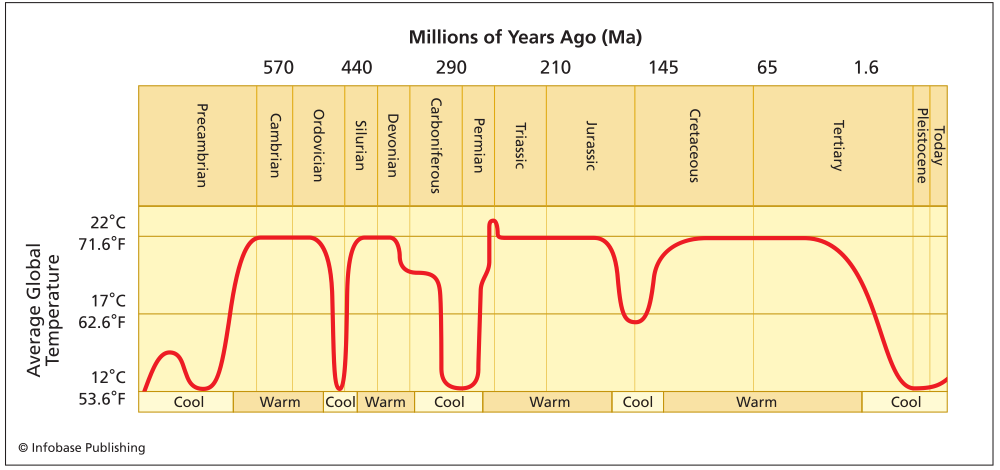
Plot showing how the average temperature on the surface of the Earth has changed with time over the past several hundreds of millions of years. These represent slow, long-term changes in global temperature.
Climate belts expand and contract in response to these changes. Warm periods see subtropical conditions extending to high latitudes, while cold periods witness polar climates advancing toward the equator. The current anthropogenic climate change, however, is distinguished by its unprecedented rate, driven by the release of sequestered carbon over mere centuries. This poses a unique challenge, as natural adaptation and migration mechanisms for ecosystems and human infrastructure may be unable to keep pace with the rapid shift in climatic baselines.
Date added: 2026-07-14; views: 111;