
Exploring Caves: Formation, Types, and Spectacular Speleothems
A cave is defined as a natural underground opening in rock large enough for human entry, though the term is sometimes extended to include rock shelters and overhanging cliffs. These subterranean voids range from small pockets to immense chambers, forming through various geological processes. The world's largest is Sarawak Chamber in Borneo, with a staggering volume of 65 million cubic feet. Other record-holding caverns include Majlis Al Jinn in Oman, the Belize Chamber, Salle de la Verna, and the Big Room in Carlsbad Caverns, each exceeding 3 million cubic feet. Some caves form extensive networks; Mammoth Cave in Kentucky boasts over 300 miles of mapped passages, often channeling active underground streams.
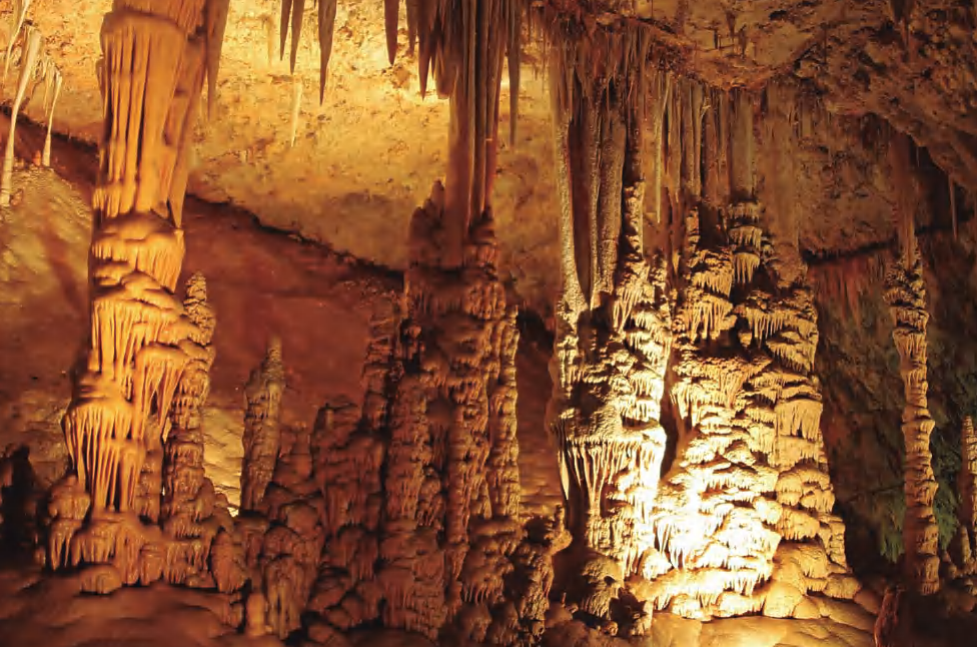
Limestone cave stalagmites and stalactites in Israel
Formation of Karst Caves and Sinkholes. Most large cave systems form in soluble karst landscapes, primarily in limestone, through a process of dissolution. Slightly acidic rainwater, enriched with carbonic acid (H₂CO₃) from atmospheric carbon dioxide, percolates through soil and into bedrock fractures. This weak acid reacts with the calcium carbonate in limestone, slowly dissolving the rock and transporting ions away in solution. Over millennia, this process, enhanced by acid rain, enlarges fractures into interconnected conduits and passages, creating underground stream networks and vast chambers. Typical dissolution rates are slow, averaging a few millimeters per thousand years.
Decoration: Speleothems and Cave Minerals. Caves are often adorned with speleothems, secondary mineral deposits formed from groundwater seepage. The most common speleothems are composed of carbonate minerals like calcite and aragonite. Dripstone forms where water enters through cracks; as droplets degas carbon dioxide, they deposit calcite rings, creating hanging stalactites (including delicate soda straws) and rising stalagmites on the floor below. Flowstone develops from water flowing as sheets over walls and floors, creating layered, terraced deposits. Colors in these formations—yellows, reds, browns—result from organic compounds or oxides leached from overlying soils.
Unusual and Varied Speleothem Forms. Beyond common types, caves host exotic speleothems. Helictites are erratic, curved formations that defy gravity, while anthodites are clusters of radiating aragonite crystals. Shields are plate-like structures protruding from walls, fed by water through a medial crack. Moonmilk is a soft, paste-like deposit of microcrystalline carbonate. In drier cave environments, evaporite minerals like gypsum can form delicate crystals. Travertine deposits accumulate in caves where waters are highly saturated with carbon dioxide. These varied formations are sensitive indicators of past climatic and hydrological conditions.
Scientific and Environmental Significance. Cave systems are critical for understanding groundwater resources, paleoclimate, and unique ecosystems. Speleothems act as natural archives; their layers contain isotopic records of past rainfall and temperature. Caves also host fragile subterranean ecosystems with specialized, often endemic, species adapted to perpetual darkness. As part of the karst hydrologic system, caves are vulnerable to pollution from surface activities, making their conservation essential. Their study, speleology, continues to reveal insights into geological processes, climate history, and biodiversity, underscoring the need to protect these remarkable underground landscapes.
Date added: 2026-07-14; views: 109;