
The Evolution and Impact of Icebreakers
Icebreakers are specialized vessels designed to navigate frozen lakes, rivers, or ocean surfaces and create navigable passages obstructed by ice. While such ships have been in use for hundreds of years, the development of true icebreakers emerged only in the nineteenth century. The recent buildup of icebreakers in the Arctic Ocean has raised concern among environmentalists.
Encountering ice obstructing navigable passages was an age-old problem, especially in geographical locations that experience temperatures below freezing. Northern European countries and the United States adapted ships by strengthening the hull to use such vessels to clear the ice, most notably from rivers. The introduction of steam and the race to the poles in the nineteenth century gave rise to true icebreakers, vessels not just converted to break the ice but constructed for this purpose. Icebreakers signaled a departure from seagoing ships by strengthening the hull, providing it with an ice-clearing shape, and— through the introduction of fossil fuels—a powerful engine capable of pushing through ice.
German and British engineers developed what later became known as the European design, which involved moving the ship’s bow above sea level and allowing the ship’s weight to crush the ice. This successful method, nevertheless, slowed the ship’s progress and was countered by a design developed in the United States of America. In the United States, the role of icebreakers was mainly limited to rivers and lakes where the ice sheets were not as thick, but a speedy clearing of passageways for commercial traffic was of the essence. Rather than the Europeans rising above the ice to crush it, American engineers introduced railroad ferries that steadily pushed through the ice by adding propellers to both the bow and the stern.
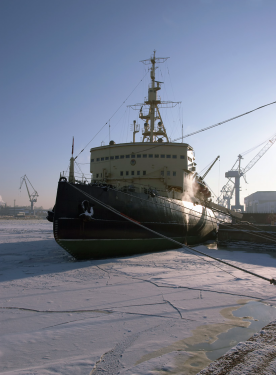
The Arctic ice breaker Krasin in port
While much improved upon, these two methods continued into the twentieth century. The American design became known as the continuous mode, which involved ships pushing through relatively thin ice sheets. The European design became the ramming mode, which involved the slower technique of riding above the ice and then crushing it through the ship’s weight. Such icebreakers would become active in the Arctic or Southern oceans where the ice was thick. The Soviet Union (USSR), with a large portion of this country’s coastline facing the Arctic Ocean, started investing in icebreakers that would play a vital role in ensuring that the Allies could supply the government during the Second World War.
When, at the end of this conflict, a cold war developed between the Soviet Union and the United States, the Arctic—the shortest route between the two countries— became contested. While the United States employed nuclear submarines to patrol the area under the ice, the USSR increasingly invested in nuclear-powered icebreakers. Nuclear reactors had the advantage of providing efficient power and made vessels independent from resupplying fuel. In the late 1950s, the United States reached the North Pole with a nuclear-powered submarine, while two decades later, an Arktika class nuclear icebreaker became the first surface ship to accomplish the same task. Ironically, the USSR collaborated with Finland, which serviced this niche market, to increase its fleet of icebreakers. With the collapse of the Soviet Union in the 1990s, many icebreakers took on a different role by ferrying high-paying international tourists to remote spots around the Arctic Ocean.
In the 2000s, the Arctic and its potential raw materials and faster navigation routes again attracted international interest. As melting ice caps made the region more accessible, the Russian Federation, successor to the USSR, replaced its aging icebreakers with modern nuclear-powered vessels. Other countries, especially China, by declaring itself a “near Arctic” power, dispatched icebreakers to this region of growing importance. Initially, such ships were meant to perform scientific research, but the Asian influence is now displaying an interest in this emerging maritime Silk Road. The increasing Sino-Russian presence in the region has US naval authorities and their Canadian allies wondering whether to invest in further icebreakers to narrow the gap in this strategic shipping technology.
Environmentalists have since 2020 raised concerns about the increasing use of icebreakers in the Arctic Ocean. They maintain that growing noise pollution hurts the local whale populations. Most importantly, some scholars argue that icebreakers actively contribute to the ice melts in the Arctic. Arctic ice sheets are crucial in the albedo effect— refracting sunlight into the atmosphere. Global climate change has dramatically reduced the icy surface of the Arctic. According to recent research, icebreakers play no small part in shrinking the ice around the North Pole by reducing ice sheets into crushed ice to allow navigable passages.
FURTHER READING: Cohn, Johanna. 2022. “Icebreakers in the Arctic: An Overlooked Environmental Concern.” Steady State Herald. https://steadystate.org/icebreakers-in-the-arctic-an-overlooked-environmental -concern/. Accessed October 6, 2023.
Matala, Saara. 2021. A History of Cold War Industrialization: Finnish Shipbuilding Between East And West. New York: Routledge.
Sakari, Aro and Saara Matala. 2021. “Of Titan, Winds and Power: Transnational Development of the Ice Breaker, 1890-1954.” International Journal of Maritime History 33 (4): 722-47.
Date added: 2026-02-14; views: 347;